


For decades, sunflower has been one of South Africa’s most resilient crops. Its ability to produce under drier conditions has made it a valuable option in many grain-producing areas. However, while sunflower is known for its drought tolerance, rising temperatures may pose a new challenge. As heatwaves become more frequent and intense, extreme heat could have a greater impact on yield and oil production than previously recognised.
As climate change increases the frequency and intensity of heat waves, understanding how sunflower responds to extreme temperatures is becoming more and more important. Research has recently been conducted using data from the national sunflower cultivar trials done by the Agricultural Research Council (ARC). This has revealed that heat stress may significantly reduce both yield and oil production, something that will have an impact on producers, processors, and consumers alike.
What the research examined
The study used 5 960 observations from the ARC’s national sunflower cultivar trials. The trials were conducted at 49 locations, planted from 2008 to 2024.
Researchers combined information on sunflower cultivars and yields, including the weather data for each respective location and season. This allowed them to examine the influence of temperature on sunflower performance under different production conditions.
Results indicated that sunflower yield remained relatively stable despite considerable year-to-year variation. Higher productivity was recorded during the 2009 season and from the 2016 season to the 2019 season. Lower yields were recorded during challen-
ging seasons experienced during 2008 and 2015. Throughout the 2020 to 2024 seasons, yields appeared remarkably stable, averaging around 2,20 t/ha.
Oil content also fluctuated across years, which highlighted the importance of weather conditions, cultivar performance, and management practices. These findings confirmed that, while sunflower remains a resilient crop, environmental conditions strongly influence both productivity and oil content.
Higher oil content was recorded during the 2009 to 2011 and 2016 to 2023 seasons. A lower oil content was observed during the 2015 season, and during the 2024 season it was particularly low.
These differences confirm that sunflower performance in terms of yield not only depends on temperature, but also on seasonal conditions, cultivar choice, soil, management practices, and the production environment.
When does heat become a problem for sunflower production?
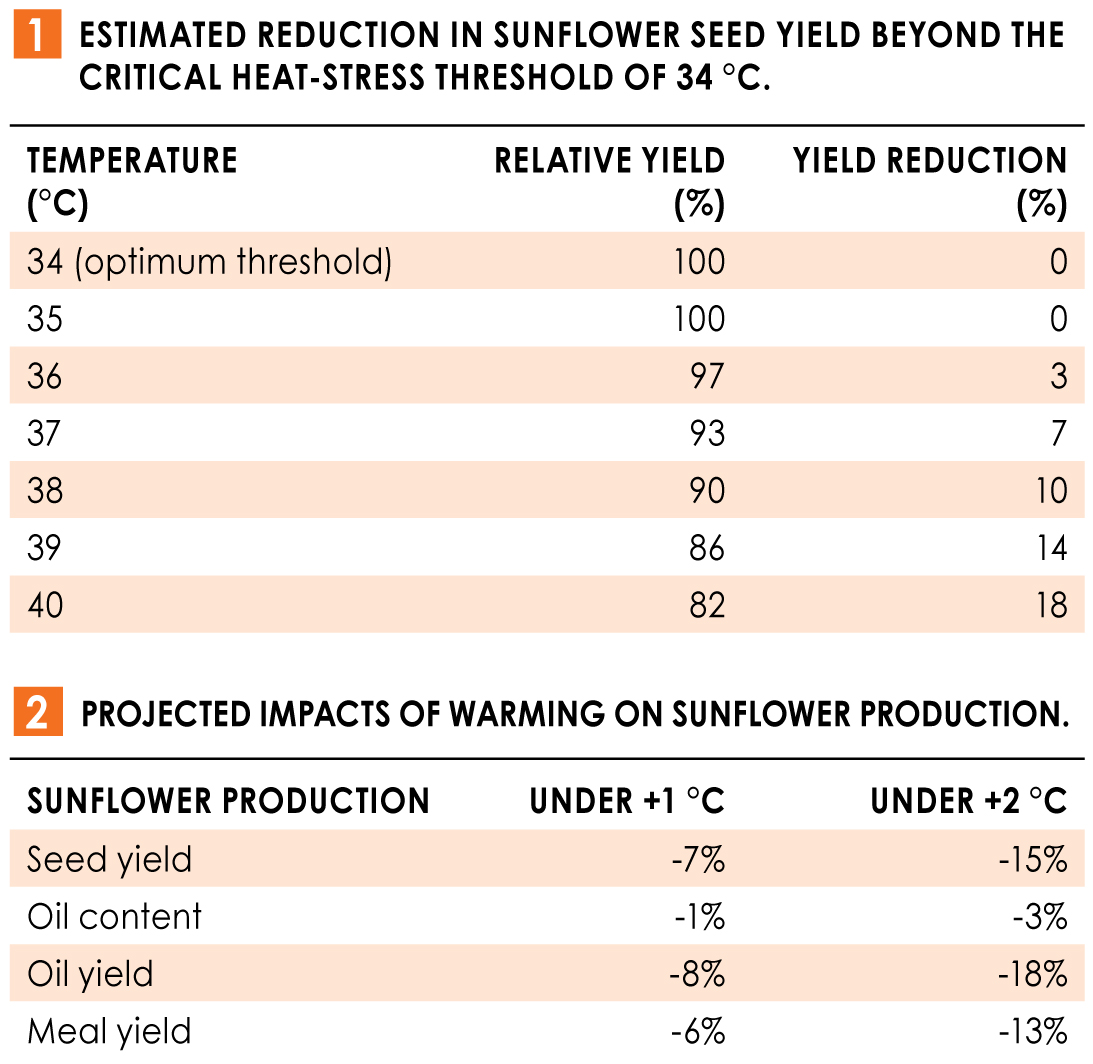
Yield remained relatively stable across a wide temperature range but declined sharply once temperatures exceeded 34 °C. During this study, most temperature recordings fell between 15 °C and 25 °C, with few observations above 34 °C. Therefore, yield estimates at temperatures of 34 °C and above are not fully researched. Regardless, the recorded results should serve as a clear warning: repeated exposure to extreme heat can significantly reduce sunflower productivity.
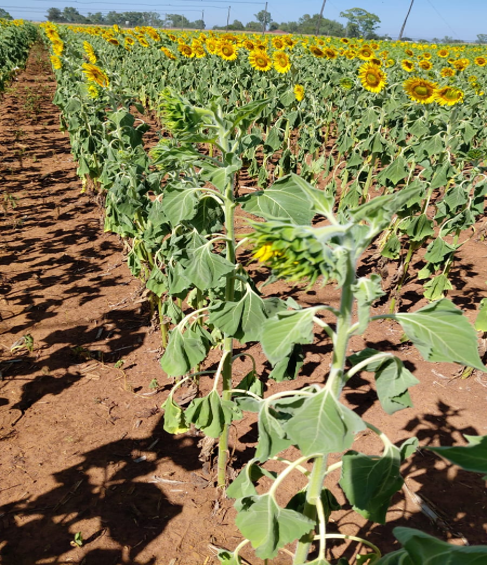
High temperatures can affect several stages of sunflower development. Heat may interfere with flowering, reduce pollen viability, limit seed formation, and shorten the period during which the plant fills its seeds. When hot conditions occur alongside water shortages, the damage may become even more severe. A single degree above 34 °C has little effect on yield, but prolonged exposure to temperatures above 36 °C can substan-
tially reduce productivity (Table 1). At 40 °C, sunflower yields may be nearly one-fifth lower than under optimal growing conditions. For each additional day above this threshold, yield declined by approximately 3,3%. This finding is particularly important, as climate projections indicate that extremely hot days are expected to become more frequent in many sunflower-growing regions.
What implications does a warmer future have for sunflower producers?
Researchers simulated warming scenarios of +1 °C and +2 °C and found that even modest increases in temperature could significantly affect both yield and product quality in sunflower production. At a +1 °C increase, sunflower seed yield, oil content, oil yield, and meal yield could decrease by 7%, 1%, 8%, and 6%, respectively. At a 2 °C increase scenario, seed yield, oil content, oil yield and meal yield could decrease by 15%, 3%, 18% and 13%, respectively (Table 2).
These projections translate directly into lower productivity and reduced profitability. Although oil content appears relatively resilient, lower seed yield leads to less oil and meal production per hectare. The negative consequences of the lower seed yield will not only affect producer income but also the processing sector that relies on edible sunflower oil and livestock feed.
 Can changes in planting dates counter the effect of warming?
One of the suggestions to mitigate the effect of warming on sunflower production was to adjust planting dates. To determine whether changes in planting dates can counter the warming effect, researchers evaluated scenarios where planting dates were shifted earlier or later in the season under +2 °C temperatures. This part of the study yielded unexpected results.
Earlier planting dates increased the production risk. When the planting date was moved to 14 days earlier than the recommended planting date, the average yield reduction was around 17%. Seven days earlier still resulted in losses of approximately 16%. In contrast, by delaying the planting date better outcomes were achieved. A seven-day delay reduced average losses to about 14%, while a 14-day delay reduced losses to approximately 12 to 13%. Additionally, delayed planting delivered more consistent performance across different production environments, which indicated that a later planting date may help crops avoid the most damaging heat during sensitive growth stages.
Adaptation will be essential
Although climate change will present a challenge to sunflower producers, this study highlights opportunities for adaptation, which will reduce heat-related losses significantly. The development and adoption of heat-tolerant cultivars, coupled with optimised planting dates, will play an important role in reducing future losses. Continued cultivar testing across environments will remain critical as production conditions evolve.
For South African sunflower producers, drought may no longer be the only climate risk demanding attention. As temperatures continue to rise, heat stress is emerging as a major factor shaping the future profitability and sustainability of sunflower production.
 Summary
Sunflower production in South Africa is highly vulnerable to extreme heat. Temperatures above 34 °C significantly reduce yield, oil content, and downstream oil production. Under a +2 °C warming scenario, sunflower yield is projected to decline by 15%, while oil yield could decrease by almost 18%. The encouraging news is that producers can adapt success-
fully. Optimising planting dates and adopting heat-tolerant cultivars could play a crucial role in protecting future productivity, profitability, and food security.
Sunflower has long been valued for its ability to withstand dry conditions. However, rising temperatures resulting from climate change may become an increasingly important factor that limits sunflower production. Heat stress, particularly tempera-
tures above 34 °C, leads to a significant reduction in yield and oil production. As climate change intensifies and temperatures rise, adaptation by sunflower producers will become essential. Developing heat-tolerant cultivars, improving crop management, and optimising planting dates will help ensure that sunflower remains a profitable and reliable crop for South African producers in the decades ahead.