

Westhuizen,
regional manager: AgTech@NWK Drone Services
Agricultural drones have developed from a relatively new technology into an increasingly important precision-application tool. Selecting the correct platform, however, involves much more than comparing tank capacities. This article examines the practical differences between the DJI Agras T55, T70P, and T100, with specific reference to a typical application rate of 30 litres/ha, field productivity, seasonal capacity, mapping, operator requirements, and scheduled maintenance.
Selecting the right drone
The first question when considering an agricultural drone should not necessarily be which model is the largest, but rather how much work needs to be completed within the available spraying window.
Several factors should form part of the decision:
- Total application hectares per season
- Normal application volume in litres per hectare
- The size and shape of the fields to be treated
- The number of applications required during the season
- The length of the available spraying windows
- Water and chemical handling logistics
- Battery and charging capacity
- Transport and field logistics
- Availability of suitably qualified operators
- Regulatory requirements applicable to the intended operation
- Availability of servicing, spare parts, and technical support
The concept of application hectares is particularly useful. A farming operation with 1 000 ha that treats the same land four times during a season does not only have 1 000 ha of drone work. It represents 4 000 application hectares.
This total workload provides a better indication of the required drone capacity than the physical size of the farm alone.
T55, T70P, and T100: the technical differences
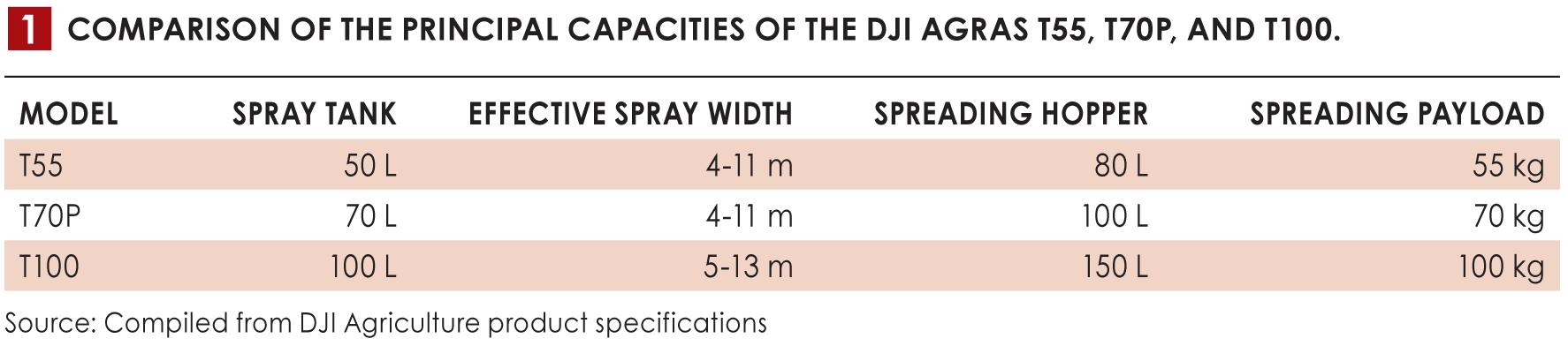
The DJI Agras T55 is equipped with a 50-litre spray tank and has an effective spray width of approximately 4 to 11 m. The standard dual-sprinkler system can deliver up to 40 litres/min, while an optional four-sprinkler configuration increases the maximum flow rate. For spreading applications, the T55 has an 80-litre hopper with an operating payload of 55 kg.
Spray capacity is increased to 70 litres with the T70P, while retaining an effective spray width of approximately 4 to 11 m. Its spreading system has a 100-litre hopper with an operating payload of up to 70 kg. The T100 is the largest of the three platforms. Its 100-litre spray tank is combined with an effective spray width of approximately 5 to 13 m. Its spreading system provides a 150-litre hopper and an operating payload of up to 100 kg.
As shown in Table 1, the primary practical difference is not simply that a larger drone may operate at a higher capacity. At higher application volumes, the amount of liquid that can be carried during each flight becomes increasingly important.
The effect of spraying at 30 litres/ha
An application rate of approximately 30 litres/ha is commonly used by producers in the areas serviced by AgTech@NWK. It therefore provides a useful practical basis for comparing the three platforms.
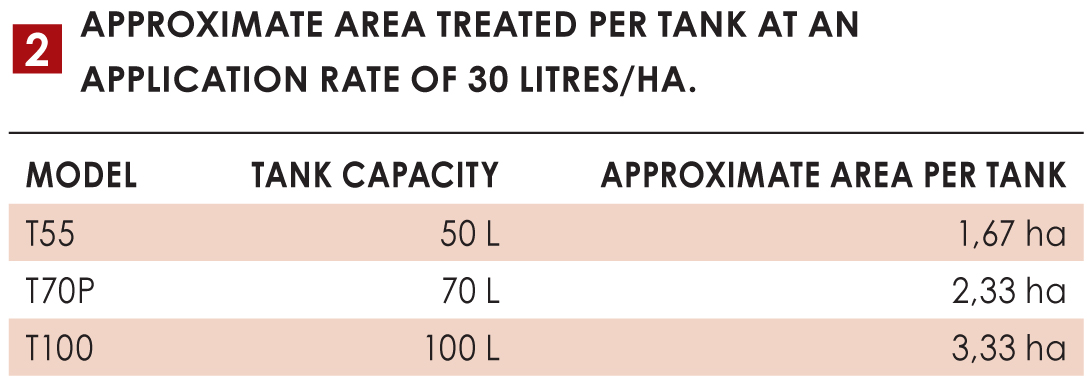
Dividing each drone’s tank volume by 30 litres/ha provides the approximate area that can be treated with one full tank. The effect becomes more evident on a 100-ha field. Treating 100 ha at 30 litres/ha requires 3 000 litres of spray mixture.
This equates to approximately:
- 60 tank loads with the T55;
- 43 tank loads with the T70P; and
- 30 tank loads with the T100.
The T100 therefore requires approximately half the number of tank loads required by the T55 to apply the same volume over the same area.
Tank size consequently affects more than the amount of liquid carried. Every refill involves a return to the service point, landing, refilling, and redeployment. Reducing the number of these cycles can make a meaningful difference during a long spraying day.
How many hectares can be sprayed per hour?
A distinction should be made between theoretical field capacity and practical system capacity.
Theoretical field capacity can be estimated using working speed and effective spray width: Field capacity (ha/hour) = speed (km/hour) × effective spray width (m) ÷ 10.
For example, a drone operating at 12 m/second, equivalent to 43,2 km/hour, with an effective spray width of 7 m, has a theoretical field capacity of: 43,2 × 7 ÷ 10 = 30,2 ha/hour.
At an application volume of 30 litres/ha, this would require approximately 15,1 litres/minute of spray mixture while the aircraft is actively spraying.
This calculation demonstrates that pump capacity alone is not necessarily the factor limiting output. Practical productivity is affected by the complete operational cycle. A drone cannot spray continuously for an entire hour. It needs to return for refilling, while batteries also need to be exchanged and managed.
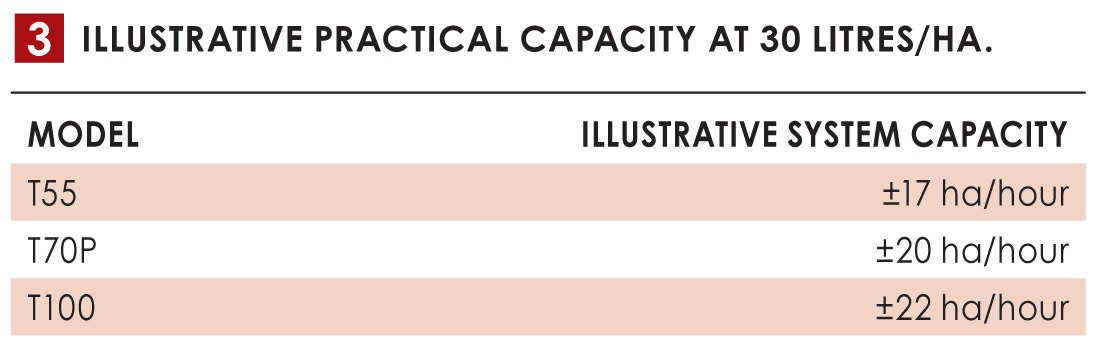
As an illustrative planning scenario, if productive airborne spraying takes place at approximately 30 ha/hour and each landing, refill, and redeployment cycle takes approximately 2,5 minutes, overall system productivity could be in the region ofregion of 17 ha/hour for the T55, 20 ha/hour for the T70P, and 22 ha/hour for the T100. Table 3 illustrates how the larger tank can improve productivity by reducing the proportion of the working hour spent refilling.
Actual results will vary according to field shape, wind, obstacles, travel distance to the refill point, turning time, operator technique, battery management, and ground-crew efficiency. Hectares per hour should therefore never be considered independently of the application volume and operating conditions.
Seasonal capacity
Seasonal capacity is equally dependent on available working hours. Consider an operation with 40 suitable spraying days and six productive spraying hours per day. This provides approximately 240 productive hours per season. Table 4 shows the illustrative seasonal capacities applying the hourly capacities shown in Table 3.
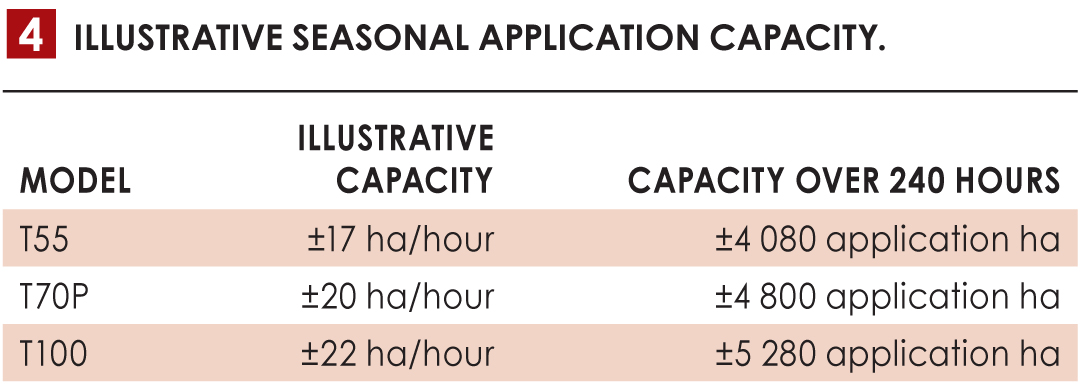
These values are not guaranteed seasonal outputs. Large, uninterrupted fields and an efficient ground-support team may increase productivity, while poor weather, smaller fields, and short spraying windows may reduce it. The important purchasing consideration is therefore how many application hectares must be completed during the critical spraying period.
Can field maps be saved?
Modern Agras operations are not dependent on repeatedly creating the same field boundary. Field boundaries and operational information can be saved digitally and reused. Once a field has been mapped and stored, it can be selected again for a later application. Relevant mission parameters such as application rate, flight height, and working speed can then be adjusted for the new task.
This is particularly valuable on farms where the same fields receive several applications during a season. Over time, stored field information effectively creates a digital database of fields and previous operations, reducing repeated setup work and improving consistency.
How many drones can one operator control?
Technical capability and regulatory approval should not be confused. For normal commercial operational planning in South Africa, one active drone per remote pilot is the appropriate conservative planning basis unless a specific multi-aircraft operation is authorised under the operator’s approved UASOC and associated operational specifications.
Commercial UAS operations must comply with the applicable South African civil aviation requirements. Where agricultural remedies are applied by air, further requirements relating to aerial application and pest control operator registration also apply.
Capacity planning should therefore not assume that one operator will automatically be permitted to control two or three spraying drones simultaneously.
Scheduled maintenance
Agricultural drones work in a demanding environment characterised by chemicals, fertiliser, dust, heat, vibration, and frequent take-off and landing cycles. Preventative maintenance is therefore a critical part of keeping the aircraft productive.
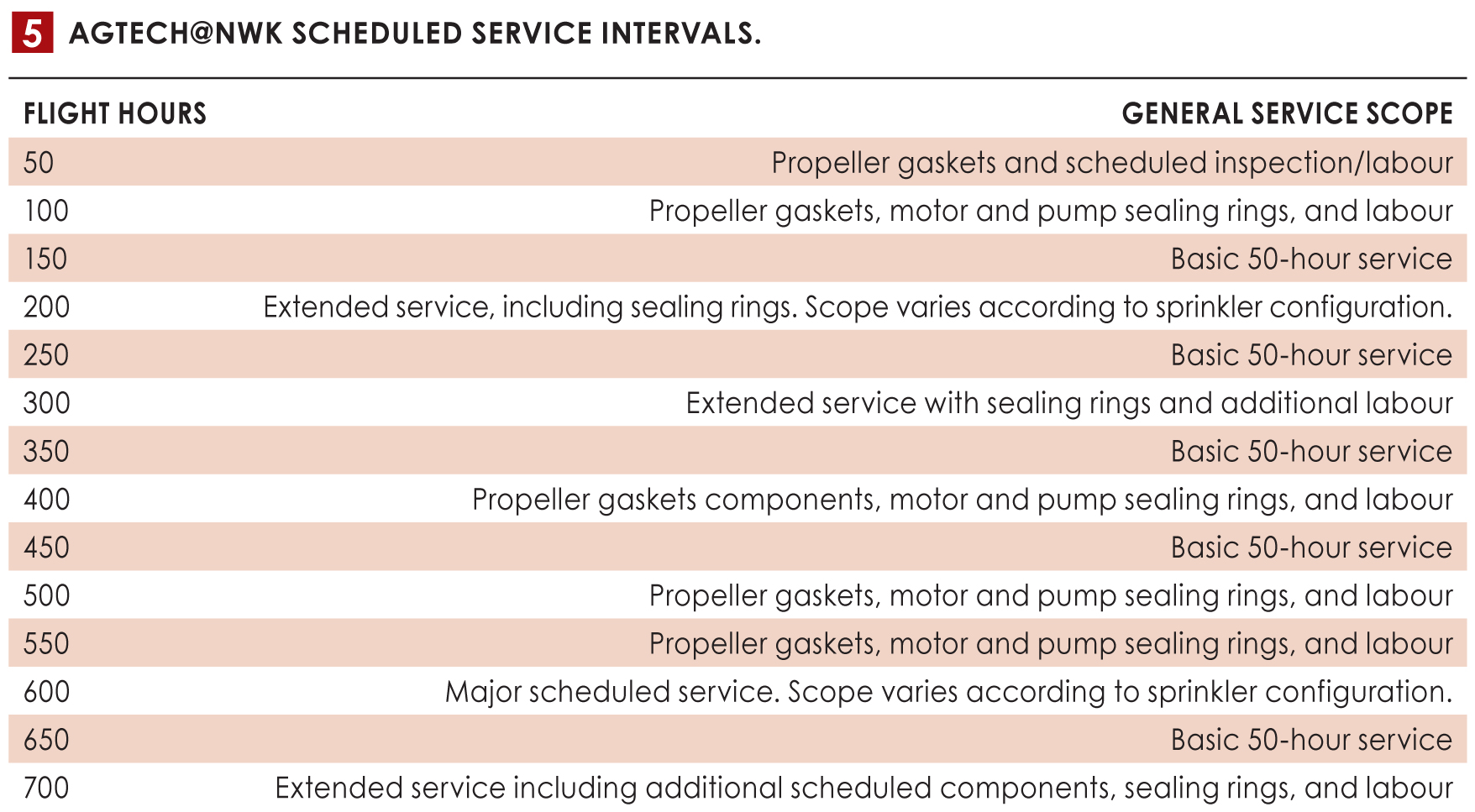
AgTech@NWK applies the same scheduled service intervals, in accordance with DJI’s specifications, for the T55, T70P, and T100. Scheduled maintenance starts at 50 flight hours and continues in 50-hour intervals.
The objective of scheduled maintenance is not merely to repair components after failure. Preventative servicing assists in identifying wear before it results in costly downtime during a critical spraying window.
Routine inspections remain equally important. Propellers, arms, sprinklers, pumps, pipes, electrical connections, and fasteners should be inspected regularly, while the spray system should be cleaned appropriately after use.
Ground logistics determine productivity
Drone capacity cannot be considered independently of the ground-support system. At 30 litres/ha, a drone operation completing 20 ha/hour consumes approximately: 20 ha × 30 litres/ha = 600 litres/hour.
Over six productive hours, 3 600 litres of spray mixture must therefore be prepared and supplied. The water source, chemical-mixing process, charging system, and ground crew must all be capable of keeping pace with the aircraft.
A productive agricultural drone operation consequently consists of: drone + batteries + charging system + power source + water + mixing system + transport + remote pilot + ground support.
A highly capable aircraft combined with inadequate refill or charging infrastructure may spend an unnecessary amount of time on the ground.
Matching the model to the workload
The T55 provides a practical solution where mobility, small to medium-sized fields, and a more compact logistics system are priorities. At 30 litres/ha, its smaller tank results in more frequent refill cycles.
Useful middle ground is offered by the T70P. Its 70-litre capacity reduces refill frequency while retaining a balance between capacity and operational flexibility.
The T100 becomes increasingly relevant where large continuous fields, high seasonal application hectares, short spraying windows, or contracting operations are involved. Its 100-litre tank reduces the number of refill cycles and can therefore improve overall system productivity where the surrounding logistics can support it.
Conclusion
Selecting an agricultural drone requires more than comparing tank sizes or maximum specifications. The correct platform is the one capable of completing the required application hectares, at the required application volume, within the available spraying window.
At a typical application rate of 30 litres/ha, the difference between the T55 (50 litres), T70P (70 litres), and T100 (100 litres) becomes particularly evident in refill frequency and overall operational efficiency. Seasonal workload, field characteristics, water and battery logistics, operator requirements, servicing, and technical support should therefore all form part of the purchasing decision.
Evaluating the drone as one component of a complete application system provides a more realistic basis for selecting the platform that best matches the requirements of a farming operation.
For more information on the models or for assistance in selecting the right drone solution according to your needs, contact AgTech@NWK at 018 633 1143 or agtech@nwk.co.za.
Please click on the link for a list of references used in this article.