


Lemuel Blignaut, Department of Mathe-matical Sciences, Stellenbosch University

Dr Andries le Roux, SU-BFAP Precision Agriculture Chair, Stellenbosch University

Prof Pieter Swanepoel, Department of Agronomy, Stellenbosch University

Marion Delport, man-ager: Data Science and Systems Integration, BFAP; research fellow: Agricultural Economics, Stellenbosch University

Dr Pietro Landi, Depart-ment of Mathematical Sciences, Stellenbosch University, National Insti-tute for Theoretical and Computational Sciences
Scenario planning is a way of preparing for more than one possible outcome, rather than relying on a single expectation of how the season will unfold. When reading up on plans and the importance of making and having some form of plan, a distinct trend emerges.
Firstly, it is important to have a well-thought-through and detailed plan. Secondly, it is exceedingly rare for events to unfold according to that plan. So then, what is the value of a plan in the first place? If a route and destination have been clearly defined, targeted corrections can be made to the course when it inevitably starts to shift. This is much easier than trying to adjust when the destination is only a vague idea. In the agricultural context the weather is an excellent example, as rapid intra-seasonal weather changes tend to quickly throw a spanner into the works.
With the expected increase in both the frequency and severity of extreme climate events, the accurate incorporation of weather information into crop estimates is becoming a necessity. It emphasises the need for forecasting systems capable of dynamically integrating climate, remote sensing, soil, and management information to improve forecasting accuracy under variable production conditions.
Forecasting accuracy is not only a production-related tool but also an increasingly important economic and strategic requirement within the agricultural sector. Improved forecasting systems may contribute toward reduced uncertainty and lower price volatility within markets, while also supporting improved national food security, market stability, and enabling efficient planning when it comes to storage, processing, and imports or exports.
Using data and machine learning to improve crop forecasts
Existing crop estimation approaches, whilst valuable and highly accurate, are often limited in their ability to dynamically incorporate rapid intra-seasonal climatic changes and complex interactions between weather conditions, crop development, soil properties, and management practices.
At the same time, the increasing availability of high-resolution environmental data, earth observation technologies, and advanced analytical methods creates new opportunities to support and strengthen national crop estimation systems. In this context there is growing scope to integrate diverse data streams and modelling approaches into a more holistic framework that strengthens the evidence base for field-level crop monitoring and decision making.
This is where machine-learning models come into their own. Machine-learning approaches can improve forecasting performance due to their ability to identify complex, non-linear relationships within high-dimensional datasets, and are able to update frequently as new information becomes available. Interpreting precision agricultural data with machine learning unlocks two key management tools: field-level yield forecasting and dynamic scenario planning. Importantly, much of the data that will be needed are already being recorded on many farms that have implemented precision agriculture across South Africa or are freely available from other sources.
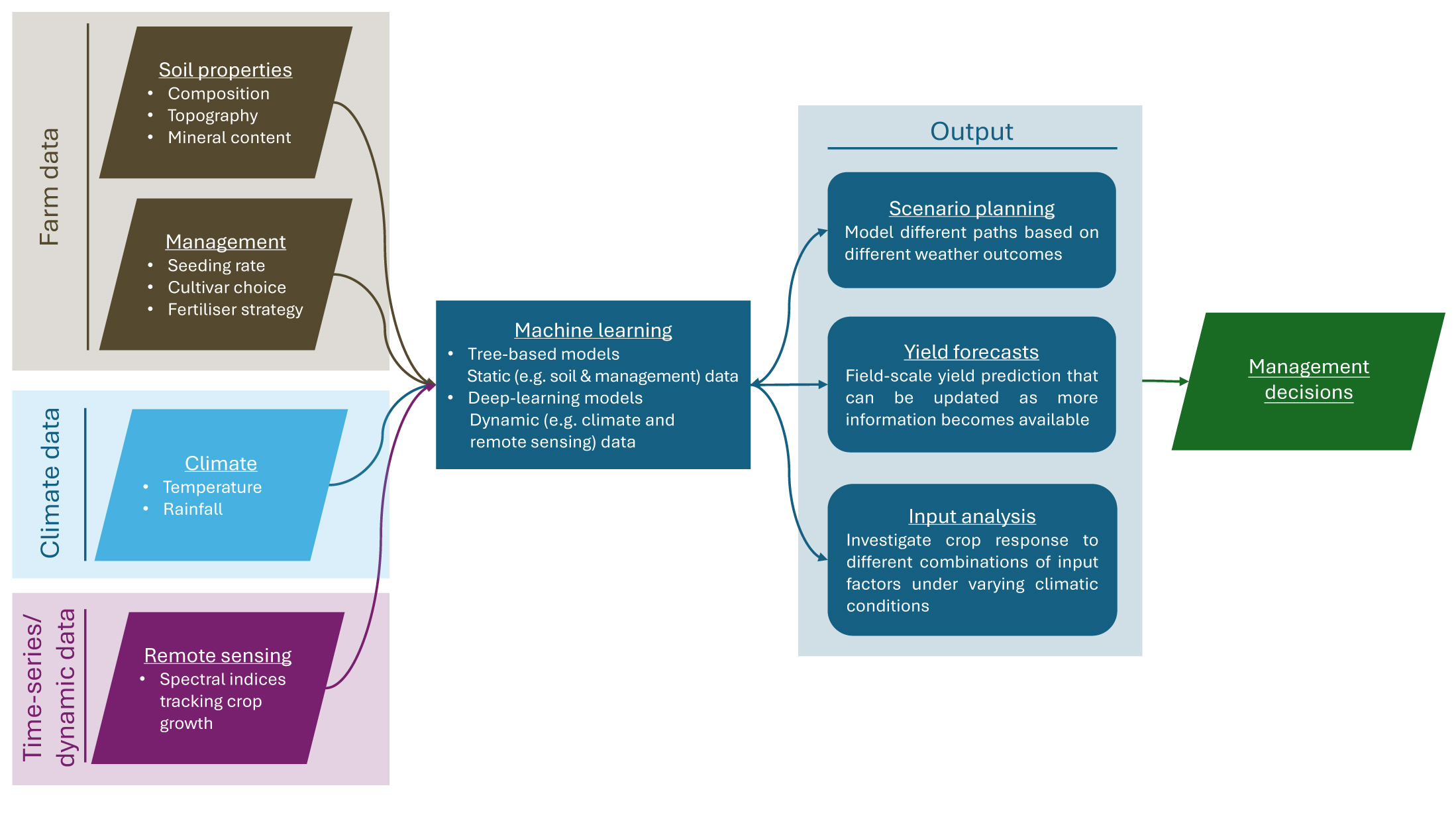
To build these predictive models and run accurate farm-scale simulations, the system integrates multiple layers of data. Higher data density generally improves the reliability of the output. This includes farm- and field-level management information such as planting date, seeding rate, cultivar choice, fertiliser strategy, and irrigation scheduling (where relevant), with remote sensing data from satellite-derived spectral indices that monitor crop health and development. The daily average, minimum, and maximum temperatures are layered with both the intensity and distribution of rainfall events, and a unified dataset built from the data.
This is not an exhaustive list, and value can be added from other sources as well. However, it is also important to note that all data streams are not always required to generate a reliable estimate.
From prediction to better on-farm decisions
When working with extensive datasets where remote sensing data are combined with comprehensive environmental data, machine-learning models demonstrate high accuracy for field crop yield prediction and remain relatively high even when working with less comprehensive datasets (Hara et al., 2021; Lu et al., 2024). The reliability of these predictions will depend on the quality, quantity, and relevance of the data used, as well as how well the model has been trained to simulate local production conditions. Apart from yield forecasting, machine-learning models can also be used as a diagnostic tool to identify key yield drivers both in a positive and negative sense. Understanding why a crop reacts the way it does in specific zones of a field could allow producers to adapt their management accordingly, thereby maximising yield potential.
There are a wide variety of models available. Each model is suited to different tasks or types of data. As an example, tree-based models perform well when considering static data such as soil analyses, field topography, seeding rates, and fertiliser rates. Meanwhile, deep-learning models are particularly suited to time-series data such as the local climate over a certain period.
Models can also be trained to recognise long-term climatic trends and will thus interpret the season in question’s climate data in the right context, for example the heat and dry spells that can be expected during an El Niño phase. This allows producers to model multiple future paths based on different weather distributions for the remainder of the season, and the corresponding final yield and net margin shifts. For example, if late-season rainfall drops 20% below average and yield potential is likely to be lower, the producer could reconsider costly late fertiliser applications if the crop is unlikely to use them efficiently.
Similarly, if heat stress is expected during grain filling, the forecast could help with adjusting yield expectations, marketing decisions, storage planning, or other risk-management decisions. Armed with a realistic range of outcomes rather than a single estimate, producers can make objective, risk-adjusted decisions. Figure 1 outlines the flow of data into a model that returns a result that can be used to inform management decisions.
The above serves to illustrate that the value of precision agriculture extends far beyond ‘just’ the physical efficiency of a variable-rate planter, a smarter spray boom, or the ability to reduce overall inputs and target specific areas to maximise yield. There is great value in the data that are being recorded every time the machine is operational, and the resulting dataset that is built up over time. This data should not be viewed as a record only, but as a deposit of highly valuable information which should be extracted, processed, and used to support better decision making. Only then will the benefits in terms of scenario planning by modelling yield response to a variety of factors and dynamic forecasting become available.
The SU-BFAP Chair in Precision Agriculture will participate in and collaborate on research aimed at developing these types of data-driven tools for South African grain production systems. More specifically, the chair will help to test, validate, and translate tools related to crop yield prediction, dynamic scenario planning, and the practical use of precision agriculture data as they move from development towards practical application, with the aim of supporting more informed on-farm decision making by South African producers.
The fact that events rarely transpire according to plan does not mean that all the tools and information available should not be used to make the best plan possible – rather the opposite.
References
- Hara, P, Piekutowska, M & Niedbała, G. 2021. Selection of Independent Variables for Crop Yield Prediction Using Artificial Neural Network Models with Remote Sensing Data. Land, 10(6). https://doi.org/10.3390/land10060609
- Lu, J, Li, J, Fu, H, Tang, X, Liu, Z, Chen, H, Sun, Y & Ning, X. Deep Learning for Multi-Source Data-Driven Crop Yield Prediction in Northeast China. Agriculture, 14(6). https://doi.org/10.3390/agriculture14060794