


ARC-Small Grain
Given the adaptive ability and high damage potential of aphids, it is necessary to monitor aphid populations in wheat production areas and screen them for shifts in sensitivity against commonly used active ingredients. Grain aphid surveys were conducted in all the wheat production areas of South Africa during the 2025 production season, and aphid clone populations were established in the glasshouse from field-collected samples.
The field-collected populations were screened against commonly used active ingredients: dimethoate, acetamiprid, imidacloprid, thiamethoxam, and flupyradifurone. An IRAC-approved leaf dip method was used to determine shifts in susceptibility of the aphid populations against these active ingredients.
To determine a shift in susceptibility, the LD50 of each population screened against an active ingredient was measured against the recommended dose of the active ingredient and a susceptibility factor (SF) was determined. An SF of above 1 indicates a loss of susceptibility of the screened aphid population to the particular active ingredient.
Russian wheat aphid (RWA)
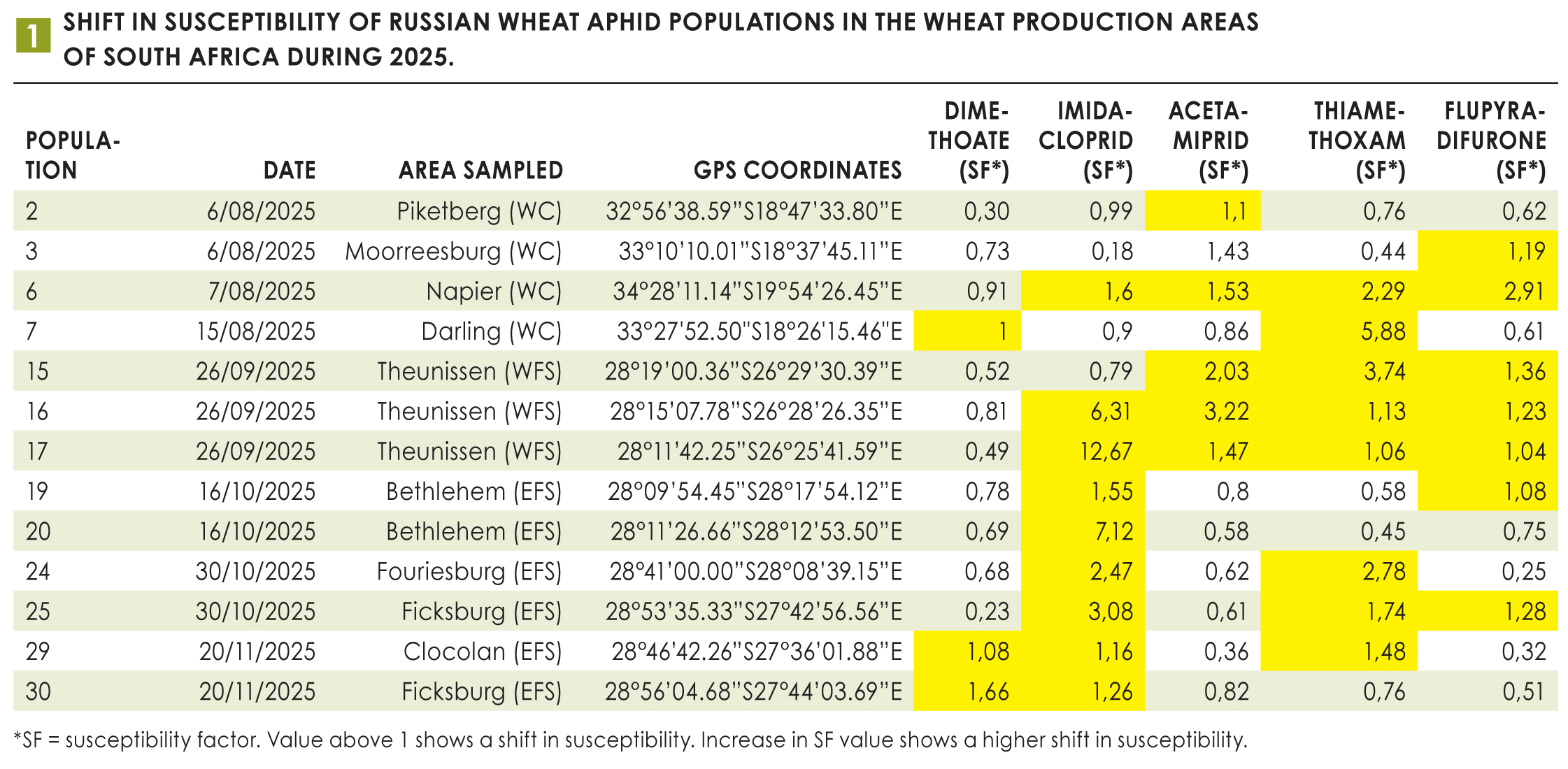
RWA populations showed SF values of higher than 1 against dimethoate in the dryland wheat production regions of the Western Cape (WC) and Eastern Free State (EFS) and SF values of higher than 1 against imidacloprid, acetamiprid, thiamethoxam, and flupy-
radifurone in the WC and EFS dryland wheat production regions as well as the irrigation wheat production regions in the Western Free State (WFS) (Table 1). This means that the LD50 was higher than the recommended dose for these populations, and there was therefore a shift in susceptibility in them.
Rose grain aphid
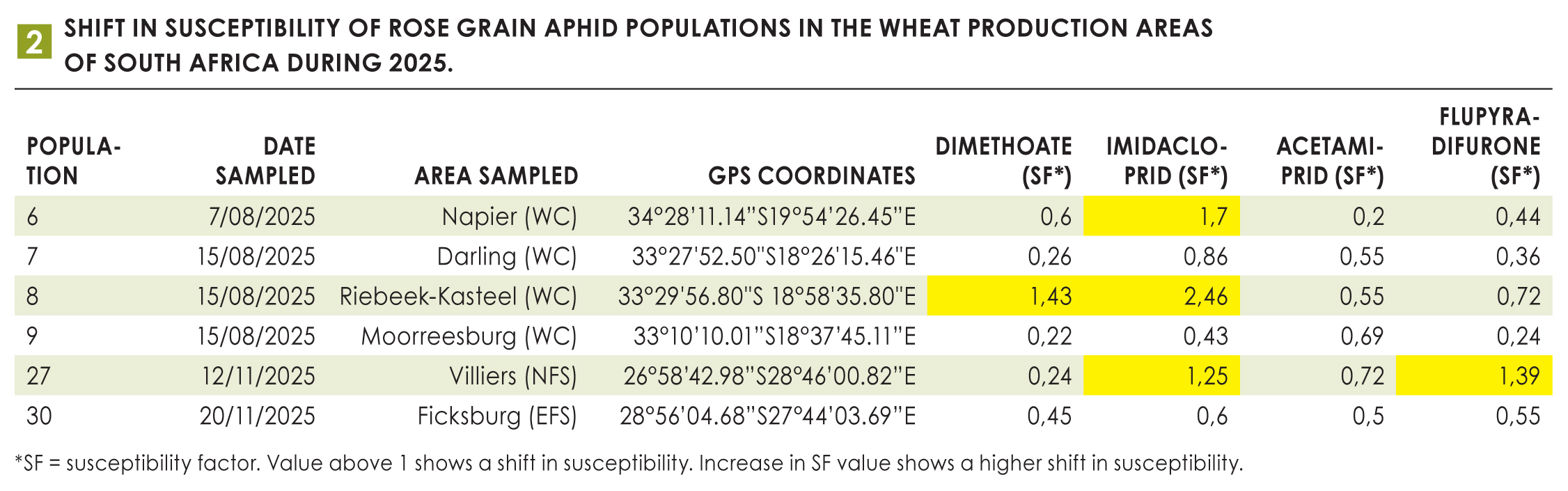
The SF was above 1 for a rose grain aphid population screened against dimethoate in the WC dryland wheat production region, and SF values of higher than 1 were deter-
mined for rose grain aphid populations screened against imidacloprid in the WC dry-
land wheat production region, as well as the irrigation wheat production region of the Northern Free State (NFS) (Table 2). The SF was above 1 for a rose grain aphid popu-
lation screened against flupyradifurone in the NFS irrigation wheat production region. The SF was below 1 for all rose grain aphid populations screened against acetamiprid, indicating that there were no shifts in susceptibility against acetamiprid in all the populations screened.
Oat aphid
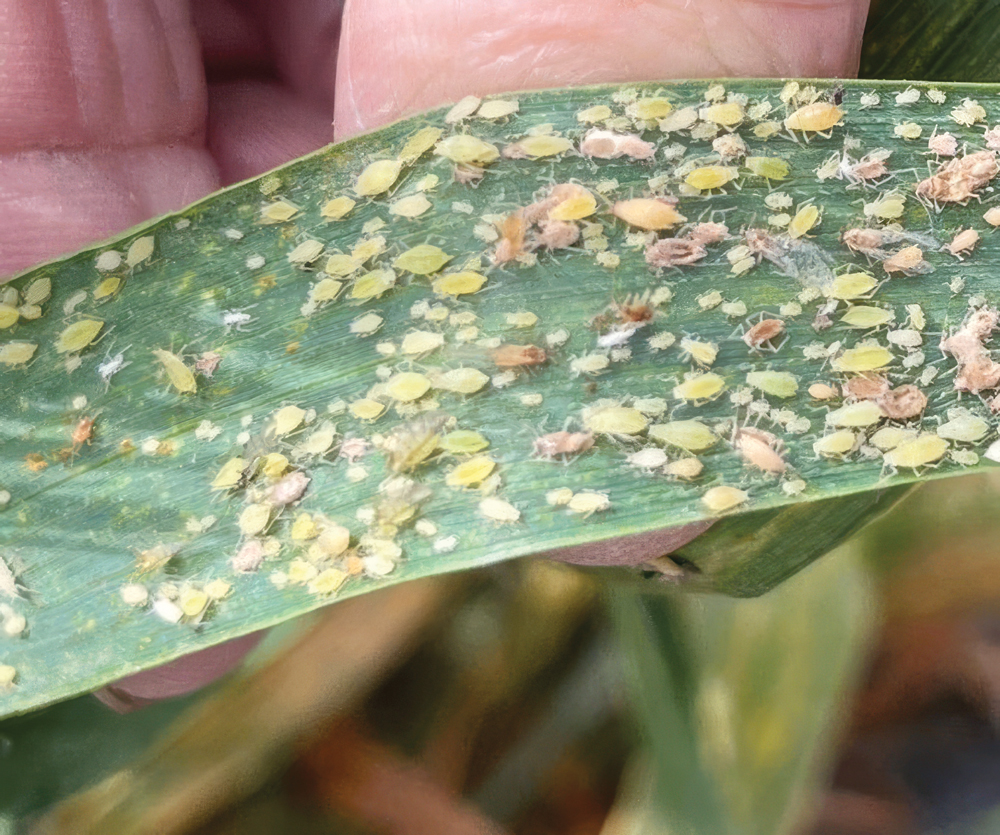
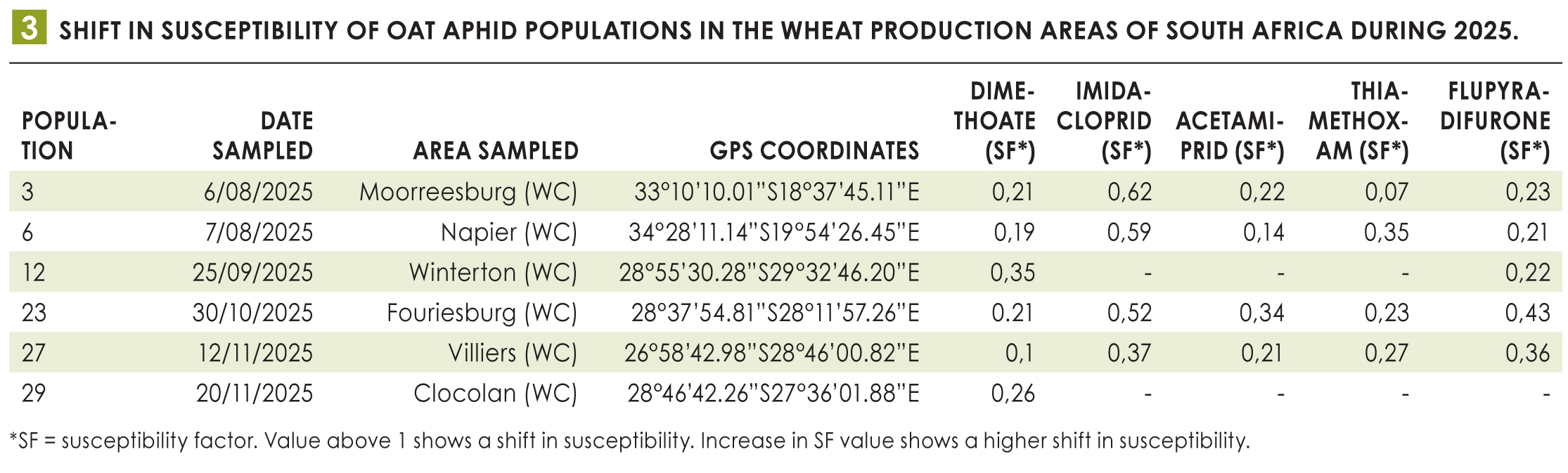
The SF was below 1 for all the oat aphid populations screened against dimethoate, imidacloprid, acetamiprid, thiamethoxam, and flupyradifurone in all the wheat produc-
tion regions surveyed (Table 3). This indicates that there were no shifts in susceptibility in oat aphid populations screened to the active ingredients.
Conclusion
Results from grain aphid surveys and insecticide resistance screening showed that there is a widespread loss of susceptibility against commonly used active ingredients in RWA and rose grain aphid populations in the wheat production regions of South Africa, while oat aphid populations in these areas are still susceptible to all active ingredients screened. This means that the insecticides with these active ingredients will not be effective in keeping the RWA and rose grain aphid populations below the damaging threshold.
 Because of the adaptability of aphids, the populations change continuously in response to management practices and changes in the environment. It is therefore crucial to continue with surveys, collection of samples, and screening for susceptibility shifts to monitor and adapt management practices to continuous changes in aphid populations. This information will enable producers to plan a target-specific management programme. To prevent insecticide resistance from developing in these populations, chemical control should be rotated with alternative management practices in an integrated pest management (IPM) programme.