


Agriculture has always evolved alongside technology. From the introduction of mechanised tractors to satellite-guided precision farming, every major technological advancement has helped producers produce more while making better use of increasingly limited resources. Today, another technology is rapidly finding its place in the agricultural toolbox: the spray drone.
Over the past few years, spray drones have moved beyond being viewed as experimental technology. They are now being used commercially across many farming regions in South Africa, particularly where difficult terrain, wet field conditions, or time-sensitive crop protection create challenges for conventional spraying equipment. As producers continue to seek greater efficiency and precision, spray drones are proving to be a valuable addition to modern farming operations.
Unlike traditional spraying equipment, a spray drone is not designed to replace existing machinery. Instead, it provides producers with another application option when conventional equipment cannot perform the task effectively or when greater precision is required. Every farming enterprise is different, and successful crop protection depends on selecting the most appropriate tool for the specific crop, field conditions, and application requirements.
South African agriculture presents a unique set of challenges. Wheat and canola producers in the Western Cape often contend with waterlogged fields during the winter production season, making it difficult for tractors to enter fields without causing soil compaction or crop damage. Vineyards and orchards frequently include steep slopes and uneven terrain where manoeuvring conventional equipment can be difficult. In these situations, spray drones offer an alternative method of applying crop protection products quickly while avoiding unnecessary damage to crops and soil.
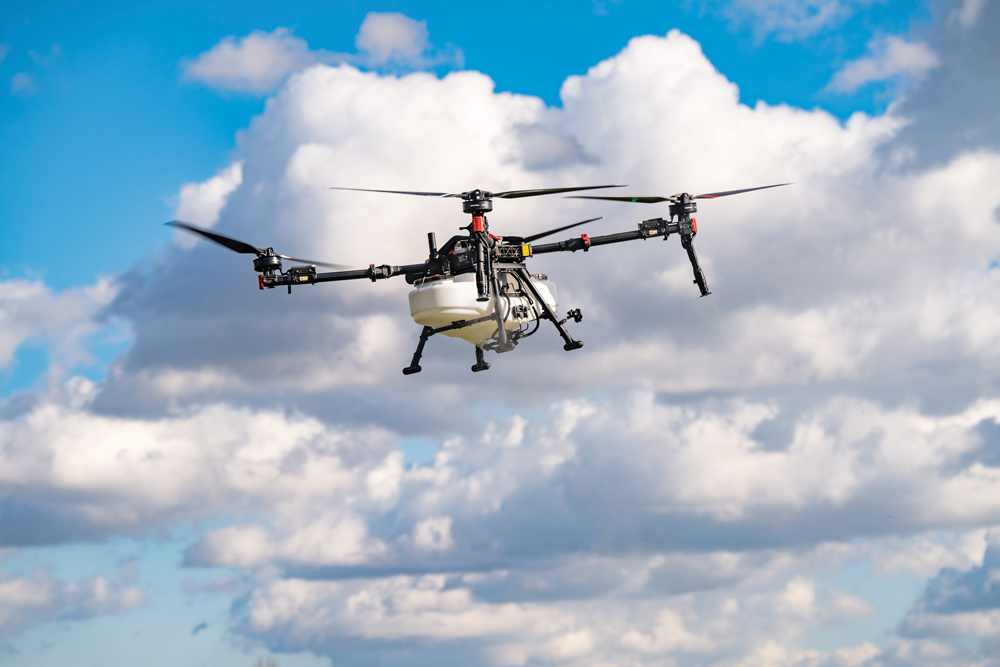
Another important driver behind the adoption of spray drones is the increasing emphasis on precision agriculture. Producers are no longer focused solely on applying products across entire fields. Instead, the objective is to apply the right product, at the right rate, at the right place and at the right time. Spray drones fit naturally into this philosophy by allowing highly targeted applications that can improve operational efficiency while reducing unnecessary input use.
As with any agricultural technology, success does not depend solely on the equipment itself. Careful planning, correct product selection, suitable weather conditions, and well-trained operators remain essential. Spray drones are powerful tools, but they achieve their greatest value when they form part of an integrated crop management strategy rather than operating in isolation.
More than just another sprayer
One of the biggest misconceptions surrounding spray drones is that they are intended to replace conventional boom sprayers or manned agricultural aircraft. In reality, this is neither their purpose nor their greatest strength.
Each spraying platform has distinct advantages depending on the farming operation. Conventional boom sprayers remain highly effective for treating extensive, open fields where large areas can be covered efficiently. Manned agricultural aircraft continue to play an important role where very large areas require rapid application over short periods.
Spray drones occupy a different position within this system. Their greatest strength lies in flexibility, accessibility, and precision.
Because spray drones operate without making contact with the crop, they eliminate wheel-track damage that often occurs when tractors enter growing fields. This is particularly valuable in cereal crops such as wheat and in broadleaf crops such as canola, where flattened plants represent a direct production loss. Every pass made by ground equipment has the potential to reduce harvestable yield, whereas an aerial application leaves the crop undisturbed.
Another significant advantage is accessibility. South African producers frequently experience periods when rainfall delays spraying operations because fields remain too wet to support heavy machinery. During these critical windows, disease pressure can increase rapidly, and delays in fungicide or herbicide applications may reduce treatment effectiveness. Spray drones can often resume operations sooner because they do not rely on field trafficability.
The technology also creates opportunities in areas that are difficult to access with conventional machinery. Steep vineyards, orchards, irregular field boundaries, and environmentally sensitive areas all present situations where aerial application can provide practical advantages. Rather than forcing one solution onto every field, spray drones allow producers to match the application method to the conditions encountered on the farm.
This balanced approach is important. The future of agricultural spraying is unlikely to be dominated by a single technology. Instead, it will involve producers selecting the most suitable application platform for each specific task. Spray drones therefore complement existing spraying systems, expanding the range of options available rather than replacing equipment that continues to perform extremely well under the right conditions.
Why producers are adopting the technology
The rapid growth of spray drones in South Africa is being driven by practical benefits that address real farming challenges rather than by technology alone. Producers ultimately invest in equipment that improves efficiency, reduces risk, and contributes to profitable production.
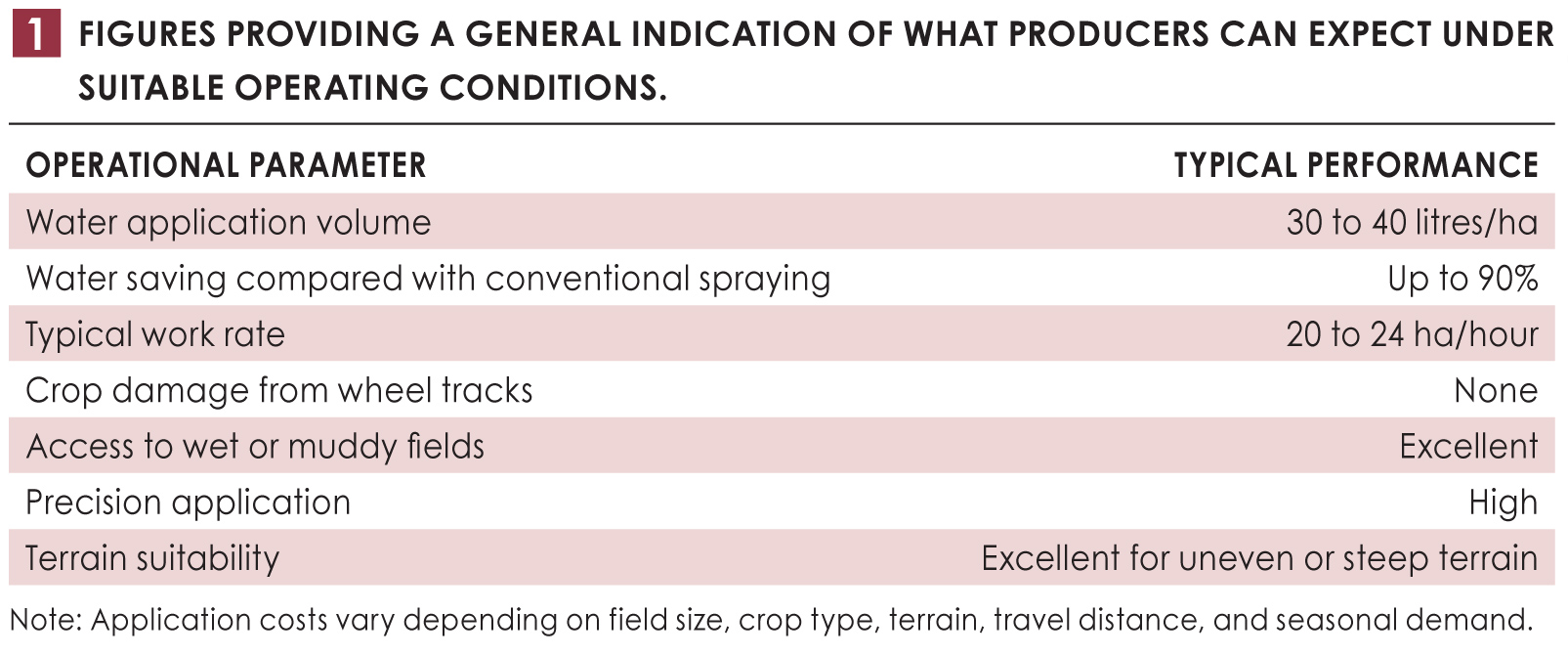
Perhaps one of the most noticeable advantages is the dramatic reduction in water required for spraying. Conventional boom sprayers often apply between 100 and 300 litres of water/ha, depending on the crop and product being used. Spray drones typically operate at application volumes of approximately 10 to 30 litres/ha, representing a substantial reduction in water use. This not only decreases the amount of water transported to the field but also improves logistical efficiency during spraying operations.
Time is another critical factor. Crop protection products are frequently most effective within relatively narrow application windows. Diseases, insect pests, and weeds do not wait for ideal conditions, and delays can reduce treatment success. Spray drones enable rapid deployment and can typically treat between 10 and 15 ha/hour under suitable operating conditions. Their ability to mobilise quickly allows producers to respond faster when favourable weather conditions become available. The fact that drones can swarm increases this coverage over time significantly.
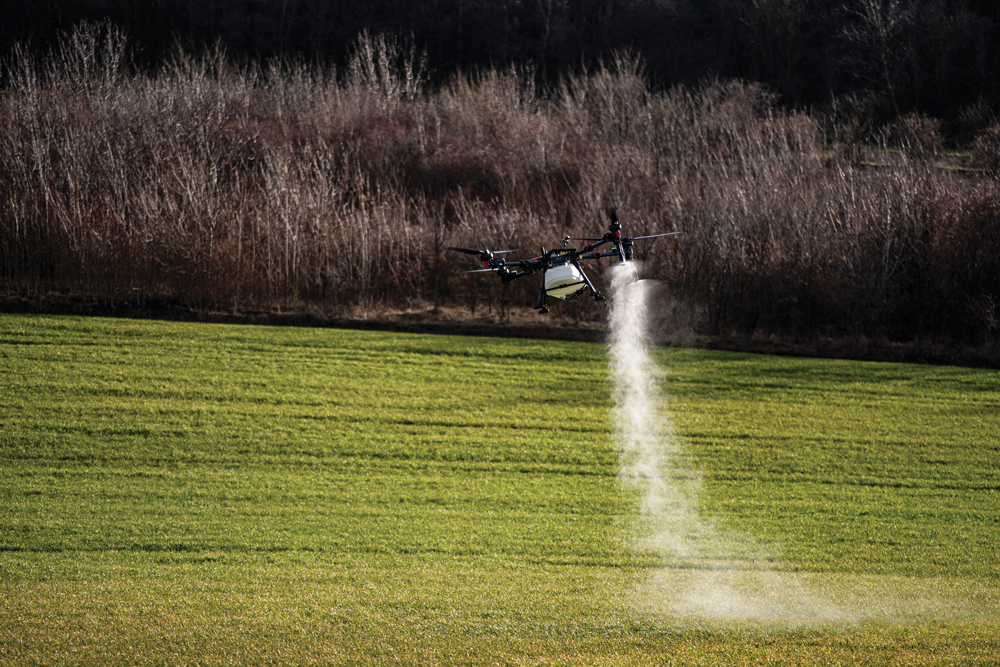
 Crop protection also benefits from the unique airflow generated by the drone’s rotors. The downward movement of air assists spray droplets in penetrating crop canopies, improving coverage on leaves and plant surfaces that may be more difficult to reach using conventional application methods. This characteristic has attracted considerable attention in the whole agricultural sector, where achieving adequate coverage throughout dense canopies is essential for effective disease management.
Another important benefit is the elimination of wheel-track losses. Every time a tractor enters an established crop, some plants are inevitably damaged or flattened. By remaining above the crop canopy, spray drones remove this source of production loss entirely. While the impact varies between crops and field conditions, avoiding unnecessary crop damage contributes directly to protecting potential yield.
Safety also deserves consideration. Operators are able to remain at a greater distance from crop protection products during application, reducing direct exposure compared with manual spraying methods. Although appropriate personal protective equipment and safe chemical handling remain essential, reducing operator exposure is an important advantage in modern agricultural practice.
Perhaps most importantly, spray drones support the broader movement towards precision agriculture. Advances in navigation systems, automated flight planning, and application control allow treatments to be applied with a high degree of consistency. As precision farming continues to evolve in South Africa, spray drones are becoming one component of an integrated technology ecosystem that includes satellite imagery, sensors, geographic information systems, and data-driven farm management.
The result is not simply a new way of spraying crops. It is a more informed, flexible, and responsive approach to crop protection that enables producers to make better use of their time, water, inputs, and resources while maintaining the productivity that modern agriculture demands.
More affordable than many realise
One of the biggest misconceptions surrounding spray drones is that they are too expensive. While this may have been true when the technology first entered the market, significant advances over the past few years have resulted in larger payload capacities, improved performance, and greater operational efficiency without a proportional increase in cost. In practical terms, producers today receive considerably more capability for their investment than they did only a few years ago.
When compared with the purchase price of modern precision spraying technology, spray drones are substantially more affordable. This lower capital investment has made the technology accessible not only to large commercial farming operations, but also to agricultural contractors and smaller producers who may choose to own a drone or make use of specialised spraying services. As the technology continues to mature, improved affordability is expected to remain one of the key drivers behind the growing adoption of spray drones in South African agriculture.
Performance at a glance
While spray drone performance varies according to crop type, terrain, weather conditions, and product labels, several operational trends have become evident through commercial use in South Africa.
These figures should not be interpreted as fixed values. Every spraying operation is influenced by environmental conditions, application rates, nozzle selection, wind speed, droplet size, battery management, and field logistics. The objective should never be to maximise speed at the expense of application quality.
One of the greatest strengths of spray drones lies in their adaptability. Flight speed, spray pressure, nozzle selection, and flying height can all be adjusted according to the crop and application objective. Slower flight speeds may improve canopy penetration in dense crops, while adjustments to flight paths help minimise spray drift under changing weather conditions.
As with any spraying system, successful application depends on careful calibration and good operational planning. Precision is achieved not only through advanced technology but also through skilled operators who understand both the equipment and the agronomic requirements of the crop.
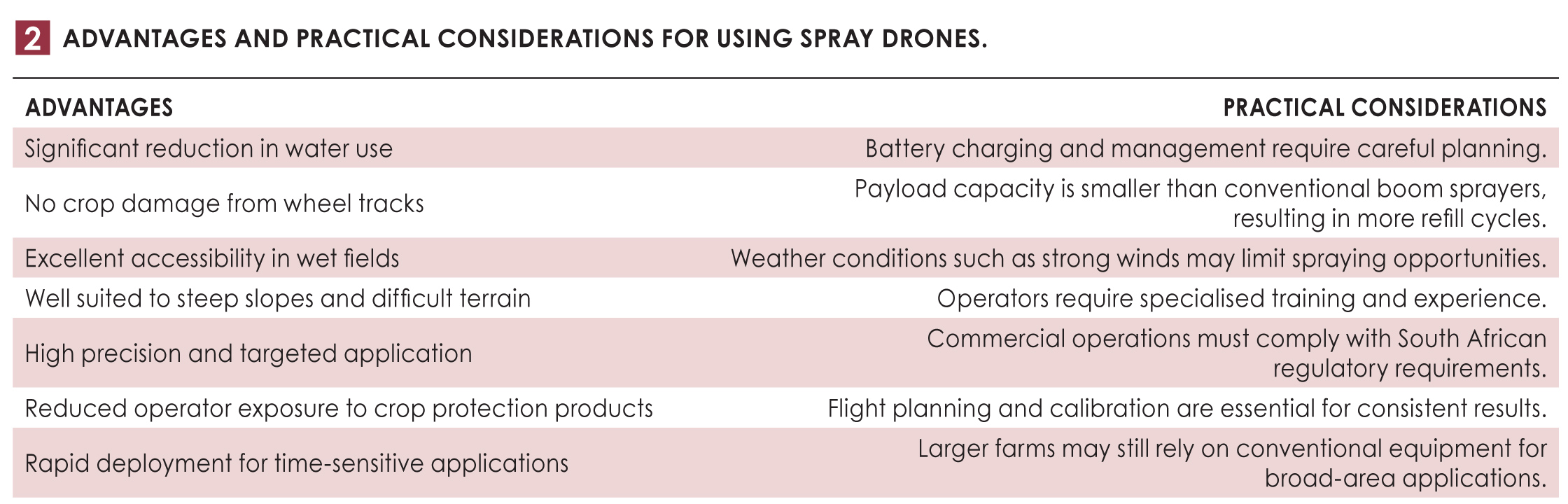 Advantages and practical considerations
Like any agricultural technology, spray drones are not a universal solution. They offer significant advantages in many situations but also have practical limitations that producers should consider before integrating them into their farming operations.
These considerations should not be viewed as disadvantages that limit the technology. Rather, they highlight the importance of selecting the right tool for the right situation.
A useful way to think about spray drones is to compare them with other agricultural equipment already found on most farms. A producer would not expect a tractor, combine harvester, and planter to perform the same function. Each machine contributes to the farming operation in a different way. Spray drones should be viewed in the same light.
In many cases, they provide solutions where conventional equipment faces practical limitations. Conversely, there are still many situations where tractor-mounted boom sprayers or manned agricultural aircraft remain the most efficient option. Modern agriculture increasingly relies on combining technologies rather than replacing one with another.
Responsible operation and compliance
The growing use of spray drones brings with it an equally important responsibility to operate safely, professionally, and within the regulatory framework applicable in South Africa.
Crop protection products are carefully developed and registered for specific uses, and every application should follow the approved label instructions regarding dosage, application timing, environmental conditions, and safety precautions. The effectiveness of any spraying operation depends as much on responsible application as it does on the equipment being used.
Commercial spray drone operations should be conducted by appropriately trained and authorised operators who comply with the relevant aviation and agricultural requirements. Responsible operation not only protects neighbouring crops, the environment, and surrounding communities, but also contributes to maintaining confidence in this rapidly developing technology.
Environmental stewardship is another important consideration. Appropriate weather conditions, particularly wind speed and temperature, should always be assessed before spraying begins. Good operational planning helps reduce spray drift, improves deposition on the target crop, and promotes the responsible use of crop protection products.
Ultimately, technology alone does not guarantee successful spraying. Professional planning, sound agronomic knowledge, and responsible decision making remain the foundation of every effective crop protection programme. Spray drones simply provide producers with another highly capable tool to support these objectives.
Looking ahead: the next generation of autonomous spraying
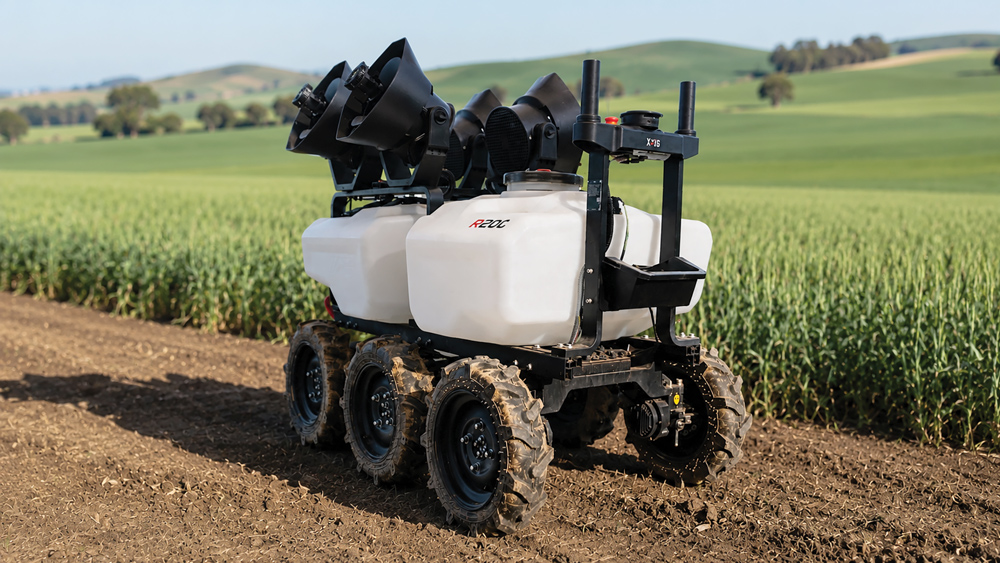
Spray drones represent an important step in the evolution of precision agriculture, but they are unlikely to be the final step. As automation continues to develop, the agricultural sector is beginning to explore the use of autonomous ground spraying platforms that can work alongside aerial systems.
Unlike conventional tractors, these compact autonomous vehicles are designed to navigate fields independently while carrying out specific tasks such as targeted spraying, weed control, and crop monitoring. Operating close to the ground, they offer an additional option for situations where aerial application may not be the preferred choice. Their ability to work autonomously, often for extended periods and with minimal operator intervention, has the potential to improve labour efficiency while maintaining precise application standards.
The greatest opportunity, however, lies not in choosing between aerial and ground-based autonomous systems, but in combining their strengths. Future farming operations may use spray drones for rapid response applications in wet fields, steep terrain, or difficult-to-access areas, while autonomous ground platforms perform routine applications where field conditions allow. Working together, these technologies could provide producers with greater flexibility than either system could achieve independently.
This integrated approach aligns closely with the principles of precision agriculture. Advances in satellite imagery, remote sensing, field sensors, and artificial intelligence are enabling producers to make increasingly informed decisions about where, when, and how crop protection products should be applied. Rather than treating an entire field uniformly, future systems may focus only on areas requiring intervention, reducing unnecessary input use while maintaining crop health and productivity.
Although these technologies continue to evolve, their long-term success will depend on more than automation alone. Reliability, affordability, ease of operation, and practical value to the producer will ultimately determine the rate at which they are adopted. As with any innovation, technology must solve real farming challenges before it becomes an integral part of everyday agricultural practice.
The future of crop protection in South Africa
South African agriculture has never stood still. Every generation of producers has adopted new technologies to improve productivity, strengthen resilience and make better use of available resources. Spray drones are part of this continuing journey of innovation.
Their value extends beyond simply applying crop protection products. They provide producers with greater flexibility during narrow spraying windows, reduce unnecessary crop damage, improve access to challenging terrain and support more efficient use of water and agricultural inputs. When integrated into a broader precision farming strategy, they become another tool that helps producers make informed decisions based on the specific needs of each field and crop.
At the same time, it is important to recognise that no single technology provides all the answers. Conventional boom sprayers, manned agricultural aircraft, autonomous ground platforms, and spray drones all have a valuable role to play within modern farming systems. The most successful farming operations will continue to select the right tool for the right application, recognising that different technologies often complement rather than compete with one another.
As research continues and experience grows under South African farming conditions, our understanding of spray application, droplet behaviour, canopy penetration, and operational efficiency will continue to improve. This knowledge will help refine best practices and ensure that spray drones are used responsibly, effectively, and where they add the greatest value.
Looking ahead, the future of agricultural spraying is unlikely to be defined by a single machine or technology. Instead, it will be characterised by integrated systems that combine automation, precision agriculture, digital technologies, and sound agronomic principles. Producers will increasingly rely on accurate data to guide management decisions, while intelligent application platforms, both aerial and ground-based, will help deliver crop protection products with greater precision than ever before.
Ultimately, spray drones should not be viewed as a replacement for existing agricultural equipment, but as another valuable tool that strengthens the producer’s ability to respond to changing environmental conditions, increasing production pressures, and the growing demand for sustainable farming practices. Used responsibly and as part of an integrated farming system, they have the potential to make a meaningful contribution to the future of South African agriculture.