


Mary Maluleke,
junior researcher economist,
ASSET Research

Prof James Blignaut,
director, ASSET Research

Dr Hendrik Smith,
conservation agriculture
researcher, ASSET
Research

Dr Jaap Knot,
ASSET Research

Liané Erasmus,
ASSET Research
Crop producers in South Africa operate in an increasingly complex and uncertain environment. Pressures arise from deteriorating soils, climate variations, rising input costs, and volatile commodity prices. These pressures pose a threat to the profitability and long-term sustainability of crop production systems. For a farm enterprise to be sustainable in the long run it has to be both financially and ecologically sustainable.
Much research has been conducted, both locally and abroad, to mitigate these and other pressures. This research has yielded a growing body of knowledge that highlights the potential of more sustainable production systems to help producers improve farm resilience and resource efficiency. Production systems like conservation and regenerative agriculture (CA/RA) have gained attention for their potential to enhance soil health, improve water-use efficiency, and stabilise yields and profitability under variable conditions.
Despite this growing body of evidence, the adoption and sustained implementation of CA/RA practices remain relatively low and unevenly distributed in South Africa’s summer crop production regions. While this is due to a range of factors, producers have also highlighted the limited availability of localised farm-level economic and production data which reflect the realities of specific farming regions and contexts as a barrier.
Development of a short-term financial model
Considering the above and the need expressed by producers, a short-term financial model was developed by ASSET Research. The tool was designed to assist producers, researchers, and decision-makers in analysing and comparing the short-term (i.e., one production cycle) financial performance and viability of various mixed crop-livestock production systems. The financial model includes a component on crops, livestock, and results (https://assetresearch.org.za/wp-content/uploads/2025/09/Crop-Production-Cost-Estimate-Model-Write-up-Final-for-sharing.zip).
The crop model follows a standard format of a production budget which estimates production costs, income, and net margins for maize, soybean, and sunflower under conventional tillage (CT), no-tillage (NT), and integrated conservation agriculture (CA/RA). The livestock model calculates the integration of crop and livestock systems through the utilisation of crop biomass (crop residues and in case of CA cover crops) by animals and include purchase and variable costs such as feed and overheads.
The results model integrates the outputs of the crop and livestock models to provide a holistic analysis of the financial performances across systems.
This model was tested and adjusted in consultation with producers and agribusiness representatives during three interactive modelling workshops. These workshops were held in the Maluti, north-eastern Free State, and Mpumalanga Highveld grain production regions on 12, 13, and 14 August 2025, with each being attended by between 24 and 26 people.
In this article we report on the results of those three workshops with specific reference to maize, with the CA/RA system modelled as a maize plus intercropping (with cover crops) system allowing livestock integration in the winter. The value of intercropping for environmental, production, and financial gains are well known, but it is recognised that it is a new practice that will challenge the successful practical application in different large-scale crop production systems. However, success stories are emerging, and producers are encouraged to learn from and test these in their own situations. The modelling has been done for all three summer crops (maize, soybean, and sunflower) and the results are available upon request.
Model results
Crop net margins (excluding livestock)
Graph 1 shows the workshop results of the estimated net margins for the 2025/2026 production season with respect to maize production in the three regions. The calculation uses income (R/ha) less the cost before marketing costs (R/ha) for the crop operation and excludes any income or costs pertaining to livestock.
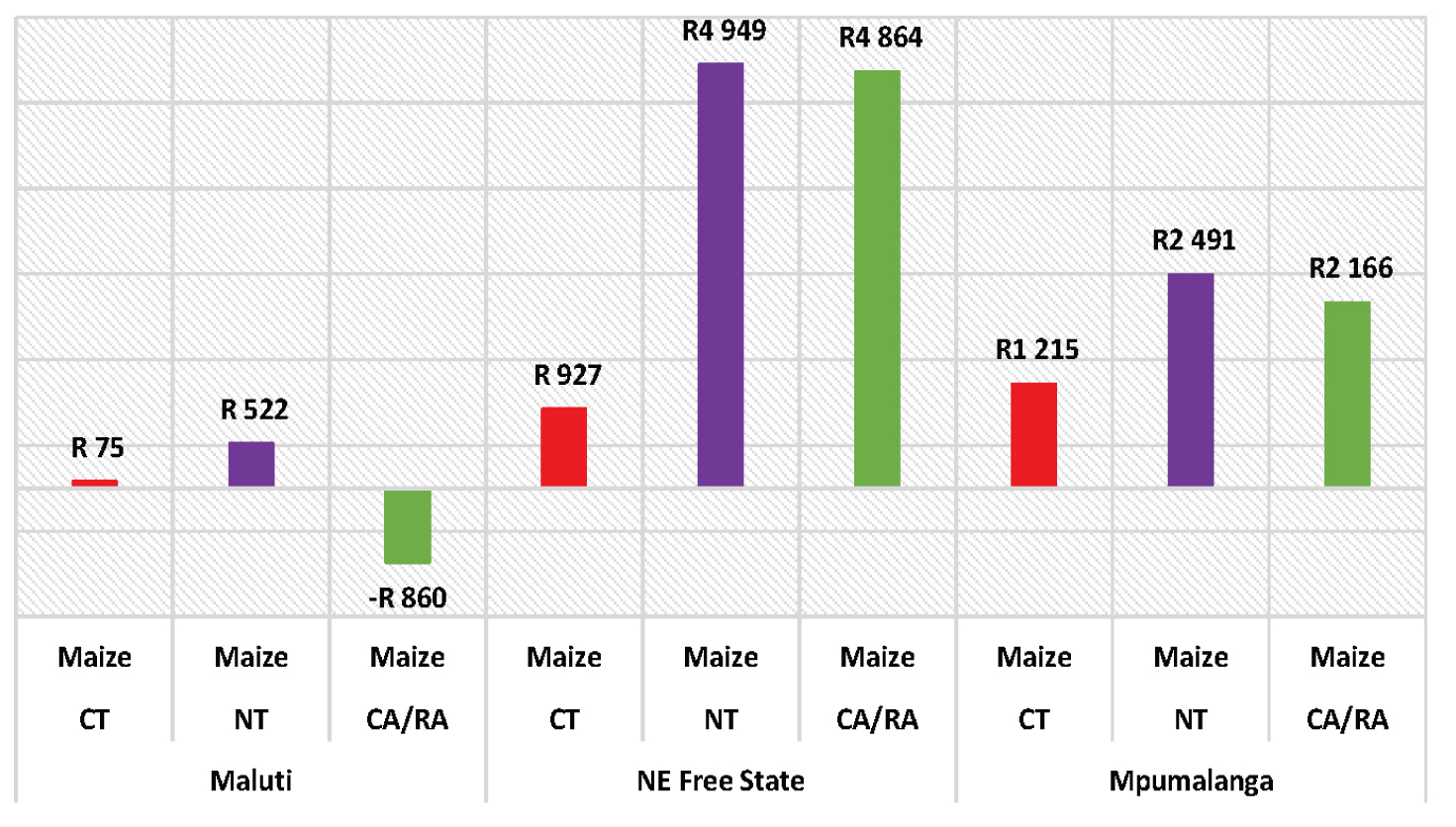
Results in Graph 1 show the following: In the Maluti region the net margin of CT maize is R75/ha, NT is R522/ha, and CA/RA is -R860/ha. The main reason for CT having a lower net margin than NT is the higher production cost associated with it driven by fuel, field preparation, and especially overhead costs. The reason for the lower net margin under CA/RA is mainly due to an anticipated reduction in yield of 0,2 t/ha over the short term; improved soil health and management are likely to negate this reduction.
The net margins for maize production were much higher for all production systems within the north-eastern Free State production region. The net margin for CT was R927/ha, while NT and CA/RA were both much higher at approximately R4 900/ha.
Similar cost patterns were observed under CT and NT as in Maluti, but unlike in the case of Maluti, the high yield potential of the production area significantly improved CA/RA performance. As a note on the side, practically CT producers can adopt elements from CA like increasing use of biostimulants (i.e., seed coating, pop-ups, foliar applications) and planting winter cover crops after soybean and sunflower.
In the Mpumalanga Highveld region, the net margin for CT is R1 215/ha, NT is the highest in this case with almost R2 500/ha, while CA/RA also performs strongly with R2 166/ha. It was noted that some producers practicing NT for many consecutive years observe tighter (less productive) soils as well as increased weed resistance, which require proper investigations and appropriate corrections.
In summary, when livestock is excluded, NT is the top-performing cropping system in all three regions.
CA/RA is competitive with NT in the north-eastern Free State and Mpumalanga Highveld regions. Apart from the Maluti region where CA/RA runs at a loss, CT had the lowest net margins as it was considered the costliest due to especially machinery/diesel costs. The results confirm that regional agroecological conditions have a strong influence on the financial performance of the different cropping systems.
Net margins including livestock
Graph 2 presents the net margins with livestock included for the three regions. The livestock net margins calculated in the model (lighter bars) are added to that of the crops (darker shaded bottom bars) resulting in a much different picture. Key livestock assumptions included the following:
- Producers with cattle were assumed to purchase their own growing, weaner, or backgrounding animals from themselves and sell them back to themselves, effectively modelling an unlimited supply of cattle available to utilise the dry matter (DM) produced by the system over a given period.
- Average livestock purchase and selling prices (R/kg) from August 2025 for the different regions were applied.
- Each region was assigned its respective variable costs, including protein and non-protein supplementation, veterinary expenses, stocking costs, and overheads.
- The livestock model was DM-driven, meaning that the supply of DM determined the number of animals that could be supported by the system, from a defined ‘buying weight’ to a ‘selling weight’ (kg).
- Where intercrops were successfully drilled into standing maize at knee height, the average DM yield per hectare was assumed to be 1,0 ton in Maluti, 1,25 ton in the north-eastern Free State, and 1,5 ton in Mpumalanga.
- Livestock returns were calculated based on DM production within each system. Cattle have a daily DM requirement, and DM has a digestibility percentage. The total amount of digestible DM determined the number of growing livestock units that could be supported, which were then sold at a specific weight according to prevailing regional selling prices (R/kg).
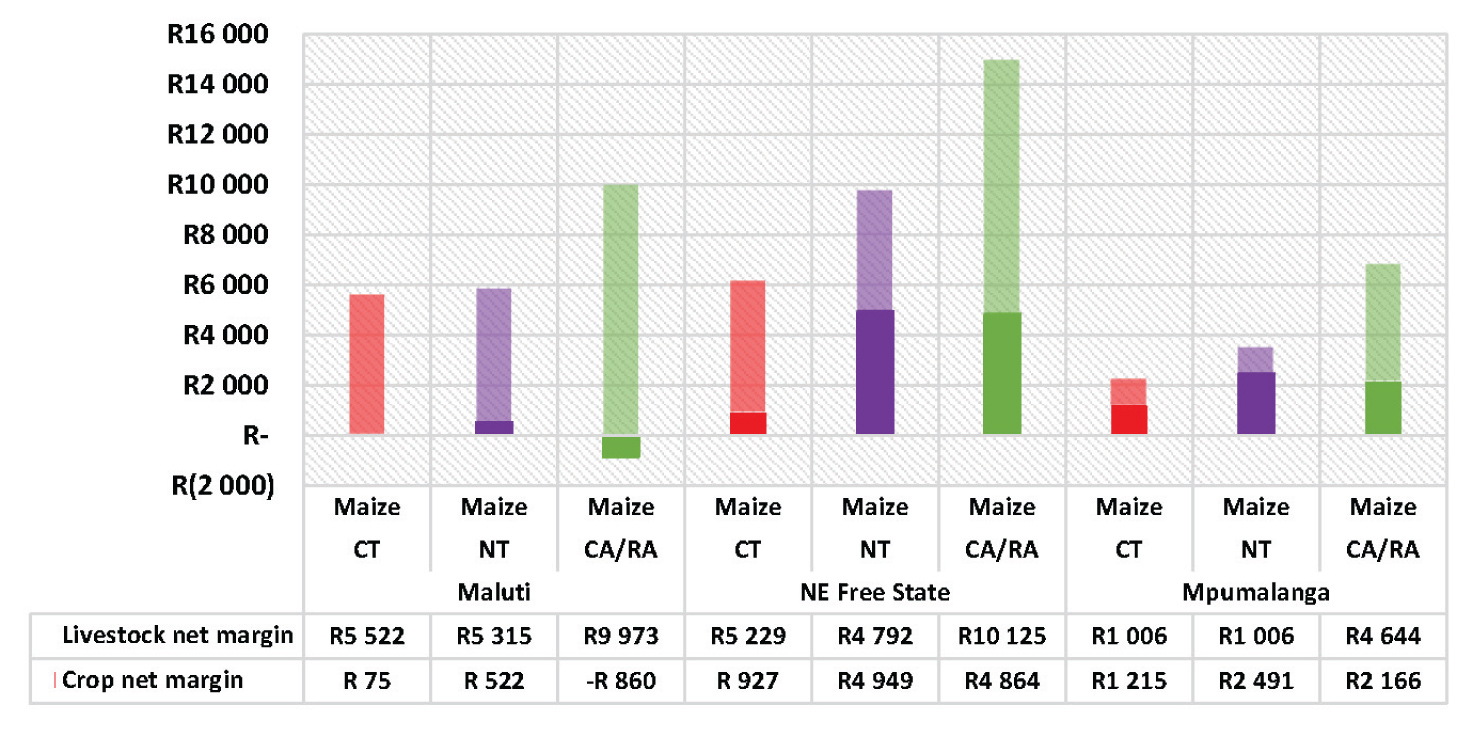
The estimated total net margin (combining crops and livestock) for CT and NT is between R5 300/ha and R5 500/ha. This increases to nearly R10 000/ha for integrated CA/RA systems in the Maluti production area. Similar results are seen in the north-eastern Free State region. In the Mpumalanga Highveld, however, livestock net margins are lower under CT and NT, but CA/RA still outperforms the other systems at around R4 600/ha.
These results show that integrated crop-livestock CA/RA systems as analysed in these regions can enhance farm profitability and viability. It does require proper planning, implementation, and integration of cover crops in rotation with cash crops in combination with all the other CA/RA principles and practices to produce sufficient biomass or improved grazing and meat production. This fully integrated CA/RA system may also capture significant environmental benefits and translate them into a financial return.
From a system perspective, a CA/RA mixed maize-livestock system produces the highest total net margins, suggesting substantial benefits beyond crop production when implemented under favourable conditions. Cross-regional variation reinforces the need for locally grounded analysis and producer-led evaluations when assessing alternative production systems.
Successfully implementing an integrated crop-livestock CA/RA system that combines crop and livestock performs the best in this analysis. It does require a mind-shift and a dedicated, sustained effort to apply it in unique biophysical (soil and climate) environments and producer contexts across different regions.