



Trystan Nadasen, junior research coordinator, Grain SA
Global markets, not only commodity markets, increasingly must be adaptable to increased volatility and high energy costs, yet still produce products as affordably as possible. A major component in the success of any economy is the ability to effectively transport goods and services. Since the early 2000s there has been a global push towards more efficient transport, whether this relates to cost or carbon emissions.
As the world looks for ways to reduce greenhouse gas emissions and address climate change, interest in renewable energy sources such as biofuels continues to grow. Rising energy demand, limited fossil fuel reserves, stricter environmental regulations, and recent geopolitical conflicts have all highlighted the vulnerability of global oil supplies and the need for greater energy security. Biofuels, which are produced from plant material and other biological resources, offer an attractive alternative. For agriculture, the growing biofuels industry also presents new opportunities by creating additional markets for crops and agricultural residues.
Biofuels
Biofuels are renewable fuels produced from biological materials and can be used as alternatives to conventional fossil fuels such as petrol, diesel, and aviation fuel. Biomass used for biofuel production includes food crops, crop residues, animal waste, and other organic materials. Depending on the feedstock and the desired end product, biomass can be converted into fuel through biological, chemical, or thermal processes. For example, sugar- and starch-rich crops can be fermented to produce ethanol, while oil-rich crops are used to manufacture biodiesel. More advanced technologies can also convert agricultural residues and other waste products into liquid or gaseous fuels.
Globally, the United States and Brazil dominate ethanol production, together accounting for more than 80% of the world’s supply, while the United States and countries within the European Union are among the leading producers of biodiesel. Biofuels are commonly classified according to the raw materials used in their production.
First-generation biofuels are derived from food crops such as maize, sugarcane, and oilseeds. Second-generation biofuels utilise non-food biomass, including crop residues and dedicated energy crops, whereas third-generation biofuels are produced from algae. As technologies continue to advance, biofuels are increasingly being viewed as an important component of future sustainable energy systems and a potential new market for agricultural production.
International trends
The modern biofuel industry was not created by market forces alone. It has largely been driven by policy developments, governmental mandates, tax incentives, subsidies, and carbon reduction targets that created demand for biofuels. Today, more than 80 countries have policies supporting biofuel production.
In 2025 the world produced 50,4 billion litres of biodiesel and 128,9 billion litres of ethanol (Graph 1), which is expected to increase to a collective production of 181,9 billion litres by 2023. Currently, 85% of the global biofuel market is dominated by four markets: the United States, Brazil, Europe, and Indonesia. The International Energy Agency (IEA) expects these four markets to contribute to the largest portion of production growth by 2030, with Brazil leading the growth.
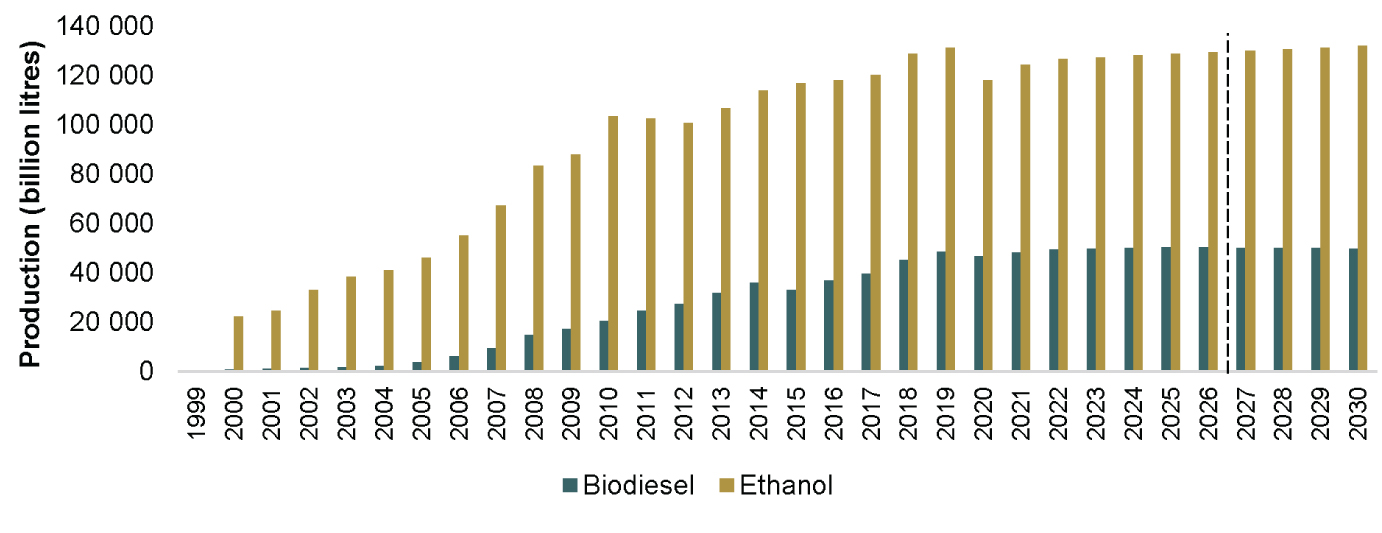
Source: OECD
Crops used for production
A wide range of crops can be used to produce biofuels. First-generation biofuels are commonly manufactured from food crops rich in sugars, starches or oils, including maize, sugarcane, wheat, sugar beet, potatoes, sorghum, canola, and soybean. Sugars and starches from grains and tubers are typically fermented to produce ethanol, while oils extracted from oilseed crops are converted into biodiesel. Beyond these traditional feedstocks, almost every part of a plant can potentially be utilised for biofuel production. Seeds, fruits, stems, leaves, roots, and agricultural residues all contain compounds that can be converted into fuel.
Plant materials rich in cellulose and lignin, such as stalks, leaves, and crop residues, are increasingly being used in the production of advanced biofuels, allowing waste materials to be converted into valuable energy products. In South Africa, several crops have been evaluated for their suitability as biofuel feedstocks. A recent study commissioned by the Localisation Support Fund (LSF) identified sorghum as one of the most promising crops for the development of a local bioethanol industry (Graph 2).
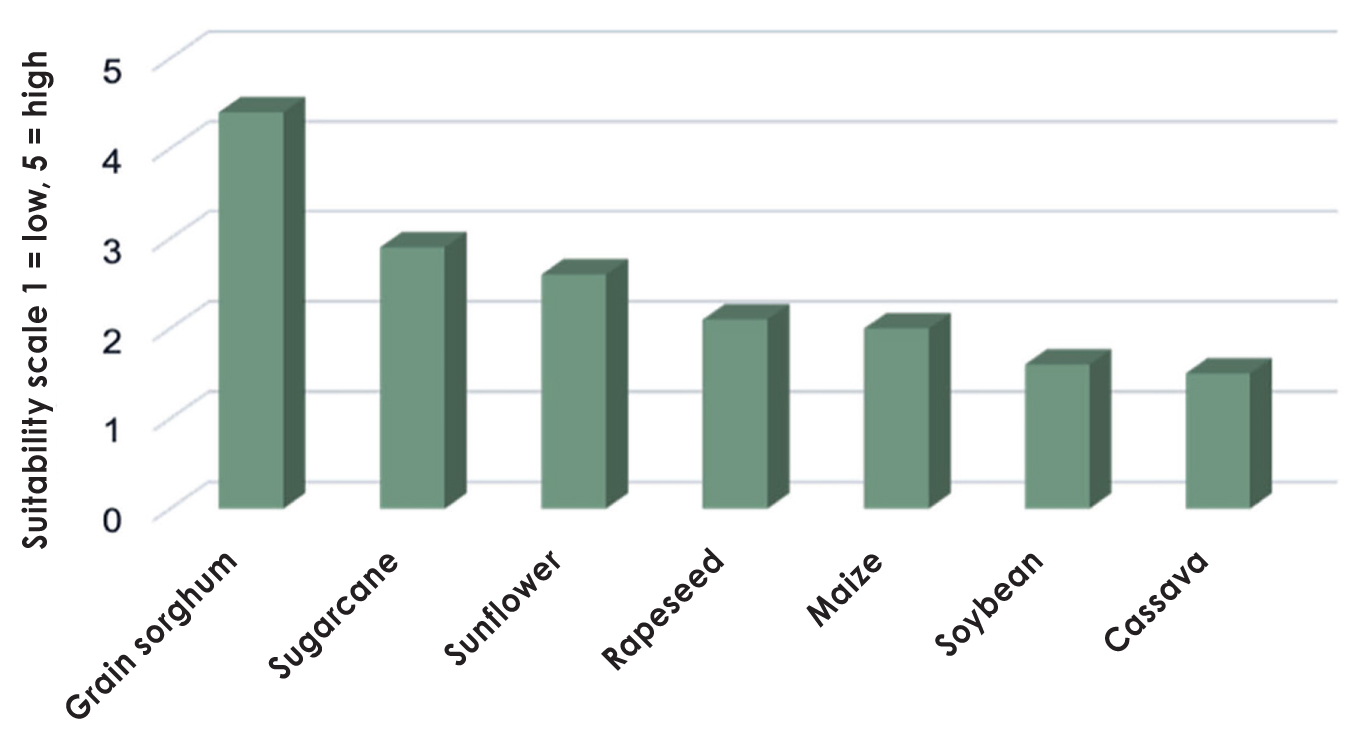
Source: Adapted from Blueprint Holdings (Pty) Ltd (commissioned by the Localisation Support Fund), Comprehensive Assessment of the Viability of a Domestic Sorghum-Based Bioethanol Industry in South Africa, based on value chain analysis, international benchmarking, and integrated scenario modelling.
Sorghum is an increasingly important candidate for biofuel production due to its adaptability to South African growing conditions, low water requirements, and versatility across multiple uses. As the fifth most important cereal crop globally, it is already widely used for food, animal feed, fodder, and increasingly, energy production. Its drought tolerance makes it particularly valuable compared to crops such as maize, allowing it to be cultivated in marginal areas where other grains perform poorly.
Depending on the processing method, virtually all parts of the sorghum plant can be converted into biofuels and related energy products, including ethanol, biogas, bio-oil, biochar, hydrogen, and biodiesel. In addition, processing generates valuable by-products such as dried distillers’ grains with solubles (DDGS), which can be used either as a nutrient-rich livestock feed or as an additional energy source.
Sorghum is grown in several forms, including grain sorghum for food use, sweet sorghum for its high-sugar stalks, forage sorghum for grazing, and biomass sorghum for high-volume plant material production.
Despite these advantages, sorghum production is declining in some regions due to limited market development and low demand. Expanding its use in biofuel industries presents a potential pathway to strengthen its economic value while supporting both agricultural resilience and renewable energy goals.
Case study: Brazil
Brazil as a country resembles the near perfect example of large-scale integration of renewable transport fuels into a national economy. Even though the Brazilian economy is ranked as the tenth largest economy globally while South Africa competes for number 39, both these countries are highly dependent on road transportation. As such cost-effective transport is essential for sustaining economic activity, locally and in Brazil.
In Brazil the energy requirement grew with 1,9% per annum between 2000 and 2024, while the requirement from the transport section grew faster, at 2,9% per annum, which was faster than the GDP growth rate.
Remarkably from this demand growth, the contribution of renewable resources grew by 5,9% per annum. Between 2000 and 2024 the contribution of biodiesel and ethanol collectively grew from 12% to 25%. A combination of incentives, dissemination of flex-fuel vehicles, mandatory blending targets, and national production programmes led to this successful increase.
The Brazilian Programme for the Production and Use of Biodiesel (PNPB) is a federal incentive launched in 2004 to support the implementation of sustainably biodiesel production. The PNPB was based on three fundamental pillars: social, environmental, and economic impact.
Another key element of Brazil’s success is the use of biomass. In 2024 the primary energy of Brazil was supplied by 50% fossil fuel, 19% other low-carbon sources, and 31% biomass. Biomass is made up of 54% sugarcane; 26% wood; 12% black liquor, and 8% biodiesel.
One of the global incentives for biofuel production is the International Air Transport Association (IATA’s) Commitment to Net Zero by 2050. This represents a unified pledge by global member airlines to achieve net-zero carbon emissions by 2050. Ethanol has been recognised as a promising solution for maritime decarbonisation goals under IMO (International Maritime Organisation) regulations.
Brazilian key recommendations to develop a biofuel industry consisted of the following:
- Policy framework: consistent government support and stable regulations
- Agricultural strengths: utilising local resources for cost-effective production
- Infrastructure investment: the necessity of efficient distribution and storage networks
- Technological innovation: continuous research for improved crop yields and biofuels production
- Market demand: mandatory blending ensuring market stability and growth
Conclusion
In conclusion, biofuels represent a strategic opportunity to address rising energy demand, reduce greenhouse gas emissions, and strengthen energy security while creating new markets for agriculture. International experience, particularly from Brazil, demonstrates that sustained policy support, infrastructure investments, and mandatory blending can successfully integrate biofuels into a national energy system.
For South Africa, sorghum stands out as highly suitable due to its adaptability, low water requirements, and multiple value-chain opportunities. Expanding a sorghum-based bioethanol industry could therefore support rural development, enhance agricultural resilience, and contribute meaningfully to the country’s renewable energy and climate objectives. This will be discussed in a follow-up article.
References
- Ameen, M, Mahmood, A, Shahzad, AN, Zia, MA & Javaid, MM. 2024. Sorghum’s potential unleashed: A comprehensive exploration of bio-energy production strategies and innovations. Bioresource Technology Reports, 27, 101906.
- Blueprint Holdings (Pty) Ltd. 2026. Developing the sorghum biofuel value chain in South Africa. Johannesburg: Localisation Support Fund. Available at: https://www.lsf-sa.co.za/reports/developing-the-sorghum-biofuel-value-chain-in-south-africa [Accessed 19 June 2026].
- Prasad, S, Yadav, KK, Kumar, S, Pandita, P, Bhutto, JK, Alreshidi, MA, Ravindran, B, Yaseen, ZM, Osman, SM & Cabral-Pinto, MMS. 2024. Review on biofuel production: Sustainable development scenario, environment, and climate change perspectives − A sustainable approach. Journal of Environmental Chemical Engineering, 12, 111996.
- Stamenković, OS, Siliveru, K, Veljković, VB, Banković-Ilić, IB, Tasić, MB, Ciampitti, IA, Dalović, IG, Mitrović, PM, Sikora, VŠ & Prasad, PVV. 2020. Production of biofuels from sorghum. Renewable and Sustainable Energy Reviews, 124, 109769.