



Prof Hannalene du Plessis, North-West University
Maize streak disease (MSD) is an old enemy that still poses the same challenges reported in KwaZulu-Natal after the first outbreak in 1896.
MSD occurs throughout Africa and is generally considered a sporadic disease in South Africa. However, the status of MSD has increased over recent times, especially in KwaZulu-Natal, where it is now of serious and perennial importance. MSD can occur everywhere in South Africa where environmental conditions favour the survival of host plants, leafhoppers, and the maize streak virus. Regions in South Africa where MSD is prevalent include irrigation schemes in parts of Limpopo, the Northern Cape, and Mpumalanga, and particularly areas experiencing high rainfall and temperatures. The disease is, however, not confined to such areas and often also occurs in dryland production systems in Gauteng, the North West, and Free State.
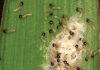
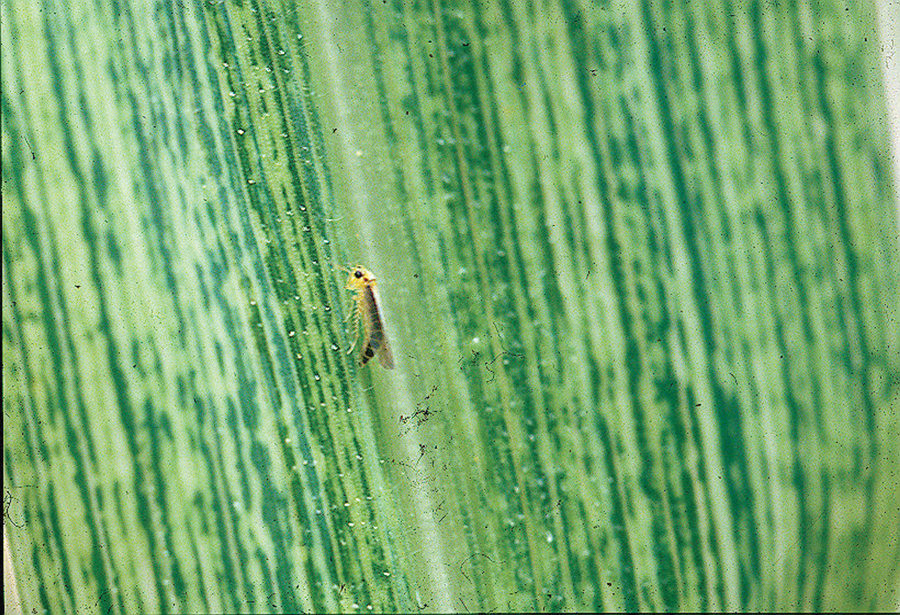
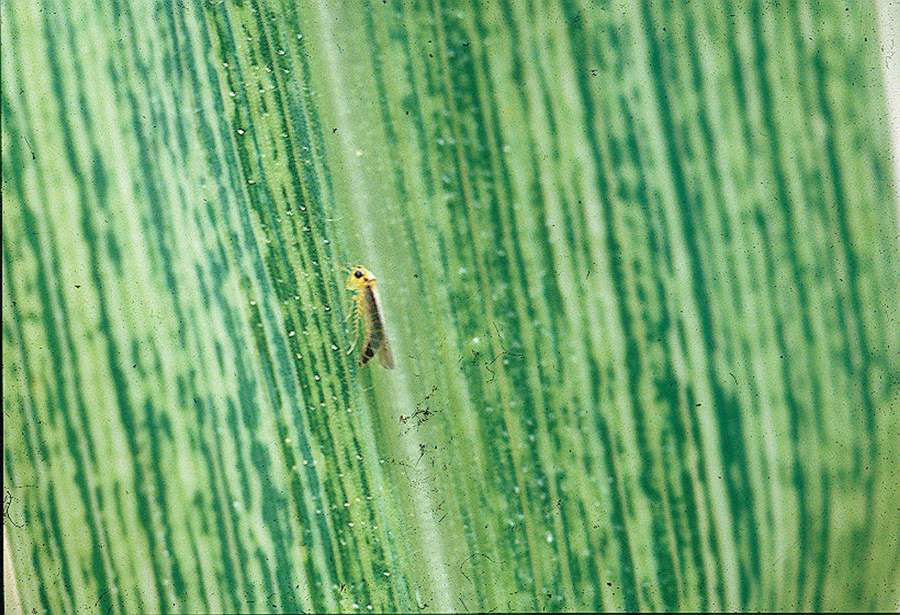
It is caused by the maize streak virus (MSV), which is transmitted by Cicadulina leafhoppers (Photo 1). Sugarcane streak disease, which is also caused by the MSV-A strain in sugarcane, is increasing in prevalence in Southern Africa and may in future become a serious disease of this crop in the region.
Why is it difficult to manage MSD?
The prevalence of MSD is determined by complex interactions between maize plants, the leafhopper vector, wild grasses that host the vectors, and environmental conditions.
Rapid increases in disease infection and epidemic spread in maize crops are usually ascribed to the convergence of factors such as:
- staggered growing seasons in which MSV can bulk up in early planted maize;
- the population density of wild grasses that are reservoirs of both MSV and leafhopper vectors;
- the presence of large leafhopper populations;
- movement of leafhoppers between fields and wild grasses;
- environmental factors that support the growth of grasses; and
- environmental factors that drive the long-distance movement of leafhoppers.
Infection increases under conditions where maize hybrids are less tolerant to the disease and when alternate hosts are continuously available under favourable environmental conditions, such as high rainfall and temperatures.
Transmission of the virus
The only known transmission pathway is Cicadulina leafhoppers which transmit MSV from wild grasses to maize plants and from one maize plant to another. Leafhoppers can acquire the virus from infected plants after a feeding period of only a few minutes and are able to transmit the virus for five weeks after an acquisition. The virus may be transmitted to host plants in less than five minutes.
The MSV itself occurs within the mesophyll tissue of infected plants and initial contact may occur when the vectors feed in the mesophyll cells. Leafhoppers feed on the phloem sap inside the plant, acquiring or releasing the virus into the phloem where it replicates.
On-farm monitoring of MSD in grasses in Ghana showed that the main vector species (Cicadulina mbila) occurs largely in shady areas while another important vector (Cicadulina storeyi) occurs mostly outside of the shade, effectively separating the two species behaviourally. The incidence of MSV-infected plants was nearly three times higher underneath the shade of trees than in grasses growing in full sunny conditions.
Good vibrations
The males and females of Cicadulina locate each other by means of vibrations transmitted through leaves on which they sit, and the acoustic properties of the plants may be an important factor in their selection of plants on which to settle. Female leafhoppers lay eggs in the living tissue of grasses or maize plants, where they remain dormant or hatch within a few weeks. After hatching, the nymphs feed on vascular tissues. Grasses do not always show symptoms of MSD, and infected leafhoppers can transmit the virus from these symptomless grasses to maize plants.
Leafhopper biology and migration behaviour
Overwintering of the virus and its leafhopper vectors occurs primarily in grasses. In irrigation systems, where growing conditions for grass hosts are good, this results in particularly severe pest pressure. The migratory behaviour of the Cicadulina leafhoppers is influenced by environmental conditions and phenology of the grass hosts that are present around maize fields. The distance that MSV spreads from a source of inoculum is determined by the movement behaviour of leafhoppers. Although most movement is local, from nearby grasses into adjacent fields, distinct long- and short-distance flight morphs have been detected among certain Cicadulina populations. It is believed that the long-flight morphs are a migratory form and that they are responsible for the rapid long-distance spread of the virus. Wind currents can also carry leafhoppers over longer distances, contributing to the spread of the disease.
Most disease spread within fields appears to be caused by the highly mobile males which move throughout fields in search of females. The females are more sedentary within the crop and are principally found up in the canopy of maize (particularly the whorls), while the males move around closer to the ground.
Leafhopper migration from grasses to maize
Approximately 70% of the more than 138 grass species in Africa on which leafhoppers feed are also MSV hosts, including important crops such as maize, wheat, barley, and rye. The density and composition of grass communities in any region almost certainly have a major influence on MSD epidemiology in that region. For example, the maize-adapted MSV-A strain appears to be particularly well adapted to the infection of grasses in the genus Digitaria.
Symptom development
Plants infected with MSV develop symptoms between three and seven days after infection. Symptoms always appear on young, growing, tender leaves, which leafhoppers prefer for feeding. Symptoms only develop above the site of inoculation on newly emerging leaves.
Management
Yield losses are directly related to the plant growth stage at the time of infection, with the most serious being infection during seedling stages. For this reason, the use of systemic seed treatments may provide protection against early leafhopper infestations. Although seed dressing insecticides are available for the control of maize leafhoppers, these products do not provide protection against leafhopper vectors for longer than the mid-vegetative growth stages of maize plants.
Chemical control of leafhoppers can be done through in-furrow applications of registered granular formulations of insecticides at planting. The systemic activity of these products will provide some level of protection against leafhoppers during the early vegetative growth stages. However, the incidence of MSD may still be high at later growth stages, especially on very susceptible cultivars.
Ultra-short-season hybrids are especially vulnerable because of their high susceptibility to MSV and the very high plant populations used for these hybrids. This provides a favourable microenvironment for leafhopper proliferation, with a subsequent spread of the virus. In addition, shortened growing seasons provide little chance for corrective action and recovery. This is because insecticidal control of leafhopper populations cannot usually be implemented in time to effectively control the spread of the disease.
MSV epidemiology is primarily governed by the presence of grasses and the cultivation of crops such as wheat during the winter. Wheat also serves as a host for both the leafhoppers and the virus. Temporal overlap of these two crops provides a ‘green bridge’, allowing survival of the leafhopper throughout the year. Additionally, the migratory behaviour makes MSD difficult to control, as even well-managed fields can be reinfested by infective leafhoppers from surrounding grasses.
Studies in Kenya and Ghana showed a decreased incidence and severity of MSD in maize varieties grown in soils amended with potassium (K) fertiliser. The opposite was observed with maize leaf N content. Research on other crop species has also shown that the presence of adequate plant K content decreases internal competition by pathogens for nutrient resources, and increases phenol concentrations, which play a critical role in plant resistance.
Conclusions
The severity of MSD is determined by the various interactions between environmental conditions, the vector, and wild grasses or other crops such as wheat that host the vector and the virus. Seed treatments and planting of MSD-tolerant hybrids are the only tools available to manage this insect-virus-disease complex.