


The use of naturally derived products and active ingredients, referred to as biological products, is a trend finding its way into every sphere of consumerism – from agriculture to cosmetics, pharmaceuticals, cleaning, and packaging.
Indeed, all these industries can draw their origins from natural substances which were later synthetically designed and mass produced to overcome barriers such as stability, availability, directed impact, ease of production, and ease of use. But in the last few decades, research and interest have returned to natural resources – why?
Now, more than ever, people are conscious of the unsustainable impact of consumerism on the environment, as well as the rise in incurable diseases for which science still struggles to identify exact causes. Popular culture has blamed a variety of sources, and substances which have potential toxicity are strongly regulated to protect applicators, consumers, livestock, and non-target organisms. In this gap, the market of biologicals in agriculture is taking hold.
Being derived from nature logically suggests that ecosystems are already designed to accommodate these products, with established degradation pathways, non-target tolerances, and balanced targets. However, it is critical to remember that if nature alone could control pests within modern farming systems, there would be no need for intervention. Years of monoculture to support a growing world population has necessitated the need for intervention because natural balance is already negatively affected. Thus, there is a need to change the way producers farm. This concept is intimidating because of the mountain of challenges they already face – climate change, pest pressure, market requirements, labour costs, safety requirements. Why change what isn’t broken?
The adoption of biological crop protection is currently driven far more by external pressure than by internal business conviction. Growers are moving towards biologicals mainly to meet strict organic or low-residue regulations and environmental compliance requirements. Consumer demand for healthier, residue-free food further reinforces this shift. The South African Bioproducts Organisation (SABO) promotes the use of integrated pest management (IPM). This involves the careful consideration of all available techniques to support the growth of a healthy crop: selection of the most suitable cultivar for the environment; maintaining of healthy and nutritious soil; planting practices and maintenance to avoid pest pressure; regular monitoring and inspection for early warning and intervention; as well as selection of the most appropriate crop protection measures, whether synthetic or biological.
The trend of IPM and the use of bioproducts are clearly increasing at an exponential rate both globally and locally.
Currently, the global market for bioproducts is over R200 billion, increasing at 14% per annum. In South Africa bioproducts make up around 8% of the market, or R1,4 billion, mainly focused on permanent crops. Local distributors believe that this will increase to between 10 and 20% within the next five years. However, there are still real barriers to the adoption of bioproducts. SABO’s recent market analysis survey indicated that growers need more proof and guidance, as performance confidence and cost justification remain the biggest hurdles, while training and regulatory improvement are key enablers.
This is very likely due to the historical roots of bioproducts, the so-called ‘snake oils’. These were widely marketed as the key to solve all problems quickly and with low impact on residue levels.
However, these products were inconsistently produced, contained unresearched actives, and often created more damage than solutions. Overpromise and underdeliver became the key tagline for biologicals locally – and still remains a challenge in the industry. Wherever there is a growing industry, there are always fraudsters waiting to grab a piece of the pie.
SABO’s compliance drive aims to raise awareness of growers regarding the regulatory requirements for registered products to protect them from poorly researched, non-compliant but well-marketed products. Any product that is an inoculant or plant growth regulator or claims pest control must have registration with the Department of Agriculture under Act No. 36. This is indicated by ‘Reg. No. L<unique product code> Act 36 of 1947’ appearing on the label. If the product claims improvement in growth or yield of plants, or the condition of soil, it should be supported by ‘Reg. No. M<unique product code> Act 36 of 1947’ on its label. The absence of these two registrations or use of an M number where pest control is claimed, is unlawful. This means the seller has not submitted their product for independent local regulation, therefore, claims on poor efficacy, formulation, or stability cannot be supported.
Be vigilant
What to look out for on non-compliant products includes a lack of information on the active ingredient, registration holder details, application directions, or the lack of a label altogether. If a non-compliant product is suspected, send an email to compliance@sabo.org.za. It is these non-compliant products that detract from the excellent technology that has been developed over the last few decades. Local and international companies are bringing naturally derived products to South Africa on a large scale. These have been developed to be more stable, easier to apply, and fit for purpose while still having a low impact on the environment and low toxicity to the environment, consumers, and livestock.
If there is doubt on what can be achieved by biologicals, Southern Hemisphere neighbours, Brazil, can be used as a positive example. Also juggling a developing economy, Brazil has become the largest global adopter of biological products and sustainable agriculture practices, with biological control products forming 57% of the overall agricultural crop protection and fertiliser market (almost 900 registered products). Yet the country remains a firm competitor to South Africa in export markets to Europe and the United States. They supply a local market, growing 47 million ha of soybeans and 23 million ha of maize, compared to South Africa’s 1 million ha of soybeans and 2,6 million ha of maize. The success of adoption has been because of their highly successful National Programme for Bioinputs (PNB).
SABO recognised this success as well as the struggles that South Africa is facing with a growing market that requires regulatory and implementation support to protect local growers. In November 2025, SABO held the Bio-Alliance Conference in collaboration with the embassy of Brazil in South Africa. The purpose of this event was to draw on the signed memorandum of intent between Brazil and South Africa, which allows for collaboration to support areas of learning within the agricultural sector. At a time where there is growing lobbying for a rewrite of the outdated pesticide policy, this event sought to bring together all value chain stakeholders locally and from Brazil to understand the bioproduct sector and the lessons Brazil has learnt in their programme which can assist in developing a strategy suited for South Africa.
This event saw attendance by grower groups, researchers, students, academics, governmental officials, extension officers, manufacturers, distributors, retailers, financial institutions, consultants, journalists, and representatives from the European Union. The two-day discussion dived into the PNB in Brazil, where it was clear that success was achieved through the mass collaboration of stakeholders from the private and government sectors and the aim of supporting growers to overcome the risk of transitioning to new technology. Alongside Brazilian counterparts, South Africa’s local products were showcased, and hard conversations were had about the impact of the loss of chemistry on growers, the barriers created by outdated regulations, and the reality of adopting an IPM programme. The two-day conference inspired a new wave of momentum in the agricultural sector, and SABO is already working hard on making some important improvements in the local market.
Where producers should start
Moving forward, the biggest message from the conference was to start small but to start today. Done too rapidly and on a large scale, the adoption of biologicals has the potential to become a financial burden, while lessons are learnt about what suits each individual environment. However, waiting with implementation risks reactive farming as critical chemicals are removed from markets due to toxicity concerns. Lack of trust in biological products should be something of the past, with bodies like SABO championing products that are well researched and developed while actively highlighting non-compliance.
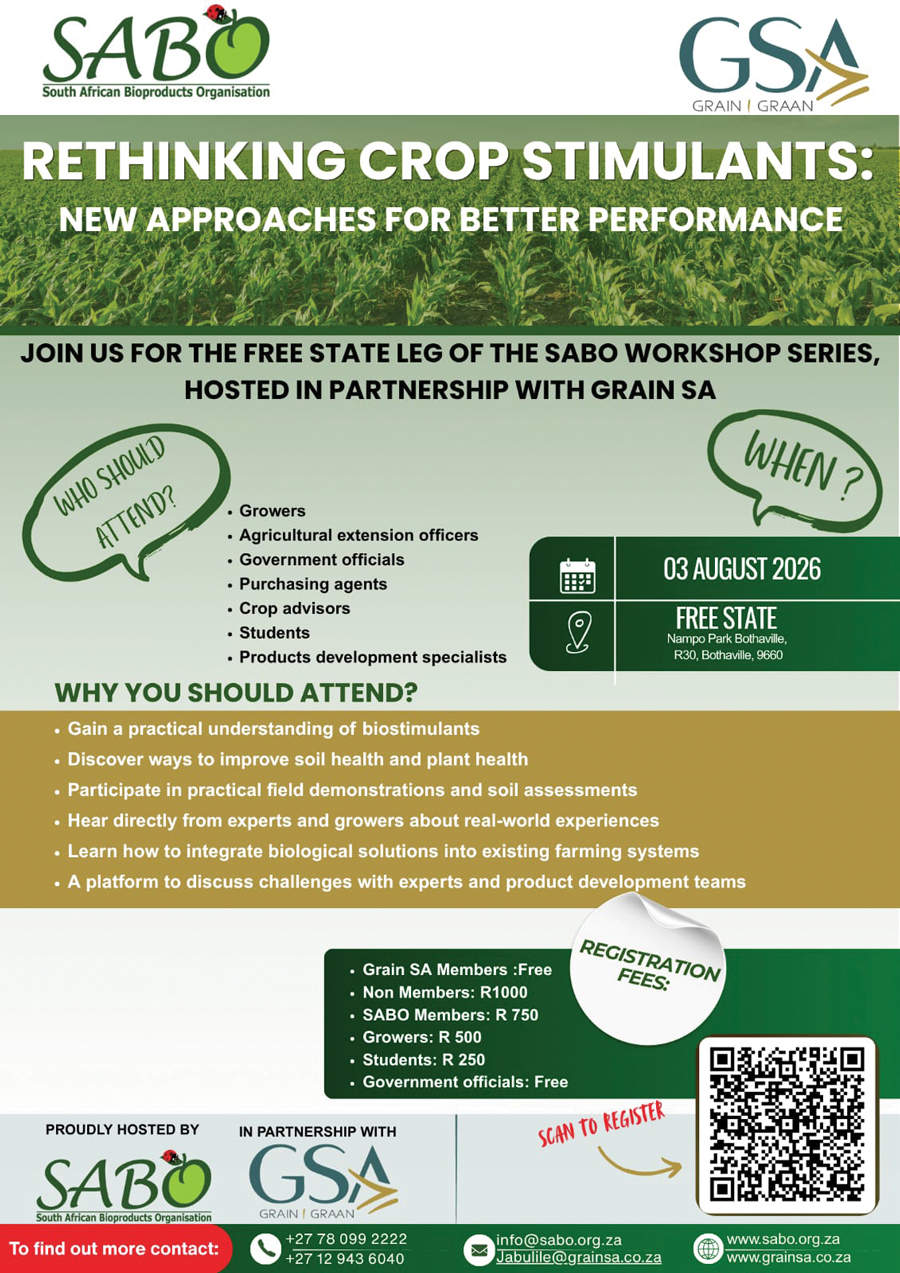
Producers should educate themselves through interactions with knowledgeable advisors or in SABO workshops, allowing identification of solutions that can be adopted over time. The question is no longer whether biologicals have a place in the industry, but whether there is a willingness to adopt them wisely and responsibly. Producers can take hands with nature rather than work against it – and still fulfil their ultimate goal: to provide.