



Cobus van Coller, producer and Grain SA-member

Prof Juan Vorster,
Plant and Soil Science, SAHRI, University of Pretoria
Across South Africa’s grain-producing regions, feathered chloris (Chloris virgata) has quietly established itself as more than just another grass on the veld edge. Known locally as witgras, witpluimchloris or witpluimgras, this species thrives in the very conditions created by modern grain farming: disturbance, minimal tillage, and open soil surfaces.
To manage it effectively, producers need to understand not only where it occurs, but how it behaves and why it is so persistent. There are eight chloris species across South Africa, but only Chloris virgata and Chloris gayana (Rhodesgras, rooiklossiegras or Rhodesian blue grass) are considered important weed species.
A grass built for opportunity
Feathered chloris is best described as a pioneer: a species designed to move in quickly when conditions allow. It commonly appears on bare or disturbed ground, including fallow lands, lands recently cultivated, road verges, and field margins. Its biology is tightly linked to this opportunistic strategy.
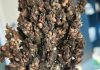
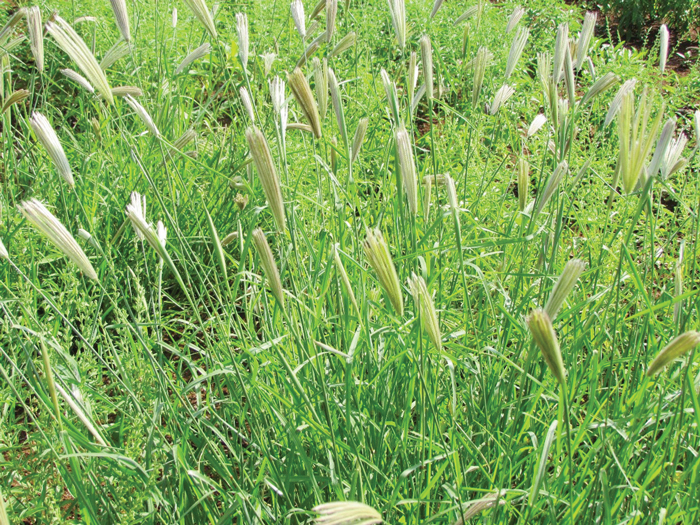
The plant itself is relatively modest in stature, usually between 30 and 75 cm tall, but its distinctive feathery seed heads make it easy to identify. These seed heads, with their finger-like branches radiating from a central point, are not just visually striking; they are highly efficient reproductive structures. Each plant can produce thousands of seeds under favourable conditions, ensuring rapid population build-up once it gets a foothold. A mature plant can produce 6 000 seeds, and this can be done without cross-pollination, meaning that a small population can grow and spread.
Equally important is the speed at which it completes its lifecycle. Feathered chloris can move from emergence to seed production in as little as six weeks, especially under moisture stress. This means that even late-emerging plants, or those growing in suboptimal conditions, still contribute to the seed bank. For producers, this short window between emergence and reproduction leaves little margin for delayed control.
Germination behaviour further adds to its resilience. Seeds tend to germinate from the soil surface or very shallow depths, often responding to relatively small rainfall events (seeds will emerge after 10 mm of rain). This allows feathered chloris to establish before many crops or competing weeds, particularly in conservation agriculture (CA) systems where soil disturbance is minimal. The majority of field emergence takes place from seed in the zero to 2-cm soil layer. It is reduced to less than 20% emergence below 5 cm.
Wide distribution and adaptability
Feathered chloris is not confined to a single region or soil type. It is native to warm regions across the globe and occurs widely throughout Africa, including most of South Africa’s main grain-producing provinces. From the Free State to Limpopo and into the Western Cape, it is already present and often locally abundant.
Its environmental adaptability is one of its defining characteristics. It grows in sandy and clay soils – even in relatively dry conditions – and is commonly found in disturbed habitats ranging from cultivated land to seasonal pans. This flexibility means that very few grain-producing environments are naturally resistant to invasion.
In practical terms, this wide distribution ensures that feathered chloris is rarely an isolated problem. Seeds can be moved by wind, machinery, or livestock, allowing infestations to spread rapidly across farms and between regions.
Why feathered chloris thrives in modern agriculture
Many of the practices that improve soil health and sustainability, such as reduced tillage and residue retention, also favour feathered chloris. Because its seeds germinate best near the soil surface, undisturbed soils provide ideal conditions for establishment.
Similarly, the species is well adapted to exploit gaps in crop competition. Situations that leave soil exposed, poor crop establishment, drought stress, or delays in planting all create an opportunity for chloris to emerge and dominate. Once established, it competes aggressively for water, nutrients, and light, reducing yields and crop uniformity.
A further complication is the increasing difficulty of chemical control. In several regions globally, populations have shown tolerance or resistance to commonly used herbicides such as glyphosate. While this challenge varies locally, it reinforces the need to avoid reliance on a single control method.
Managing feathered chloris: a systems approach
Effective control of feathered chloris depends less on any single intervention and more on the consistency of management over time. The biology of the weed makes one principle especially clear: preventing seed production is critical. Because each plant can contribute significantly to the soil seed bank, even a small number of survivors can sustain future infestations.
Timing is therefore essential. Control measures must be applied early, when plants are still at the seedling or early tillering stage. Once plants begin to mature, they become harder to control and more likely to survive herbicide applications.
Chemical control remains an important tool, but it needs to be used strategically. Residual herbicides applied before or at planting can reduce early establishment, while post-emergence treatments are most effective when applied promptly. In many cases, a ‘double knock’ approach, using two herbicides with different modes of action in sequence, provides more reliable control than single applications.
However, herbicides alone are rarely sufficient. Cultural practices that enhance crop competition play a major role in suppressing feathered chloris. Higher seeding rates, narrower row spacing, and vigorous cultivars can reduce the weed’s ability to establish and produce seed.
Where feasible, occasional strategic tillage can also be useful, particularly to bury seed deeper than its preferred germination zone. Even so, this must be balanced against soil conservation goals.
Chemical management of feathered chloris in grain systems
Chemical control remains a critical component in the management of feathered chloris, particularly in grain systems where rapid establishment and multiple germination flushes make non-chemical options alone insufficient. However, recent research highlights both the opportunities and the limitations of herbicide-based control, especially in the context of herbicide resistance and plant growth stage.
A study by Chauhan et al. (2021) provides valuable insight into effective herbicide strategies, particularly for glyphosate-resistant populations, which can specifically be problematic in CA systems.
A clear finding from this work is that the timing of application is as important as herbicide choice. When applied to relatively young plants (eight- to ten-leaf stage), several post-emergence herbicides delivered very high levels of control. For example, the ACCase inhibitors haloxyfop and clethodim achieved between 96 and 100% mortality, either alone or in sequence with other herbicides. These active ingredients are widely used and registered for grass control in South African cropping systems, particularly in broadleaf crops, making them practical options for local producers.
The research also reinforces the value of sequential (double-knock) strategies. Combinations such as haloxyfop followed by paraquat significantly improved control consistency, particularly in more advanced growth stages. Paraquat remains registered as a contact herbicide in South Africa, although its use is increasingly regulated, requiring strict adherence to label and safety requirements. This type of programme is especially important in fallow situations where large plants are often present due to staggered emergence.
As plants grow larger (24- to 50-leaf stage), control becomes notably more difficult. While haloxyfop and clethodim still provided high levels of mortality, glufosinate (which is now deregistered in South Africa) alone was less reliable and primarily reduced biomass and seed production rather than achieving complete mortality. In such cases, mixtures such as isoxaflutole plus paraquat improved control compared to single products. However, it is important to note that isoxaflutole is registered in South Africa mainly for maize systems, and its use must always align with crop-specific label recommendations.
From a pre-emergence perspective, complementary research shows that residual herbicides can play a crucial role in preventing establishment. Active ingredients such as S metolachlor, pendimethalin, and trifluralin have demonstrated strong suppression of Chloris virgata emergence, often exceeding 85 to 90% control in trials. These herbicides are well established and registered in South African grain crops, particularly in maize and some broadleaf rotations, and form an important foundation for early-season control. For example, S metolachlor is widely registered locally for grass weed control in crops such as maize and sorghum.
Persistence pays
One encouraging aspect of managing feathered chloris is that its seed bank responds to sustained pressure. Research suggests that maintaining near-complete control over two or more seasons can significantly reduce the number of viable seeds in the soil.
This highlights an important mindset shift: success is not measured by a single season’s control, but by the gradual depletion of the seed bank over time. Consistency, rather than intensity, is the key.
A weed that rewards attention to detail
Feathered chloris is unlikely to disappear from South African grain systems. Its adaptability, rapid lifecycle, and ability to exploit disturbed soils ensure that it will remain a feature of modern agriculture. Yet it is not an uncontrollable weed.
Producers who understand its biology, its preference for bare ground, its rapid seed production, and its sensitivity to early intervention are far better positioned to manage it effectively. By combining timely chemical control with strong crop competition and a long-term focus on reducing the seed bank, feathered chloris can be kept in check.
In the end, it is a weed that rewards attention to detail: not dramatic interventions, but consistent, well-timed actions that deny it the opportunity to complete its lifecycle.
Reference
Chauhan BS, Congreve M & Mahajan G. 2021. Management options for large plants of glyphosate-resistant feather fingergrass (Chloris virgata) in Australian fallow conditions. PLOS One, 16(12): e0261788.