


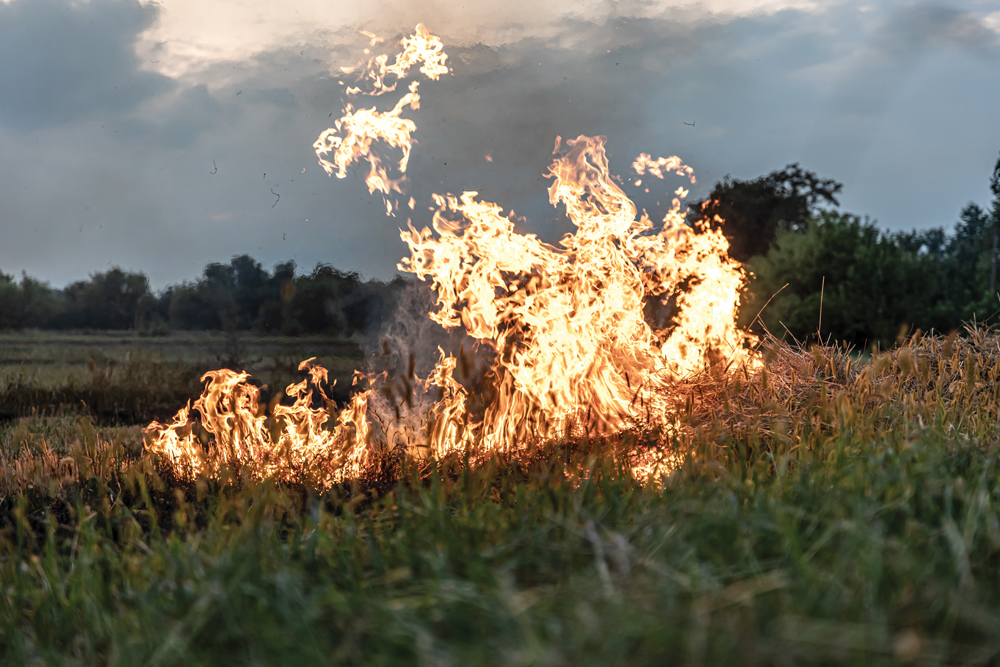
A wildfire – or commonly known as a veld fire – can be extremely difficult to combat and filled with challenges, dangers, and threats which need to be overcome. Firstly, one needs to understand that a number of people will be interested in protecting their property as their main objective for being there in the first place – and they think with their hearts not their heads. This could result in decisions being made in the interest of their property and not necessarily taking the bigger picture of the fire threat into account.
Unfortunately, many producers have been fighting fires for years and want to continue as always, leading to a resistance to change and people pulling in different directions.
Before planning starts, one should take a step back and review the conditions resulting from the past summer’s rainfall. The high volumes of rain were not all run-off water. It included a huge amount of soaking water which has not only saturated the ground but caused the water tables to be at a high surface level, keeping the roots and surface growth moist and green.
These factors have a high impact on planning and threats for the later part of the winter fire season:
-
- The ground in many areas is too wet to get implements in to cut or grade firebreaks and remove fire loads, which will have an impact on when structured burning can take place to remove dry thatch or create burn barriers in risk areas.
- This will compound the risk later in the season when the vegetation is dry enough to burn, but when a fire ban is implemented due to the inherent risks of winter.
- As August approaches, the cross-over phenomenon will pop its head out with temperatures approaching 30 °C, wind speeds approaching 30 km/h, and humidity at less than 30%.
- With this in mind wildfires will have different risks to contend with, and one will need to plan accordingly:
- Smoke will be dense and will hamper fire and safety-related elements.
- Smoke may in many circumstances contain heated steam from the damp vegetation.
- Surface areas may still be damp and soggy which may result in vehicles getting stuck.
- Lack of proper fire roads and firebreaks make firefighting procedures difficult and even more dangerous than normal.
- Thick dense smoke may be a serious threat to other road users and the safety of firefighters and vehicles.
- Previous low-water farm bridges may have washed away, restricting access routes.
- Farm roads may have suffered erosion, making roads inaccessible to some vehicles.
Before responding to a fire, take the time to consider all the points of effective planning and communicate them to all the active members of the community.
Cutting for firebreaks
- If to be burnt, keep enough length to assist the burning process.
- Remove all cut grass to reduce the potential of airborne fire spread from loose thatch carried in heat thermals.
- Try to cut long grass as soon as possible to allow the frost to dry out the base structure. Long grass protects the base from the frost, resulting in a late drying of the base growth which prevents the potential to burn early.
Pre-season burning plan
- This may need to be adjusted to accommodate the late winter.
- Identify normal hot spots for fires and try taking care of them as early as possible.
Training of management
- Involve the local fire department in planning as well as the provincial traffic authority.
- Send notifications of the burning out on all community groups to warn road users of the hazards.
- Place fire marshals at both ends of the fire line to warn road users and, if required, close the road during extra dangerous situations.
- Ensure all personnel at road points are clearly visible.
Training of staff
- Give crews proper training, paying attention to specific tasks, such as the following:
- Lighting crews on how to light based on wind direction, focusing on a staggered stair lighting method.
- Fence line protection crews with wet breaks.
- Road crews for fire jumps and wind changes.
- Mop-up crews to ensure the fire line is well extinguished and protected.
Who is required?
- Primary teams
- Mop-up teams
- Refreshment teams for crew nutrition
- Water and fuel support crews
- First aid teams
- Communication and co-ordination teams
What fire equipment is required?
- LDV with fire fighters
- LDV and tractors with trailers should be restricted depending on the geography of the area as they do not have the ability to turn anywhere putting the crew and vehicle at risk
- Knapsack water tanks
- Bush beaters
- Rakes
- Fire lighting equipment
- Support water trailers or tankers
- Blowers
- Chain saws
- VRP (vehicle assembly point)
This is the main assembly and control point: from here one can control which vehicle or crew is entering where and attending to which area of the fire with contact references. This will help with better control of resources and numbers of attendance. At the VRP one also has the ability to set up the following support, bearing in mind that the point may need to move with the fire and that there may be more than one VRP established to manage the situation. However, there will always only be one incident commander.
- Water filling points
- First aid points
- Refreshment points
- Area maps
- Access route and gates
- Communication means
- IC (incident commander)
- Additional resources
- Relief teams
There are various conditions which can contribute to making the operation difficult and hazardous; each one needs to be evaluated on the day, before deploying members into the fire ground:
- Temperature
- Wind direction and speed
- Time of wind change direction
- Type of vegetation burning
- Location of natural firebreaks
- Dwellings and structures in danger
- Livestock in danger
- Game in danger
- Access and egress routes
- Safety of crews
Decisions will need to be made as to where one will start firefighting and where controlled back burning will possibly need to take place. No two fires are ever the same and it will require a collective decision with landowners and the IC as to the approach which is best for the fire on hand. With this in mind, the following will need to be controlled and managed:
- There should be an IC and an assistant when the fire is spread over a wide area involving various communities or sectors or depending on the area.
- Identify the direction of burn and the risks currently in its path.
- Identify structures to be protected.
- Are there grounds to call in Working on Fire (WOF) and air support?
- Are neighbouring Fire Protection Associations (FPAs) required?
- Points of access may be more than one, which will result in additional VRPs.
- Determine what resources are required in the various areas as some may not be accessible to vehicles. The deployment of equipment may need to change based on the type of vegetation and landscape as the fire progresses.
- Contact persons entering the fire from each point with a contact number for an alternative person on the vehicle and if possible, a radio call sign. In many instances the cellular network is poor between the mountains, rendering cell phones of no use, while messages can still be relayed with radios.
- The number of members entering must correspond with the members exiting to ensure no member has been lost or left injured and unattended.
- Determine what means of communication will be used and communicate it to all to help ensure that as many members as possible can be kept informed of developments and changes as the incident progresses.
- Water filling points can be situated at the VRP or as satellite points in the fire ground to reduce the turnaround time of vehicles at critical firefighting points.
- Refreshment points for crews are critical with special attention to hydration. These points can be set up at each VRP and satellite water point where crews can hydrate while the vehicle is refuelling and topping up water. While hydration is a topic on its own, one must remember a firefighter will require up to 950 ml/hour. Try and secure drinks which will replace the lost electrolytes, potassium, and salts.
- First aid points can be associated with the VRP and filling points. Make sure that the first aid kit has the basics but pay extra attention to handle burns and eye injuries. In the plan, consult with an ambulance company to be available to assist at the VRP, as many of the injuries sustained in a fire environment will require the intervention of intermediate or advanced life support paramedics. Remember that burns are one of the most horrific injuries, requiring the urgent intervention of trained medical staff.
- Relief crews need to be planned early when it has been identified that the fire may be a prolonged event. However, if the incident turns favourably, mop-up and flare-up crews must be on site for at least twenty-four hours after the last flame has been extinguished.
- The tedious operation of flare-up prevention can often take more time than the actual fire and these crews have a very specific task on the fire line.
- No vehicle should ever be permitted to enter the fire ground without a minimum amount of water or firefighting equipment nor if they have no active function to perform.
- The operator of a firefighting unit should lift the pick-up tube 10 cm from the base of the tank. This will ensure that they will stop firefighting and still have sufficient water to allow the operator of a vehicle to exit the fire ground safely and have at least 75 litres of emergency water to protect himself and his crew or help someone in distress.
- Vehicles should always work in pairs and not leave the roads into unknown territory where they may become stuck or trapped, especially considering the high water table which currently exists.
- To increase the performance of the water and help reduce the reigniting factor, it is advised to add a water additive. This reduces the evaporation factor and seals off the oxygen – two key factors for effective firefighting.
- Never try to be a hero – think before you act.
Taking these points into consideration will provide the opportunity to analyse the activities of the previous incident and allow for planning to resolve identified problems and set plans and processes for the next activity.
A SWOT analysis (strengths, weaknesses, opportunities, and threats) allows for creative thinking. It is always easy to criticise, but to come up with constructive plans and solutions is a challenge.
Each one of these SWOT aspects can be broken down to the various fields to make the process area specific:
- Preplanning
- Raising the alarm
- Response
- Communication
- Access control
- VRP management
- Additional resources
- Firefighting activities
- Drone activities and information
- Weather station information
- Local authority support
- Available equipment
- Relief crews
- Mopping up
- Medical incidents and damages