



Karen Truter, project lead: New Business Development, Winfield United South Africa, Department of Agronomy, Stellenbosch University

Prof Pieter Swanepoel, Department of Agronomy, Stellenbosch University

Henja Glas, data science, BFAP

Marion Delport, manager: Data Science and Systems Integration, BFAP; research fellow: Agricultural Economics, Stellenbosch University

Prof Ferdi Meyer, managing director, BFAP, Department of Agricultural Economics, Stellenbosch University
Wheat producers in the Western Cape are farming under increasingly complex conditions. Input costs continue to rise, rainfall is becoming more variable, and fields are rarely uniform. Yet many management decisions, particularly seeding and fertiliser rates, are still applied evenly across fields.
This raises an important question: How well do uniform management practices really perform in a landscape defined by variability?
In the 2023 and 2024 production seasons, on-farm wheat trials were conducted in the Swartland and Southern Cape to better understand how wheat yield responds to changes in seeding and fertiliser rates in commercial production conditions, and how these responses are influenced by underlying soil properties. The research forms part of the Data-Intensive Farm Management (DIFM) project, an international initiative introduced in South Africa by the Bureau for Food and Agricultural Policy (BFAP) in 2019. The project now forms part of the SU BFAP Chair in Precision Agriculture, housed within the Department of Agronomy at Stellenbosch University. The DIFM project focuses on generating practical, field-scale insights through precision experimentation.
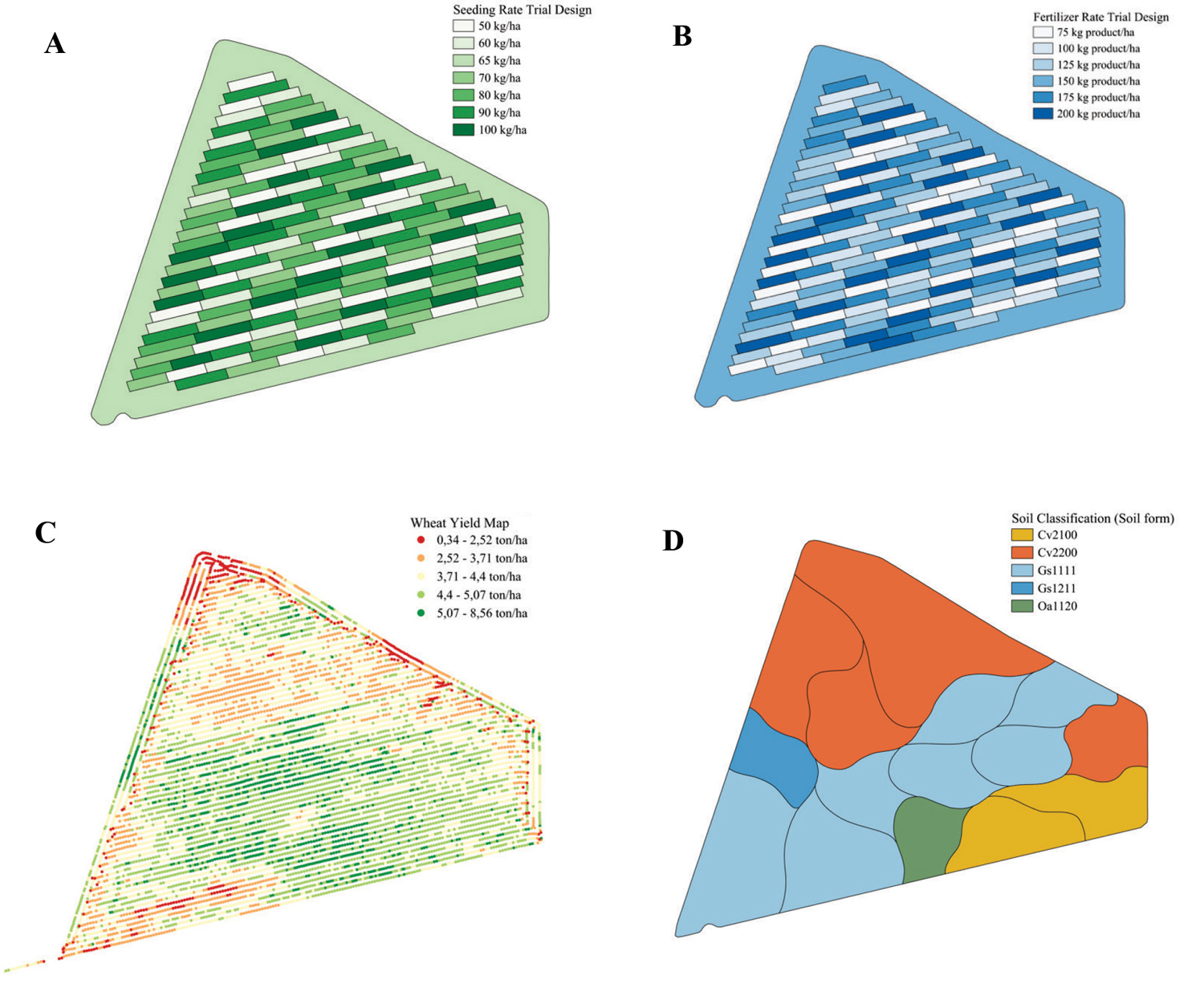
Trials were planted near the towns of Moorreesburg (four trials) and Hermon (one trial) in the Swartland region and Napier (one trial) in the Southern Cape region. Trials are designed to variably apply seed and fertiliser rates, completely randomised and not based on any background information (Figure 1A and B). With a standard algorithm these rates are then linked to raw-yield point data (Figure 1C) and soil physical data (Figure 1D) to allow for further data processing and analysis.
From these trials, our findings point to an important conclusion: Management inputs strongly influence yield, but their effectiveness is constrained by the soil’s physical capacity to support crop growth. In other words, good management cannot fully compensate for limiting soil conditions.
Working with variability, not averages
One of the defining characteristics of the Western Cape’s grain production regions is spatial variability. Within a single field, soils can differ substantially in depth, texture, structure, and water-holding capacity. These differences are often subtle and not necessarily visible from the surface, yet they play a decisive role in how crops respond to rainfall and inputs.
Uniform management assumes that all parts of the field respond similarly to seed and fertiliser. In practice, this assumption rarely holds true. Some areas respond strongly to additional inputs, while others show little response regardless of how much is applied. This mismatch can result in wasted inputs in some areas and unrealised yield potential in others.
The DIFM trials were designed to try to put this reality into perspective. Instead of comparing treatments between fields, the trials evaluated responses within fields, using producers’ standard rates, own equipment, and management systems.
This approach allowed yield responses to be analysed across thousands of data points per field, reflecting real-world complexity rather than experimental simplification.
Seeding rate responses
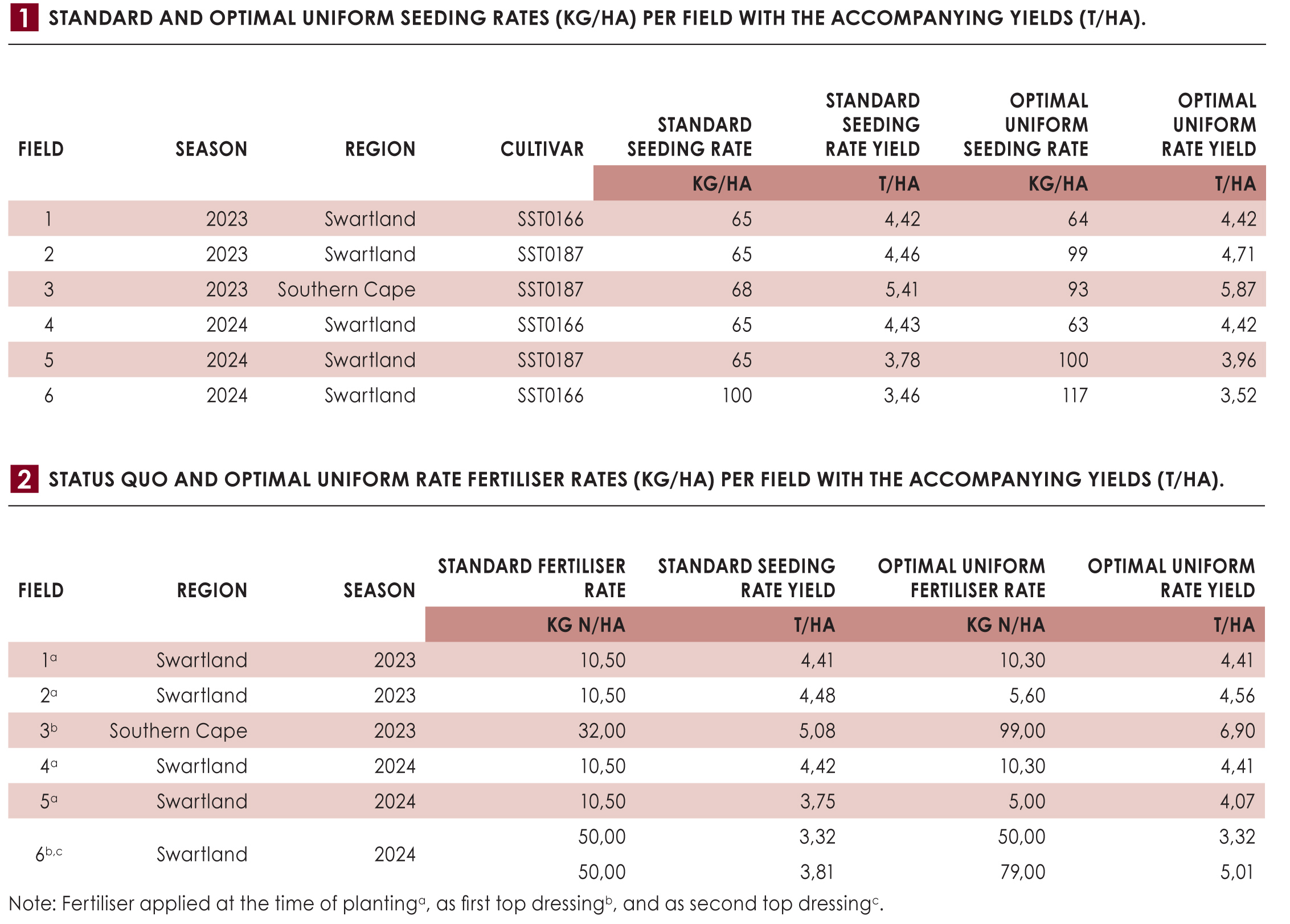
Across the six fields included in the trials, responses to seeding rate varied considerably. In some cases, current producer practices were already close to the economically optimal rate (Table 1).
Little to no yield improvement was observed with slight changes in these rates. In other fields, increasing the seeding rate led to meaningful yield gains. This was particularly evident in the Southern Cape field, where higher seeding rates translated into better canopy establishment and improved yield performance.
Although this is based on only two seasons of data, what became clear is that the same cultivar can respond very differently depending on soil conditions and seasonal context. This was the case with cultivar SST0166 (fields 1 and 4) compared to SST0187 (fields 2 and 5) – which are all fields on the same farm.
In both seasons SST0166 showed that seeding rates for the highest economic yield was around 65 kg/ha, while SST0187 recommended seeding rates of approximately 100 kg/ha to achieve the most economic yield. Fields with slightly deeper soils and higher water-holding capacity were generally more responsive to higher seeding rates, while shallow or constrained soils showed limited benefit.
These findings reinforce an important principle: Seeding rate recommendations should not be treated as fixed rules. Instead, they should be seen as starting points that need to be adjusted according to local soil and climate conditions.
Nitrogen rate response
Fertiliser responses showed greater variability than seeding responses (Table 2). Fields under long-term wheat/medic rotations often achieved stable yields at relatively low nitrogen rates (fields 1, 2, 4 and 5). In some cases, reducing fertiliser inputs had little negative impact on yield, suggesting that soil fertility built up through the crop rotation system and biological nitrogen fixation played a significant role.
In contrast, fields under continuous cash-crop systems were far more responsive to nitrogen (fields 3 and 6). In these systems, additional nitrogen applied at the right time resulted in substantial yield increases, highlighting the importance of synchronising nutrient supply with crop demand through the growing season.
 However, even where nitrogen response was strong, it was closely linked to soil physical conditions. Fields with restricted rooting depth or compacted layers often failed to fully capitalise on increased nitrogen rates, as root systems were unable to access sufficient water and nutrients during critical growth stages. This underscored a key message for fertiliser management: Nutrient availability alone does not drive yield, root access and water availability are equally important.
The seeding and fertiliser rates presented in Tables 1 and 2 represent economically optimal flat rates for the field as a whole. However, the same data can also be used to develop variable-rate recommendations within a field, where seeding and fertiliser inputs are suggested based on how the crop responds in different parts of the field when seeding or fertiliser rates change. These variable-rate recommendations are specific to the individual trial fields but can be obtained from the authors upon request.
What explains yield differences within a field?
To better understand the drivers of yield variability, management data were analysed alongside detailed soil physical measurements. While input rates emerged as the strongest predictors of yield, several soil properties consistently played a secondary but meaningful role.
Among the most influential soil factors were effective rooting depth, the depth and type of limiting layers, and plant-available water in the upper soil profile. These properties directly affect the crop’s ability to explore the soil for water and nutrients, particularly under dryland conditions where rainfall timing is unpredictable.
While soil forms are based on certain characteristics of individual soil horizons, the formal classification itself was less helpful for explaining observed yield patterns than the functional soil properties underlying those classifications.
In the trials included in this dataset, information on whether soils were shallow, compacted, or able to store sufficient water provided better insight into spatial yield variability than the soil form designation alone. One of the strongest and most consistent findings across the trials was the importance of rooting depth. Fields with shallow soils or compacted subsoil layers showed reduced yield potential and weaker responses to increased inputs.
These constraints are particularly problematic in the Western Cape’s Mediterranean climate, where crops rely heavily on stored soil moisture to buffer against dry spells. When rooting depth is limited, crops become more vulnerable to short-term drought stress, even in seasons with reasonable total rainfall. In such situations, increasing seeding or fertiliser rates often delivers disappointing results. The soil simply cannot support the additional demand created by higher plant populations or nutrient availability. This highlights the need to view soil physical constraints not as background characteristics, but as active yield-limiting factors that require great consideration in management decisions.
Precision agriculture beyond variable-rate application
Precision agriculture is often associated with variable-rate technology, and adjusting seeding or fertiliser rates across a field can indeed improve input efficiency and profitability. However, precision agriculture should better be understood as a way of using data to make better management decisions, rather than as a single technology or tool. Yield maps, soil measurements, planting and fertiliser records, and even visual crop performance data all form part of this decision-making process. Variable-rate application is simply one option that may follow once the data are interpreted in context.
These trials showed that variable-rate application is only effective when it is guided by a sound understanding of soil variability. Where soil depth, compaction, or water-holding capacity limits crop growth, changing input rates alone often delivers little benefit. In such cases, variable-rate strategies can become reactive, shifting inputs within the field without addressing why certain areas consistently underperform.
The greatest value from precision agricultural management therefore comes from integration. By combining yield data with soil information and management history, producers can better identify which parts of a field are likely to respond to additional inputs and which areas may require different management approaches altogether. This allows inputs to be placed where they are most likely to pay, while also highlighting zones where soil limitations should be more carefully considered before increasing investment.
Flat-rate optimisation – useful but limited
The trials also evaluated profit-optimising uniform rates for entire fields (Tables 1 and 2). In many cases, the optimal uniform rate differed only marginally from the producer’s standard practice, and yield improvements were modest.
This is not a negative outcome. On the contrary, it suggests that many producers are already managing their inputs efficiently at a whole-field scale. However, it also highlights the limitations of flat-rate optimisation in highly variable fields.
When yield potential varies significantly within a field, a single optimal rate represents a compromise rather than a solution. Some areas will remain under-managed, while others will continue to receive more inputs than they can effectively use.

Towards more resilient wheat systems
The takeaway lesson from this research is that yield is the product of interactions between management, soil, and climate. Inputs such as seed and fertiliser remain powerful tools, but their effectiveness depends on the environment in which they are applied. As climate variability intensifies, these interactions will become even more important. Systems that rely solely on increasing inputs are unlikely to remain profitable or sustainable in the long term.
Instead, sustainable production will depend on the following:
- Matching inputs to realistic yield potential
- Improving soil structure and rooting depth where possible
- If improvement is not possible, adapt input management decisions accordingly to optimise long-run profitability
- Using field data to inform both short-term decisions and long-term management strategies
Precision agriculture, when grounded in a solid understanding of underlaying soil properties, offers a potential pathway to achieve this balance. By recognising where soils can respond to inputs and where they cannot, producers can make more informed decisions that improve profitability while protecting the productive capacity of their land.
Acknowledgements
The SU-BFAP Chair in Precision Agriculture is supported by the Sasol Agricultural Trust, the Protein Research Foundation, John Deere, and Grain SA.
More information on these DIFM trials is available per request from trials@bfap.co.za.