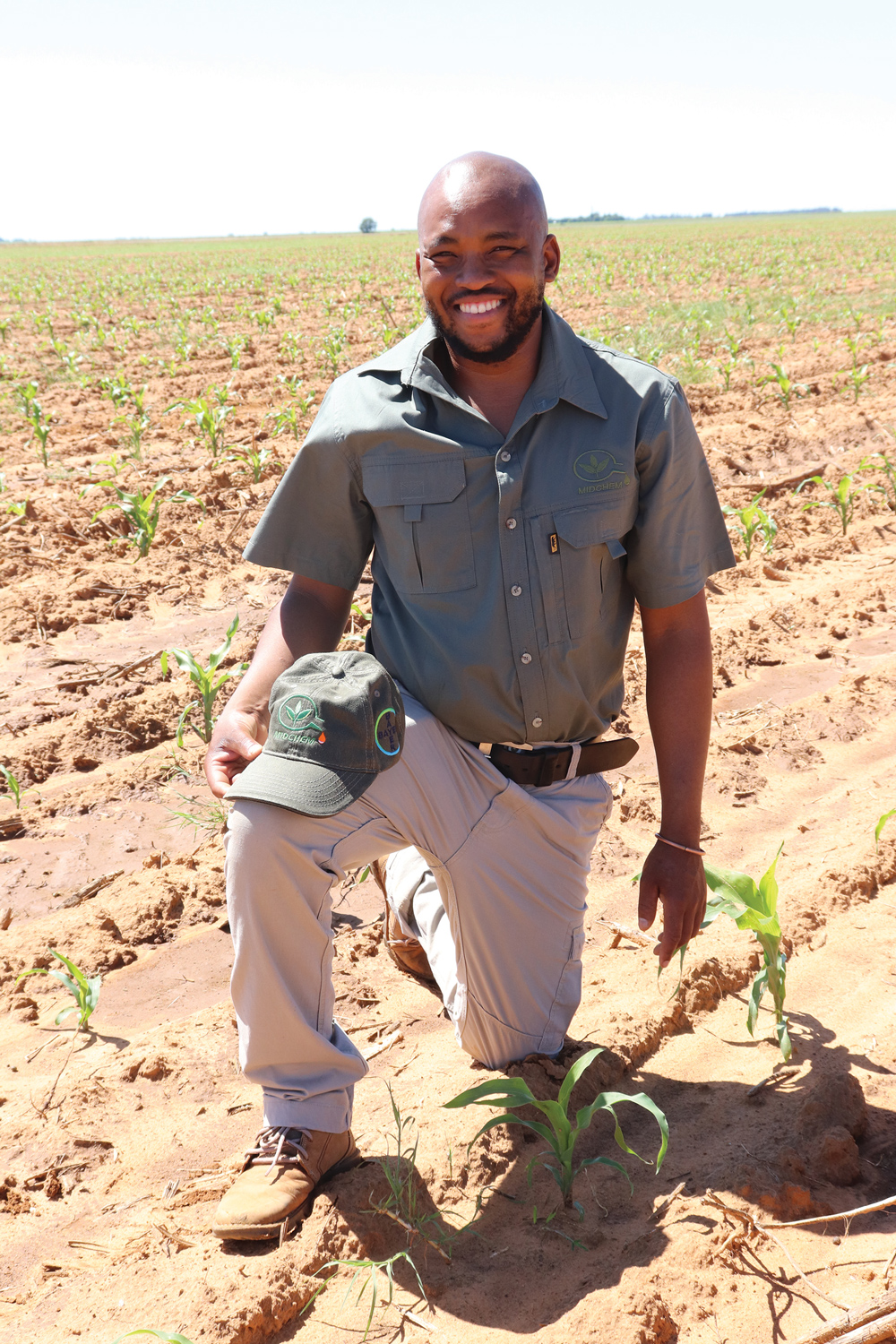


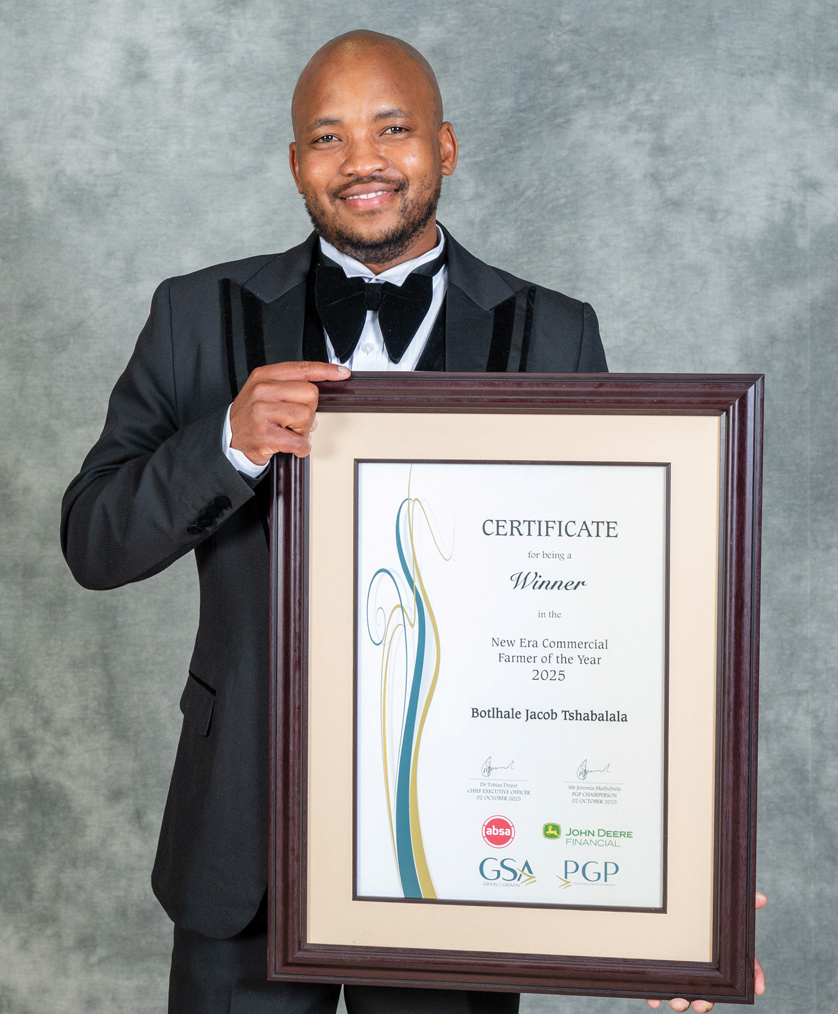
The 2025 Grain SA/Absa/John Deere Financial New Era Commercial Farmer of the Year, Botlhale Jacob Tshabalala (36), was even more motivated to become a successful farmer after being nominated as a finalist in the 2023 competition. Winning means that his dream of one day leaving a legacy for his children is becoming a reality.
This passionate young farmer is determined to grow his farming operation and – despite having to battle several challenges on communal land – has never thought of giving up. ‘As farmers we must adapt and have resilience and faith.’
Important practices to succeed
He produces maize and sunflower on communal land of the Driehoek Village Trust – where his father also farmed. Tshabalala started planting a mere 15 ha in 2013 and this season he planted 200 ha in total – 100 ha maize and 100 ha sunflower. Last season he planted sunflower on 185 ha and due to Sclerotinia caused by the excessive rain he harvested only 0,69 t/ha. At the time of the interview, he was feeling positive about this season’s outcome. He knows he has done his part and believes that the results will prove it.
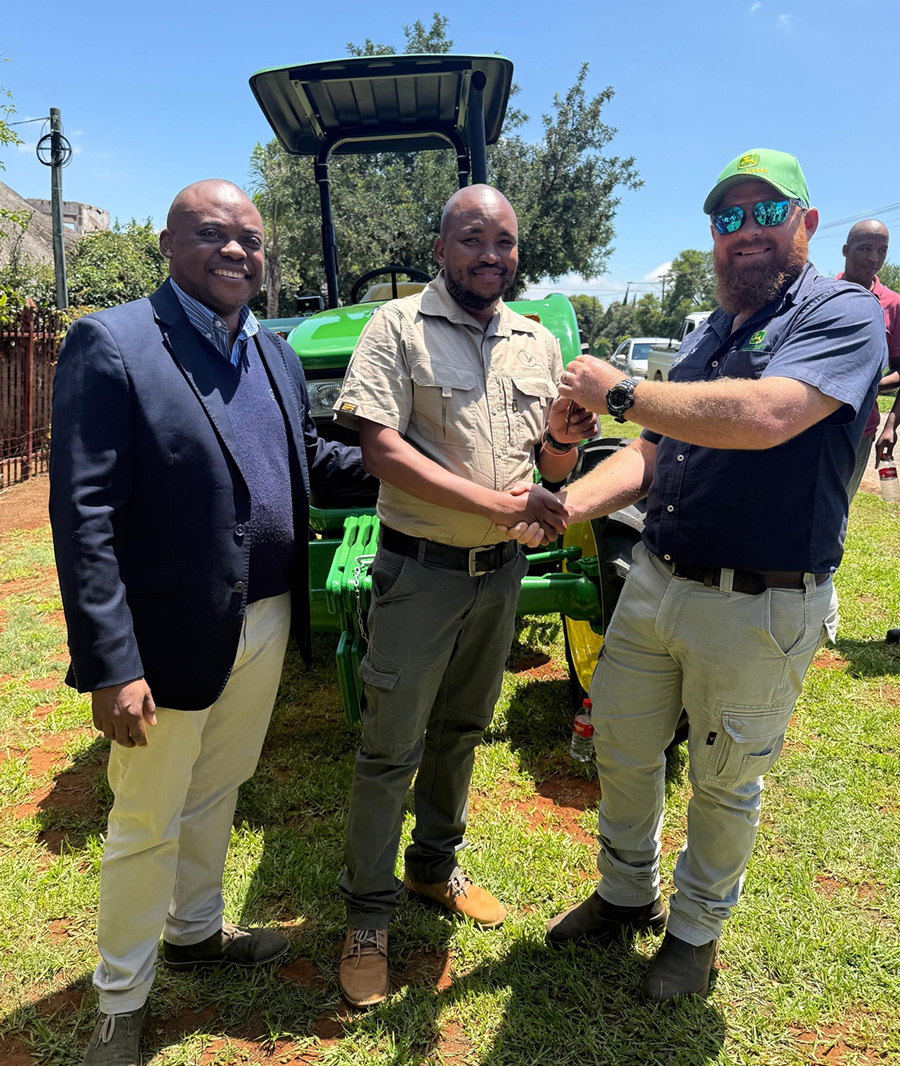
Tshabalala uses his own equipment except for harvesting, where he makes use of contractors. He also leases his equipment to other farmers in the area.
Changing failure into flourishing
Since his first unsuccessful attempt at planting, the stumbling blocks and challenges on his farming path have only motivated him more to become a successful farmer.
Tshabalala did a course in fitting and turning after completing his school career at Hoërskool Lichtenburg in 2009. When his numerous applications for apprenticeships at mines in the area were unsuccessful, his father, David, suggested that he join him on the farm. At that stage David was leasing communal land, where he produced maize and farmed with Brahman cattle.
With very little agricultural knowledge, Tshabalala planted 15 ha of maize during an extremely dry season. As a result, he didn’t even break even on that land. However, his determination to succeed inspired him to increase his agricultural knowledge by reaching out to producers in the area who could mentor him. He then tried his hand at planting again.
Armed with newly attained knowledge, he purchased inputs for his second attempt at planting using the earnings from his job at his father’s small business in town. This time he achieved more success.
Over the years he has discovered that the ‘secret to his success’ rests firmly on three foundational pillars: an unwavering passion for his work, meticulous planning, and a willingness to learn through meaningful interaction with others.
‘A farmer should be self-driven and keen to learn,’ he says. Apart from attending study groups and completing courses presented by the Phahama Grain Phakama (PGP) Farmer Development Programme, he interacts with many people who have knowledge about farming – neighbours, commercial producers, and representatives.
Apart from his father, who sparked his passion for agriculture and opened the door for him to start his farming journey, others who have played a big role in his development are the PGP team and a fellow farmer, the late Vuyani Lolwane. Lolwane, 2018’s Grain SA/Absa/John Deere Financial New Era Commercial Farmer of the Year, introduced him to Grain SA. ‘He told me that I could do much better if I joined the organisation.’
Tshabalala became a member of Grain SA in 2018, after joining the Itsoseng study group in 2016. It is there where his path crossed with Du Toit van der Westhuizen (regional development manager at PGP’s North West office).
Challenges and stumbling blocks
Farming on communal land is one of the biggest challenges he faces. Planting often has to be delayed – even if lands are prepared early and ready for planting. On communal land it is safer to plant at roughly the same time as neighbouring farmers as planting before the others increases the risk of crop theft and heightens the hazard of livestock straying into your fields. This year he managed to plant within the planting window.
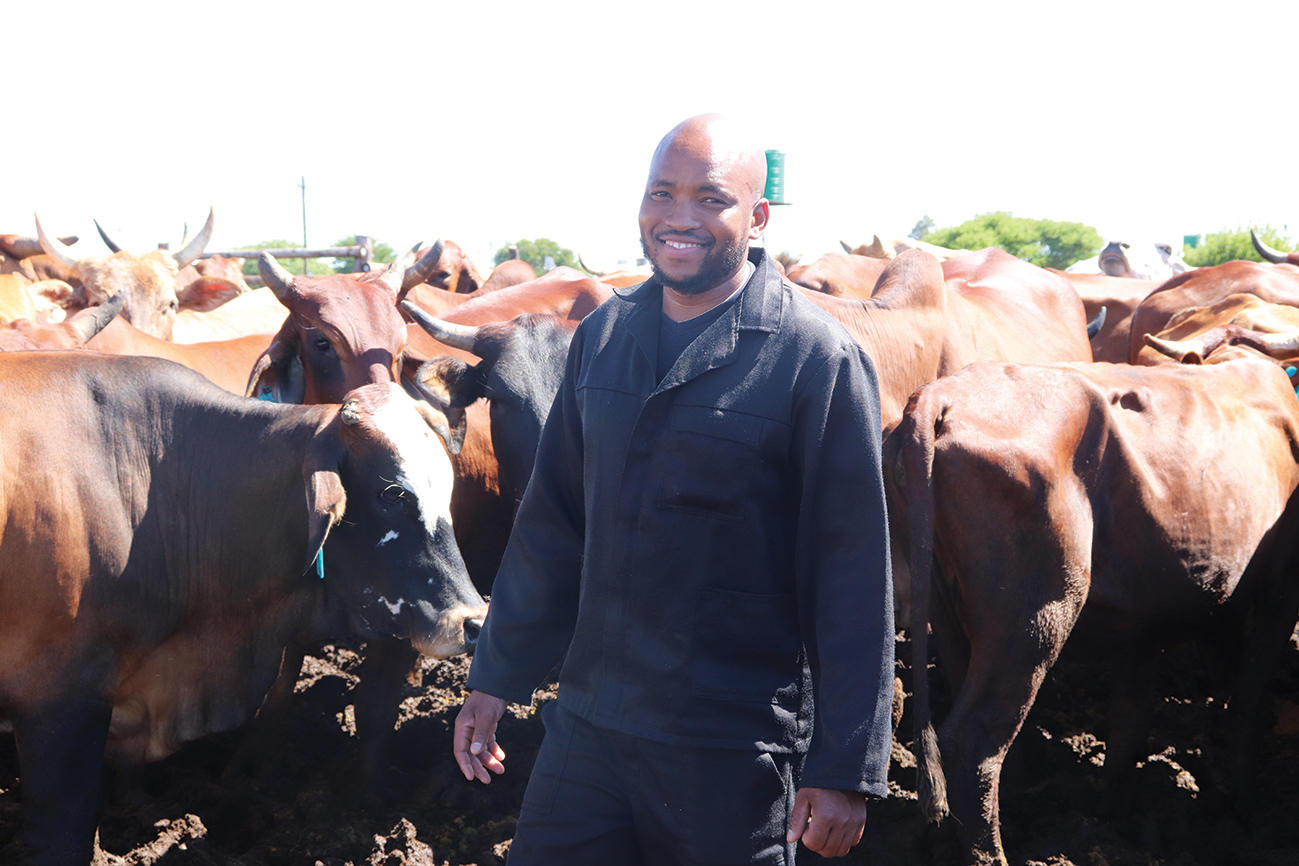
Another significant challenge is that communal land has no fencing, so animal invasion is a major issue. Tshabalala has a fully-fledged commercial Brahman herd and dreams of joining the Brahman SA Society to become a stud breeder. Communal land makes this dream unlikely to realise as he won’t be able to keep his bulls separate to let them rest or apply the selection criteria.
Communal land also limits opportunities to diversify but he sells cattle to support his cash flow.
A challenge that has an impact on all farmers, are climatic conditions. In 2023 the area was subjected to severe drought. The following season Tshabalala was ‘surprised’ by heavy rains later in the season which led to his promising sunflower crop having much lower yields than he had anticipated.
Farming forever
Tshabalala’s farming operation is slowly growing. He tries to increase his planted hectares every season. Although he is keen to expand his farming operation, he believes in doing it in small steps, especially with the unpredictable weather conditions. Through the NWK Developing Farmer Project he learned that one should only work what you can manage – the ‘low hectare, high yield’ method. ‘It is also important to do the right thing at the right time, with the right product. People want to take shortcuts, but if your budget only allows for 50 ha, don’t try and plant 100 ha because you will fail. Rather plant 50 ha and produce excellent quality.’
According to Van der Westhuizen, Tshabalala was born to be a farmer. He is passionate about agriculture and eager to learn from others. He applies the advice he receives and is a hard worker who is actively involved in the daily tasks on the farm.
‘There are numerous challenges when farming commercially on communal land. Botlhale should have his own land; he loves his livestock and needs his own land to advance his farming operation. If he has a farm of his own, he will grow and expand very quickly as he has a great deal of potential,’ says Van der Westhuizen.
His family helps by being involved in his farming operation. His wife, Lerato, supports him whole-heartedly and is his right hand in the office, making sure that all administration is up to date. Although his father’s role on the farm has decreased, he still lends a helping hand tending to the livestock and he is there when his son needs advice. His brother, Thapelo, also helps out on the farm when he is on leave.
Tshabalala hopes that his success can also encourage young people to see farming as an opportunity to make a living. ‘There isn’t work out there, but there is good quality land available, so come and try your hand at farming. People must eat! Be your own boss and feed South Africa!’