

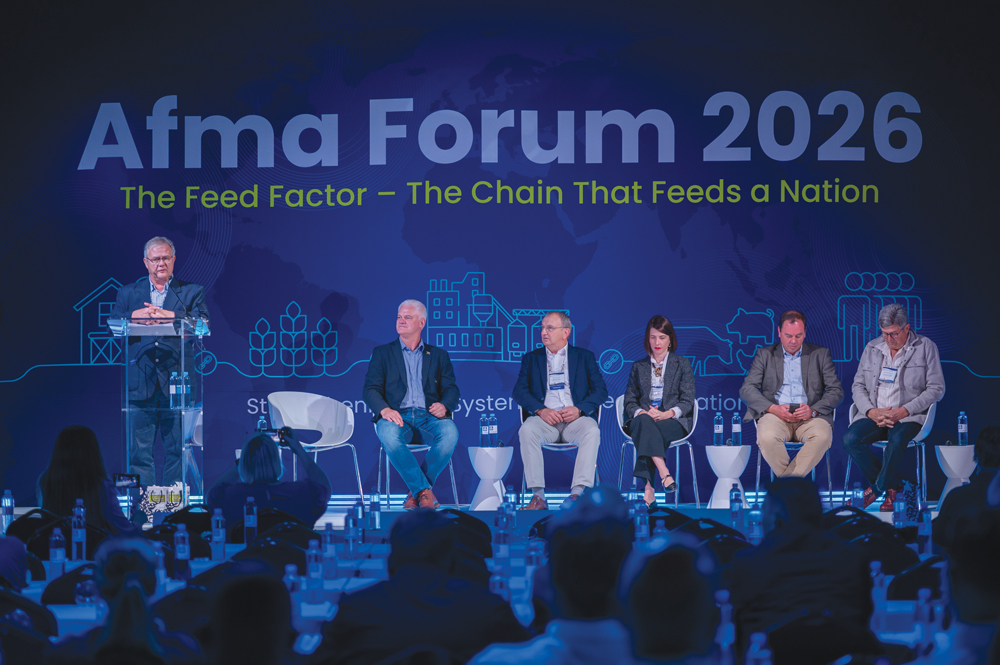
South Africa’s agricultural industries may face different pressures, but many of the challenges they face converge at the points where the value chains meet. Increasingly, what affects one industry has consequences for the others and therefore greater coordination is becoming ever more important. This was one of the key messages to emerge from a panel discussion at the recent AFMA Forum at Sun City, which focused on ‘Market volatility and performance: The collective role of industry associations’.
Facilitated by Prof André Jooste, chairperson of the National Agricultural Marketing Council (NAMC), the panel brought together the CEOs of five leading agricultural industry organisations, including Dr Tobias Doyer of Grain SA, Izaak Breitenbach of the South African Poultry Association (SAPA), Dr Marlene Louw of the South African Pork Producers’ Organisation (SAPPO), Dr Frikkie Maré of the Red Meat Producers’ Organisation (RPO) and Fanie Ferreira of the Milk Producers’ Organisation (MPO). Collectively, the five industries represented on the panel account for 61% of the gross value of agricultural production at primary level and play an integral role in the animal feed value chain.
Common challenges demand a collective response
The panel highlighted common pressures across the agricultural value chain, including unreliable infrastructure, rising input and transport costs, energy and water constraints, regulatory uncertainty, market volatility, and increasingly complex global trading conditions. Adverse weather, geopolitical tensions with their supply-chain disruptions, and the rapid effect it has on production and market stability were also pointed out.
At the same time, animal health, biosecurity, and traceability are becoming more and more important as South Africa seeks to protect its domestic market and expand its export presence. Breitenbach warned that maintaining competitiveness depends on addressing these challenges as they are adding to future cost structures.
Doyer also pointed to the importance of looking beyond the farm gate. For example, better rail infrastructure could reduce grain transport costs, improve the competiti-
veness of grain, and lower the cost of animal feed and ultimately, animal protein production. Addressing such inefficiencies, he argued, is part of the broader challenge of keeping South African agriculture competitive.
Resilience in the face of adversity
According to Jooste, despite the considerable pressures agriculture has faced in recent years, the discussion showed that the different industries have continued to adapt, invest, and look for opportunities to strengthen their competitiveness.
The poultry industry has recorded significant growth since 2019, demonstrating its ability to respond to competitive pressures and recover ground in the face of imported products. The pork industry has continued to operate through a succession of setbacks, including listeriosis, African swine fever and foot and mouth disease (FMD), each placing additional pressure on producers and the wider value chain.
Similarly, the red meat industry has had to navigate low market prices and FMD, while the dairy industry has maintained production despite FMD and escalating input costs. The grain industry, meanwhile, has demonstrated resilience through continued investment in technology, productivity, and efficiency, enabling producers to remain competitive despite the many pressures affecting them.
The dairy industry also faces the challenge of increasing consumption in a relatively small domestic market. Ferreira said South Africa’s per capita dairy consumption remains well below that of many international markets, suggesting that greater domestic consumption could provide an important avenue for growth.
But as Maré pointed out, because many of these challenges cut across the entire agricultural economy, they cannot be addressed in isolation, and collaboration cannot be limited to periods of crisis.
From individual efficiency to value-chain competitiveness
The discussion also highlighted the distinction between individual industry efficiency and agriculture’s overall competitiveness. Producers and industry organisations may be highly efficient within their value chains, but their efforts can be undermined by factors beyond their control and therefore a unified voice for agriculture is essential.
Doyer argued that this is where the next level of collaboration needs to take place. ‘Our key challenge is actually these cross-cutting issues,’ he said. ‘For the grain industry, this extends from access to technology and genetics to regulation, transport, energy, and international trade. South Africa also needs to think more deliberately about how agricultural products could be moved into higher-value markets rather than remaining dependent on commodity exports.’
With grain production facing the prospect of large surpluses, he identified growth in the animal protein market as a major opportunity for the agricultural value chain. The opportunity, however, depends on the ability of the different industries to remain competitive and to work together to unlock markets beyond South Africa.
‘That vision places issues such as traceability, animal health, regulatory compliance, logistics, and infrastructure firmly within a shared value-chain context. It also highlights the potential for greater agro-processing, where grain can be converted into higher-value products that create additional economic activity and employment,’ said Doyer.
Collaboration requires trust
The strongest point of common ground among the panellists was the need for greater cooperation between industry and government, particularly on animal health and biosecurity. FMD, for example, has exposed serious weaknesses in South Africa’s animal-health and traceability systems.
Louw provided a practical example of the benefit of such cooperation. The pork industry’s compartment system for managinganimal-disease risk illustrates the value of an established relationship between industry and government before a crisis occurs. Rather than engaging for the first time when disease strikes, regular interaction creates an understanding that can help both sides respond more quickly when problems arise.
She added that the relationship should not be viewed as industry versus government. ‘We’re all playing for the same team. Existing forums, such as the weekly meetings on FMD, have improved collaboration between industry and government, although there is room for improvement in terms of more structured coordination.’ Jooste also identified the Agricultural Master Plan as a platform for broader collaboration.
Maré similarly stated that disease control required a more coordinated and adequately resourced approach. He said systems should respond before outbreaks became major disruptions. Traceability, provincial accountability, and faster decision making were among the areas he identified as urgently needing attention.
The need for collaboration also extends beyond animal health as pointed out by Breitenbach. ‘Reliable industry information is essential for investment decisions, market planning, and coordination between sectors.’
A common purpose for agriculture
However, the panel did not suggest that all agricultural organisations should abandon their individual mandates or approaches. Instead, Doyer stated, ‘We do not need unity per se, but we need unity of purpose. If we know where we are going, then we can integrate the different ways of getting there.’
According to him, distinction is important in a sector as diverse as agriculture. Grain, poultry, pork, red meat, and dairy each have different production systems, markets, and challenges, while producers within those industries may also have different priorities. Yet they share many of the same underlying requirements, from functioning infrastructure and energy supply to effective regulation, market access, and a reliable animal-health system.
‘For the agricultural sector as a whole, however, the longer-term opportunity lies in creating an environment in which individual industries can grow while strengthening the value chains that connect them,’ said Doyer. For him, the ultimate objective is to turn agricultural competitiveness into broader economic value through collaboration. ‘The only way we’re going to grow the economy and create jobs, wealth, and prosperity is by exporting our products,’ he concluded.
Five-year vision
The discussion ended with a question about what successful collaboration would look like if the industry leaders returned to the same discussion five years from now. Their answers pointed to practical measures of progress, including a stronger public-private partnership, affordable and effective disease control, more competitive grain and animal production, and greater export orientation.
In his closing remarks Jooste said that the individual industries have demonstrated that they can adapt to difficult circumstances. The next challenge is to use that experience collectively, bringing together different industries and their respective strengths to address the problems that none can solve alone.