


Dr Andries le Roux,
SU-BFAP Precision
Agriculture Chair,
Stellenbosch University

Marion Delport,
manager: Data
Science, BFAP; research fellow: Agronomy,
Stellenbosch University

Helga Ottermann,
analyst, BFAP

Henja Glas,
data scientist, BFAP

Dr Karen Truter,
technical marketing specialist: Crop Nutrition, InteliGro
The success of precision agriculture in wheat production should not be measured by yield alone. Although yield remains important, producers ultimately need to know whether a management change improves profitability, uses inputs more efficiently, and supports better decisions across variable field conditions.
Grain SA’s Data-Intensive Farm Management (DIFM) wheat trials were established to test these questions under commercial farming conditions. The project evaluates how wheat responds to different seeding rates, fertiliser rates, and the timing of fertiliser applications within the same field.
The purpose of the project is not necessarily to promote variable-rate technology, but to determine if farm data can be used to improve input decisions and increase profitability under commercial wheat production conditions. This approach shifts the focus from simply applying inputs variably to understanding where variability is agronomically and economically meaningful enough to justify a different management decision on farm level.
What is DIFM?
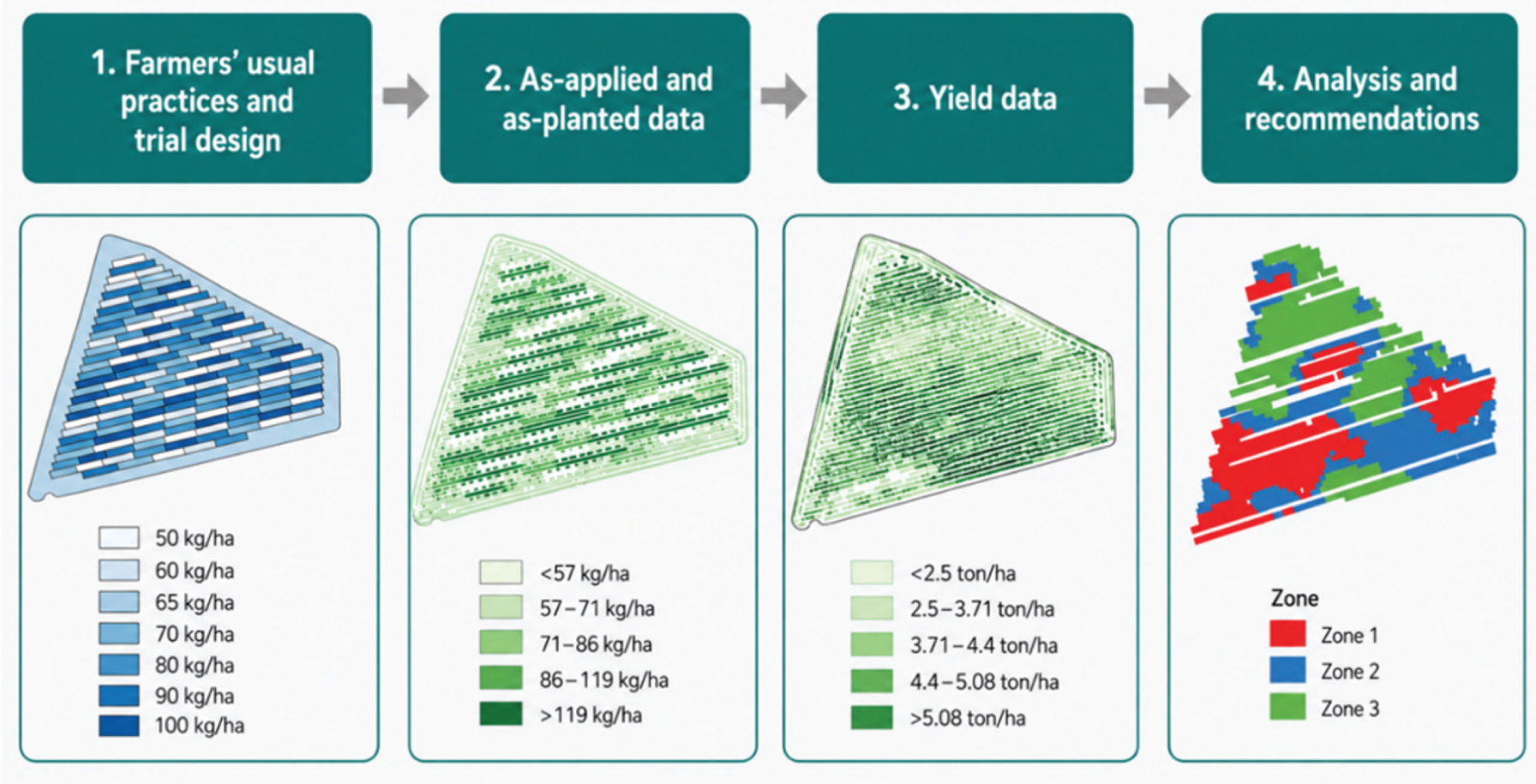
DIFM is an on-farm experimentation approach where different management options are tested directly under commercial farming conditions. Rather than relying solely on small, replicated trial plots, DIFM uses producers’ own GPS-guided and variable rate equipment to apply different input rates across a field. After harvest, yield monitor data are used to compare how the different treatment combinations performed. This allows the project to evaluate not only which rate produced the highest yield, but also where the crop responded differently to a given input rate and whether the response was large enough to justify the change in input cost. In this way, DIFM connects precision agriculture technology with practical agronomic and economic decision making.
What the project is testing
The winter grain DIFM trials focus on improving how producers make input decisions in wheat, canola, and barley. The project tests whether variable-rate management can improve crop performance and profitability compared with conventional uniform management approaches.
In the wheat trials, the focus has been on evaluating how different seeding rates, fertiliser rates, and timing of fertiliser applications influence crop performance in the same field. Rather than treating a field as a uniform production area, the trials test whether different parts of the field respond differently to changes in input rates, reflecting variation in soil properties and yield potential.
The project compares the producer’s current or usual practice with alternative management strategies, including optimised flat rates and variable-rate approaches. The focus is on identifying input rates that maximise economic returns rather than simply maximising yield. This distinction is important because the treatment that produces the highest yield is not necessarily the most profitable once the cost of additional inputs is taken into account.
A key part of the project is therefore to evaluate the response of wheat at both whole-field and management-zone level, providing insight into where spatially differentiated management may offer agronomic or economic advantages over a uniform approach.
Early wheat lessons
The early wheat DIFM trials showed that input response is not only a question of applying more of a given input such as seed or fertiliser. The response depends on the production system, the timing of nitrogen availability, the field’s yield potential, and prevailing climatic conditions. For this reason, the results should not be interpreted as one general recommendation for all wheat fields, but rather as evidence of how field-scale data can support better input decisions under different production conditions.
Three early lessons are important. The first is that rotation history influenced how wheat responded to fertiliser. The second is that the timing of nitrogen applications mattered, especially in cash-crop systems where the crop was more dependent on external sources of nitrogen. Thirdly, the highest yield was not always the most profitable outcome.
Rotation history shapes fertiliser response
Input responses should always be interpreted within the context of the production system. The DIFM trials included two broad systems: a pasture-dominant wheat-medic-medic rotation in the Swartland, and cash-crop-dominant systems located in the Swartland and Southern Cape region, where wheat formed part of canola-wheat-wheat or canola-wheat-barley rotations, depending on the site.
For seeding rate, the differences between the two systems were less clear. Some fields showed a marginal yield and profitability benefit from higher seeding rates, while others were similar to the producer’s usual practice. This suggests that seeding-rate response was more field-specific than system-specific, and was likely influenced by factors such as cultivar, crop establishment, soil constraints, general field conditions, and rainfall.
The larger difference between the two systems was observed in the nitrogen fertiliser response. In the pasture-dominant system, the producer’s usual practice was to apply a pelletised chicken manure product at planting, with no additional nitrogen topdressing later in the season. Despite this relatively low fertiliser-N input, wheat yields were comparable to those achieved in the cash-crop systems.
This response is likely linked to the rotational value of medic pastures. A medic phase can contribute nitrogen to the system through biological nitrogen fixation, while the organic fertiliser source applied at planting may also release nitrogen more gradually during the season. The DIFM results suggested that, in some of these pasture-based fields, the fertiliser-N rate could potentially be reduced without a yield penalty.
The cash-crop systems showed a different trend. In these fields, the producer’s usual nitrogen programme included fertiliser at planting and one or two topdressings during the season. The DIFM results indicated that the usual nitrogen rates were generally lower than the yield-optimising rates. In the Swartland cash-crop field, the results suggested that the topdressed nitrogen rate could have been increased, while in the Southern Cape field the response to a second additional topdress nitrogen was even stronger.
This does not mean that one system is better than the other. Rather, it shows that the same wheat crop can have very different fertiliser-N requirements depending on rotation history and main nitrogen source. In a pasture-dominant system, previous medic pastures may reduce the need for additional fertiliser-N. In a cash-crop-dominant system, where the crop is more reliant on applied fertiliser, nitrogen rate and timing become more important.
Nitrogen timing matters
Differences between the systems were not only related to the total amount of nitrogen applied, but also to when nitrogen became available to the crop. In the pasture-domin-
ant wheat-medic-medic system, nitrogen was supplied through fertiliser applied at planting, together with residual nitrogen from the previous medic phase. This created a more gradual release of nitrogen during the season, which may explain why a once-off fertiliser application at planting was sufficient to support good wheat yields.
The cash-crop systems were more dependent on readily available nitrogen fertiliser applied during the season. In these systems, nitrogen topdressing was important because crop demand continued after establishment and because seasonal rainfall patterns influenced how much nitrogen remained available to the crop.
A good example is the Southern Cape cash-crop trial, planted in 2023. The season received high rainfall, especially later in the growing season, with September and October rainfall well above the long-term monthly average. The high rainfall, after the first topdressing, most likely increased the risk of nitrogen losses or movement of nitrate below the active root zone. Under these conditions, the second topdress application played an important role by supplying nitrogen later in the season, closer to the period when the crop still had a strong demand for nitrogen. This explains why the second topdressing had such a strong influence on yield in the dataset.
A similar principle was observed in the Swartland cash-crop trial planted in 2024, although the seasonal pattern differed. The season had a relatively late and dry start, followed by a heavy rainfall event in July. This rainfall likely supported crop growth and increased yield potential but may also have affected the availability of nitrogen applied earlier in the season. In this case, a second topdressing helped ensure that nitrogen was available when the crop demand increased.
The practical lesson is that nitrogen rate and nitrogen timing should not be viewed separately. A fertiliser programme that works in a pasture-based system may not be sufficient in a cash-crop system. Similarly, a high topdressing programme may not always be necessary where the rotation already contributes nitrogen to the soil.
In dryland wheat production, rainfall distribution strongly affects whether applied nitrogen is available to the crop at the right time. The timing of fertiliser application must therefore be considered together with crop demand, rainfall, nitrogen source, and field yield potential.
The value of the DIFM project is that it allows these timing effects to be tested on large-scale in commercial operations. Instead of only asking how much nitrogen should be applied, the trials help producers ask a more practical question: when does the crop need nitrogen, and does the timing of the application improve yield and profitability under the conditions of that specific season?
Yield is not the same as profit
Another important lesson from the trials was that the highest yield is not always the most profitable outcome. A higher seeding or fertiliser rate may increase yield, but it also increases input cost. The key question is therefore not only whether the crop responded, but whether the additional yield was large enough to cover the additional cost.
For this reason, the results compare the producer’s usual practice with both an opti-
mised flat rate and a variable-rate approach. The optimised flat rate represents one improved rate applied across the whole field, while the variable-rate approach adjusts rates between management zones according to how different parts of the field re-
spond. These zones are not simply high- or low-yielding areas, but areas that have a similar response towards either seed or fertiliser inputs.
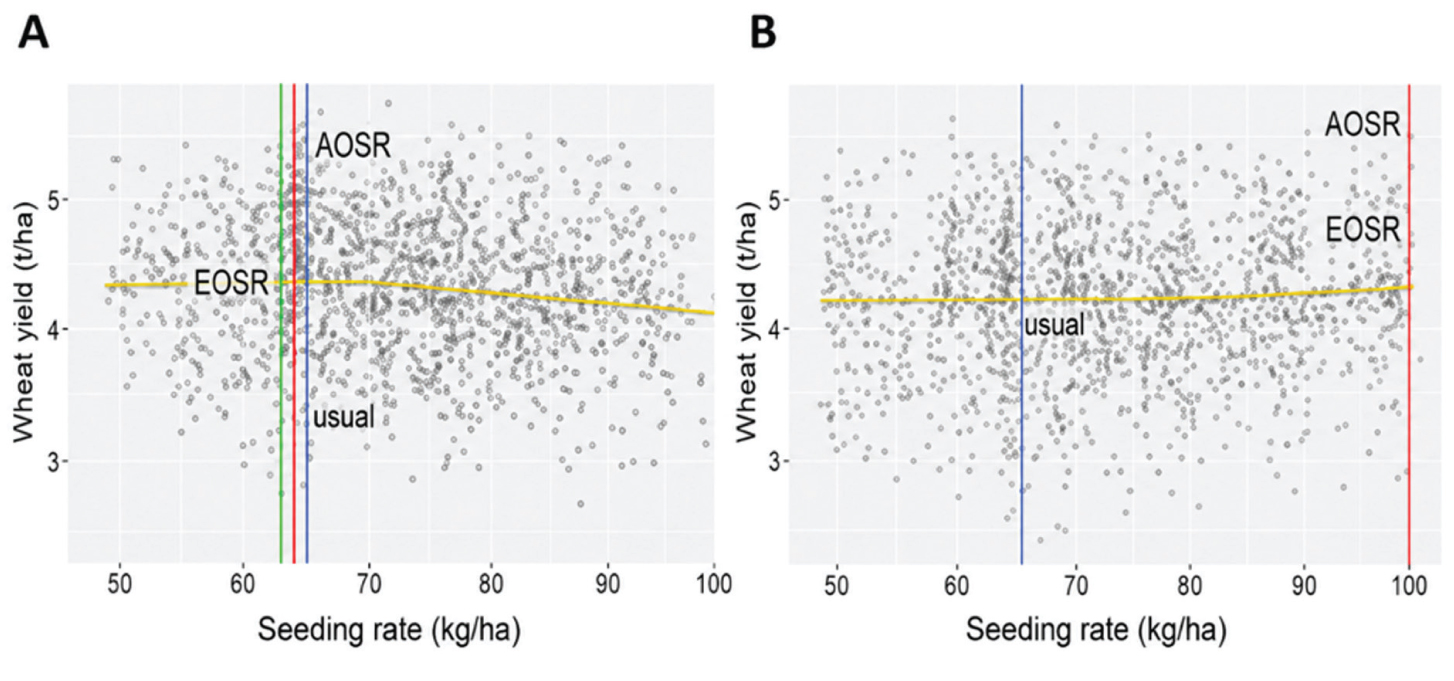
The seeding-rate results showed that slightly higher seeding rates were beneficial in several wheat fields, although the response was not the same everywhere. In some fields, the producer’s usual seeding rate was already close to the optimum, with only a small change in yield or profit. In other fields, a higher seeding rate improved both yield and profitability. Across the trial summaries, optimising the whole-field seeding rate increased profitability by up to approximately 8%, with an average improvement of about 3%. When seeding rates were managed variably between zones, the benefit was larger, increasing profitability by up to approximately 16%, with an average improvement of about 8% across all fields.
Figure 2 illustrates why seeding-rate recommendations should be tested at field level rather than assumed to be the same across farms. In one field, the producer’s usual seeding rate was already close to the optimum, while in another field, a higher seeding rate improved both yield and profitability. In our highly variable systems, such diffe-
rences are expected. The overall trend from the DIFM wheat trials was, however, that optimisation of seeding rates can improve profitability, especially where variable-rate management allows seed to be allocated according to the response potential of different zones within a field.
The fertiliser results provided an even stronger reminder that yield and profit are not always the same. In several fields, optimising the fertiliser programme improved profitability, especially in the cash-crop systems where nitrogen demand was higher and topdressing played a more important role. Across the trial summaries, optimising the whole-field fertiliser rate increased profitability by up to approximately 28%, with an average improvement of about 6%. Variable-rate fertiliser management also showed positive trends in several fields, although the size of the benefit differed between fields and systems.
Figure 3 shows this clearly. In the pasture-based system, the yield response to higher fertiliser-N was limited, suggesting that the existing nitrogen supply from the medic rotation and planting fertiliser was largely sufficient. In contrast, the cash-crop field showed a stronger yield response to additional top-dress nitrogen. However, even where yield increased at higher fertiliser rates, the additional fertiliser cost meant that the highest-yielding rate was not necessarily the most profitable. A cheaper nitrogen source could shift the economic optimum fertiliser rate, because the balance between fertiliser cost and grain income would change.
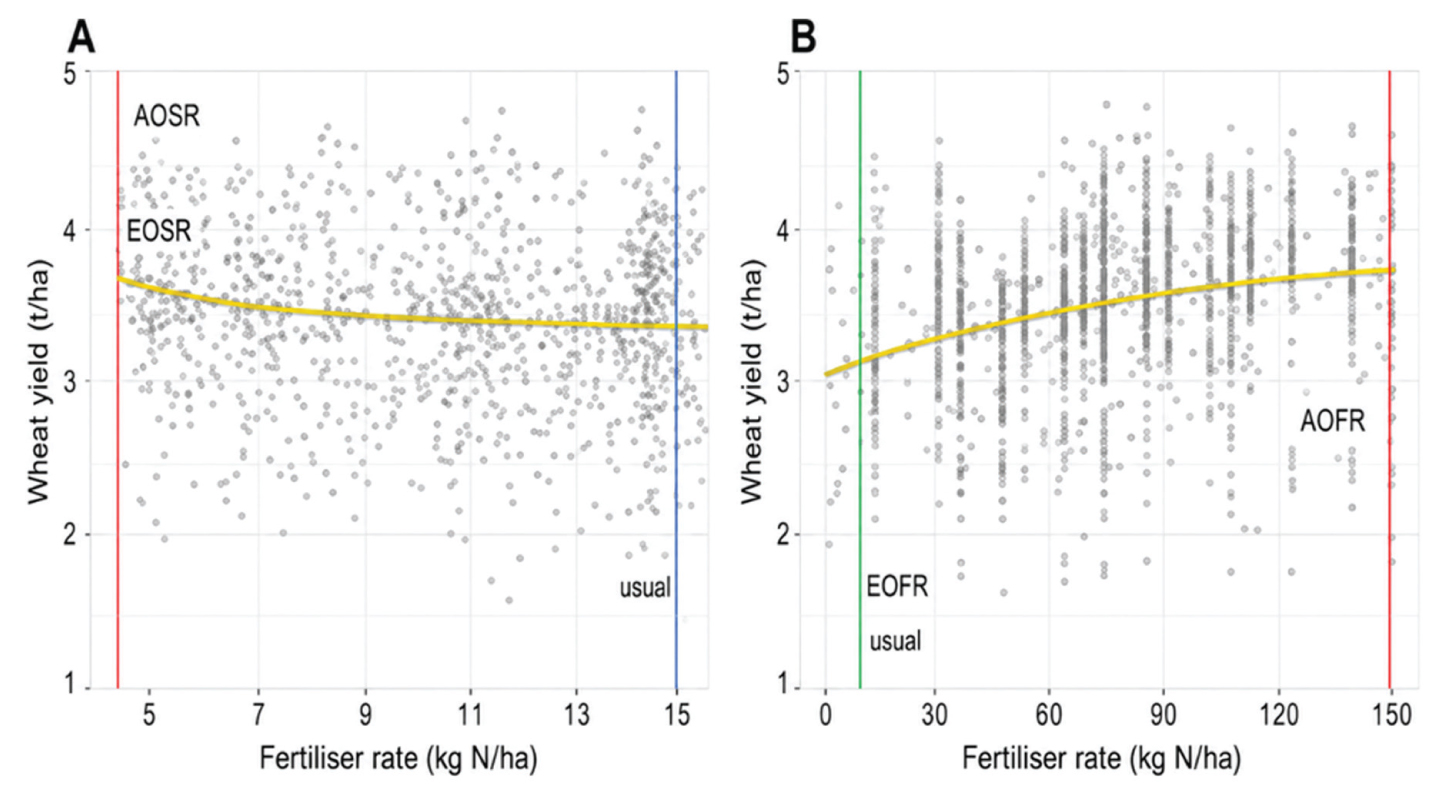
This is the key reason why profitability must be included when evaluating input management decisions and precision agriculture. A yield response curve shows whether the crop responded, but a profitability analysis shows whether the response was worth paying for. In some fields, lower input rates may maintain yield and improve profitability by avoiding unnecessary costs. In other fields, higher input rates may be justified because the yield response is large enough to increase net returns.
Although profitability improvements of 3, 6 or 8% may sound small, they can become financially important at commercial scale. A profit improvement of around R900/ha
can quickly add up over several hundred hectares of wheat. These gains can also help producers evaluate whether investment in variable-rate technology, data services, or improved decision support is justified on their farms. Furthermore, global uncertainty has led to highly volatile input costs; consequently, optimal input rates may vary from one season to the next as prices fluctuate, further affecting the monetary impact.
The DIFM results show that the producer’s usual uniform input rate may sometimes be close to optimal, but in other fields there is income being left on the table. By testing seeding and fertiliser responses directly on commercial farms, DIFM helps identify where current practice is sufficient, where inputs can be reduced, and where higher input rates may be profitable.
Collaborative research
The Grain SA DIFM project is a collaborative research effort between producers, Grain SA, the Bureau for Food and Agricultural Policy (BFAP), the SU-BFAP Chair in Precision Agriculture, and other research and industry partners. The project brings together on-farm knowledge, economic analysis, agronomic understanding, data analysis, and precision agriculture tools to test practical management questions under commercial farming conditions. The BFAP research team plays a central role in trial coordination, data handling, economic analysis, and the interpretation of yield and profitability responses, while the SU-BFAP Chair works with the team to help translate these results into practical decision-support insights for South African grain producers.
This project’s value lies in turning field-scale data into practical recommendations that producers can use. By combining producer experience, commercial field trials, and research support, DIFM helps identify where current input rates are already close to optimal, where inputs can be reduced, and where higher rates may improve returns. Expanding the project across more farms, seasons, and winter grain systems will strengthen the local evidence base and help develop more reliable decision-support guidelines.
Producers interested in participating in future DIFM trials are encouraged to collaborate with the project team, especially where farms have access to GPS-guided machinery, variable-rate planting or fertiliser equipment, yield monitor data, and a willingness to share basic field history and input cost information. Most importantly, participating producers should be interested in testing practical management questions on their own farms and using the results to improve future decision making.
Acknowledgements: The authors acknowledge the financial support of the Department of Science, Technology and Innovation (DSTI), the Technology Innovation Agency (TIA), Grain SA, the Sasol Agricultural Trust, the Protein Research Foundation (PRF), the South African Winter Cereal Industry Association (SAWCIA), and John Deere.
Click on the link to access the full published article by Truter et al. (2026): ‘Evaluating wheat yield response to management inputs and soil physical properties in the Western Cape province of South Africa.’
Producers with GPS-guided equipment, variable-rate capability, yield monitor data, and an interest in testing practical management questions on their own farms are encouraged to register their interest by clicking on the link.