



junior agricultural economist, Grain SA,
cathrine@grainsa.co.za
FUEL IS ONE OF THE LARGEST INPUT COSTS IN GRAIN PRODUCTION, WITH DIESEL PLAYING A CRITICAL ROLE IN LAND PREPARATION, PLANTING, SPRAYING, HARVESTING, IRRIGATION, AND TRANSPORT. BECAUSE MOST AGRICULTURAL MACHINERY OPERATES ON DIESEL, GRAIN FARMING IS HIGHLY EXPOSED TO FLUCTUATIONS IN FUEL PRICES.
Diesel prices also affect the broader agricultural value chain by increasing transport, grain handling, and input delivery costs. In addition, global energy markets influence fertiliser prices, particularly nitrogen fertilisers that rely heavily on natural gas during production. Fuel and fertiliser, therefore, remain closely linked cost drivers in grain production.
Typically, diesel accounts for 10 to 15% of grain production input costs, although this share rises during periods of high fuel prices. In the Western Cape, approximately 13 million litres of diesel were estimated to be required for planting activities, while producers in the northern regions were estimated to use approximately 5,6 million litres. Since South Africa imports most of its crude oil and refined fuel requirements, local diesel prices are heavily influenced by global oil markets, exchange rate movements, refining capacity constraints, geopolitical tensions, and domestic fuel levies.
This article explores how global crude oil market developments influence South African diesel prices and the resulting impact on grain producers.
Global crude oil price movements over time
Global crude oil prices are highly influenced by geopolitical tensions, supply disruptions, economic growth, and production decisions. Historically, major global crises and conflicts have caused significant volatility in oil and diesel markets (Graph 1).
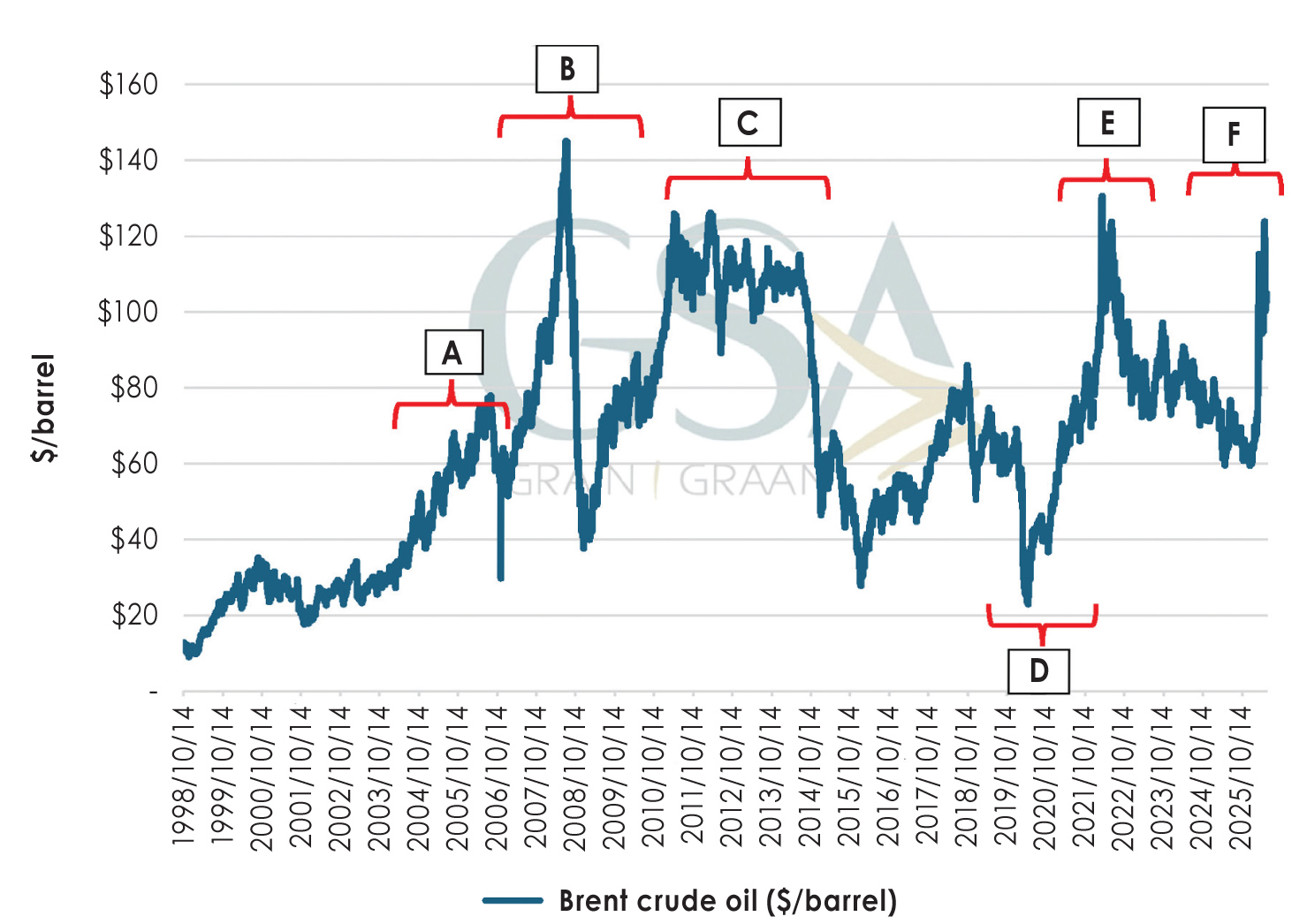
From the late 1990s to 2004, crude oil prices remained mostly below $40/barrel due to adequate supply and moderate demand. However, rapid industrial growth in China and other emerging economies, combined with geopolitical uncertainty and limited spare production capacity, pushed prices sharply higher from 2004 onwards (see A in Graph 1). During this period, South African wholesale diesel prices averaged around R3/litre.
In 2008, Brent crude oil prices reached a record high of approximately $145/barrel before collapsing below $40/barrel during the global financial crisis as economic activity and oil demand declined sharply (see B in Graph 1). South African diesel prices averaged about R8,60/litre during this period.
Between 2011 and 2014, crude oil prices recovered and remained above $100/barrel (see C in Graph 1), largely due to supply disruptions linked to the Arab Spring and the Libyan civil war, together with strong demand from emerging economies as reported by the US Energy Information Administration (EIA). South African diesel prices averaged around R11/litre.
The COVID-19 pandemic in 2020 caused one of the largest disruptions in global energy markets. Lockdowns sharply reduced oil demand, resulting in oversupply and a temporary collapse in crude oil prices below $30/barrel (see D in Graph 1). However, as economies reopened, fuel prices recovered rapidly, with South African diesel prices averaging approximately R17/litre between 2020 and 2022.
In 2022, the Russia-Ukraine conflict triggered another major energy shock. Concerns over global supply disruptions pushed crude oil prices above $130/barrel (see E in Graph 1), while diesel prices increased even more sharply due to refinery closures, limited refining capacity, and tight diesel supplies. South African wholesale diesel prices reached approximately R25/litre, the highest levels recorded at the time.
More recently (from 28 February 2026) tensions in the Middle East, particularly involving the United States and Iran, have continued to create uncertainty in global energy markets. Concerns around disruptions through the Strait of Hormuz have supported higher crude oil and fuel prices, while also affecting fertiliser markets due to the region’s importance in global sulphur and urea trade. Crude oil prices increased from approximately $70/barrel in the last week of February to above $100/barrel in the first week of March, where they are currently trading (see F in Graph 1).
Overall, global crude oil and diesel markets remain highly vulnerable to geopolitical tensions, supply disruptions, refinery constraints, and changes in global economic conditions.
South Africa’s dependence on imported fuel
South Africa relies heavily on imported crude oil and refined fuel products. Historically, the country operated several domestic refineries that processed imported crude oil into petrol and diesel. However, over time, refinery shutdowns, maintenance challenges, and infrastructure constraints reduced local refining capacity significantly.
The closure of major refineries such as SAPREF and disruptions at facilities such as Astron increased South Africa’s dependence on imported refined fuels. As a result, South Africa is now exposed not only to global crude oil price movements but also to volatility in international refined fuel markets. This means that local diesel prices are increasingly influenced by:
- global diesel refining margins;
- refinery outages;
- shipping and freight costs;
- port congestion; and
- international fuel supply shortages.
South Africa’s import dependence, therefore, increases vulnerability to global fuel market disruptions.
How South African diesel prices are calculated
Wholesale diesel prices reached record levels of approximately R31,18/litre from 6 May 2026 (Graph 2). South Africa uses a regulated fuel pricing system based on the basic fuel price (BFP). According to the Department of Mineral and Petroleum Resources, the BFP reflects what it would cost to import refined fuel into South Africa from international markets. The calculation includes international refined fuel prices, crude oil prices, shipping and freight costs, insurance costs, port and storage costs, and exchange rate movements.
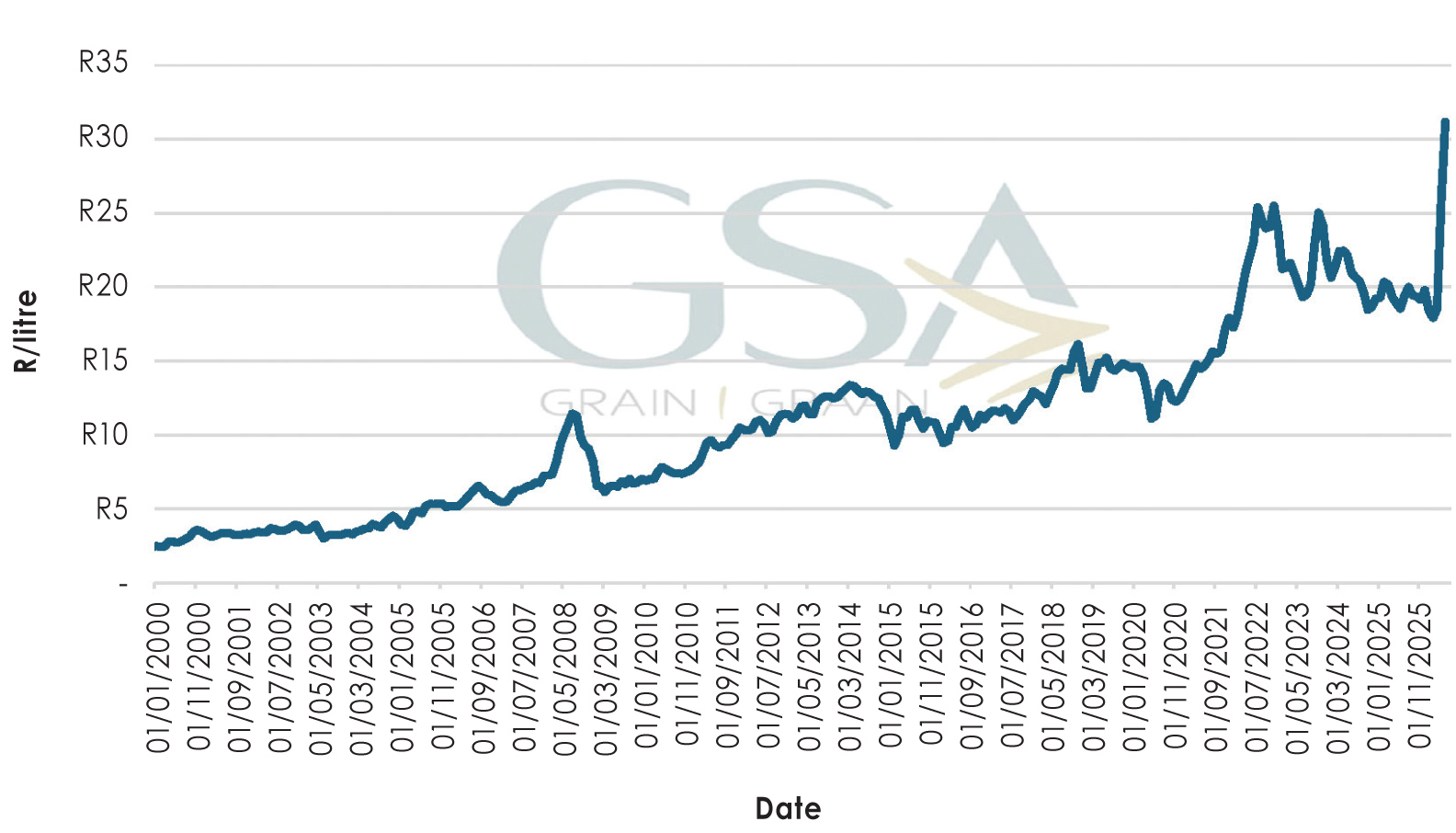
Graph 2 illustrates the long-term upward trend in wholesale diesel prices in South Africa, with particularly sharp increases observed during the 2008 financial crisis, the 2022 Russia-Ukraine conflict, and the highest price increase being seen during the recent Middle East tensions in 2026.
Because oil and refined fuel products are traded internationally in US dollars, movements in the rand/dollar exchange rate have a major influence on local fuel prices. Once the BFP has been calculated, several domestic cost components are added to determine the final diesel price. Graph 3 shows the diesel price composition based on the wholesale price of May 2026.
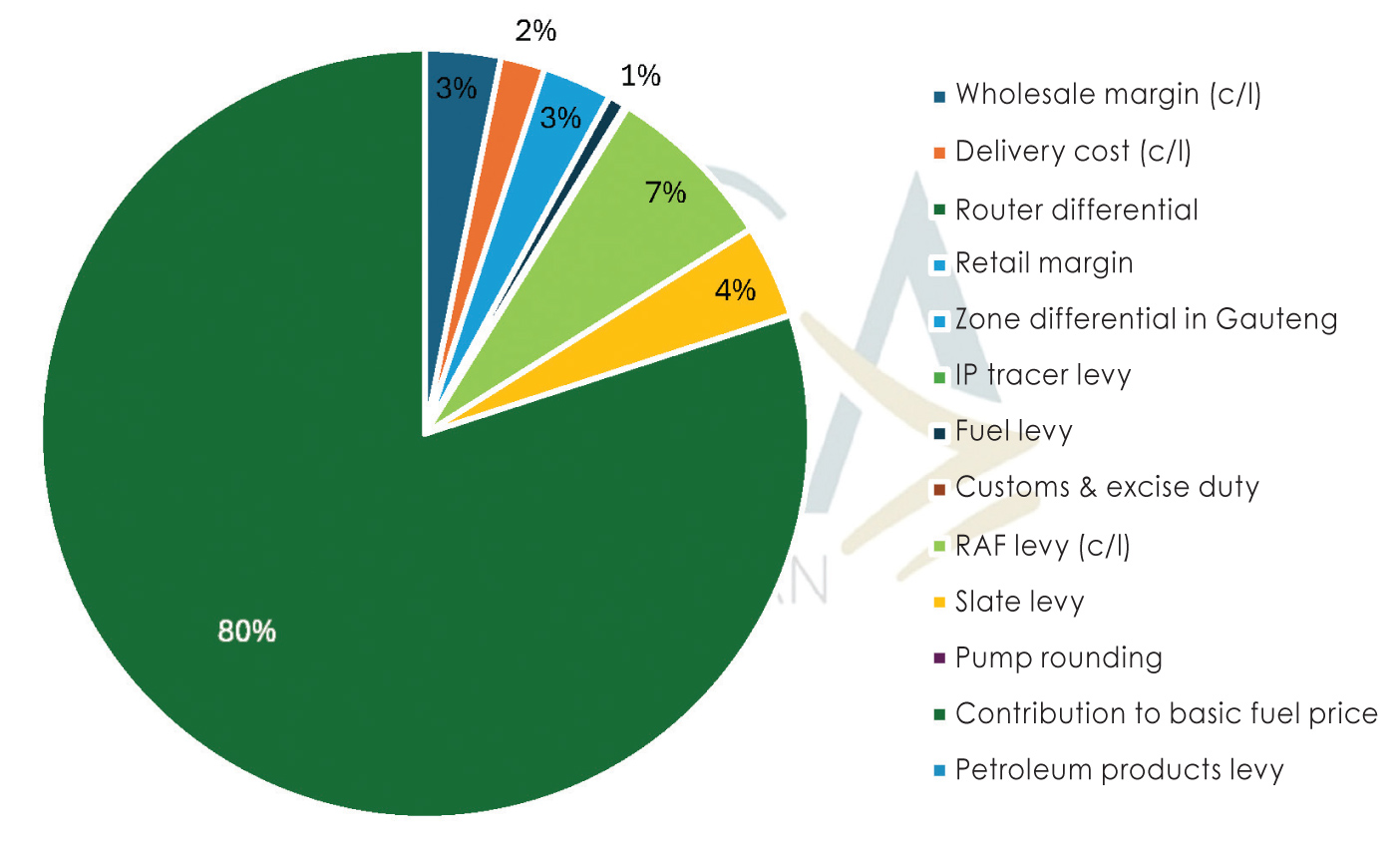
After the BFP, the Road Accident Fund (RAF) levy and slate levy contributed the most to the diesel price. As a result, changes in domestic diesel prices are not driven solely by crude oil prices. Government levies, taxes, exchange rates, and local logistics costs all contribute to movements in the final pump and wholesale diesel price.
The role of fuel levies in diesel prices
Fuel levies form a substantial component of South African diesel prices. The two largest levies are the general fuel levy (GFL) and the RAF levy. The GFL contributes towards government revenue, while the RAF levy compensates victims of road accidents. These levies are adjusted periodically through the national budget process and form an important source of fiscal revenue for the government.
In his 2026 budget speech, Minister of Finance, Enoch Godongwana announced the increase in the GFL by 9 cents/litre to R4,10/litre for petrol and 8 cents/litre to R3,93/litre for diesel. However, following sharp increases in global fuel prices linked to Middle East tensions during 2026, Minister Godongwana, together with the Minister of Mineral and Petroleum Resources, Gwede Mantashe, announced a temporary reduction of R3/litre in the GFL on 31 March from April 2026 to reduce pressure on consumers and businesses. This meant that the GFL was now R1,10/litre for petrol and R0,93/litre for diesel. From 6 May 2026, the GFL for diesel was further reduced to zero.
The measure was later extended into June 2026, with diesel receiving additional temporary relief due to the substantial increases in diesel prices. Without the temporary levy reduction, diesel prices could have increased to beyond R34/litre during May 2026. However, the relief came at a substantial fiscal cost. The government estimated that approximately R17,2 billion in tax revenue would be lost during the relief period. From July onwards, the GFL will return to the original amounts.
Conclusion
Global crude oil and diesel markets remain highly vulnerable to geopolitical tensions, supply disruptions, refinery constraints, and changing economic conditions. Because South Africa relies heavily on imported fuel, fluctuations in global oil prices, exchange rates, and domestic fuel levies directly influence local diesel prices.
Higher diesel prices significantly increase the cost of planting, harvesting, transport, and agricultural inputs, placing financial pressure on grain producers and the broader agricultural value chain. Although temporary fuel levy reductions and diesel rebates provide short-term relief, fuel price volatility is expected to remain a major risk factor for South African agriculture in the future.