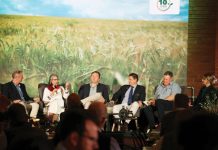


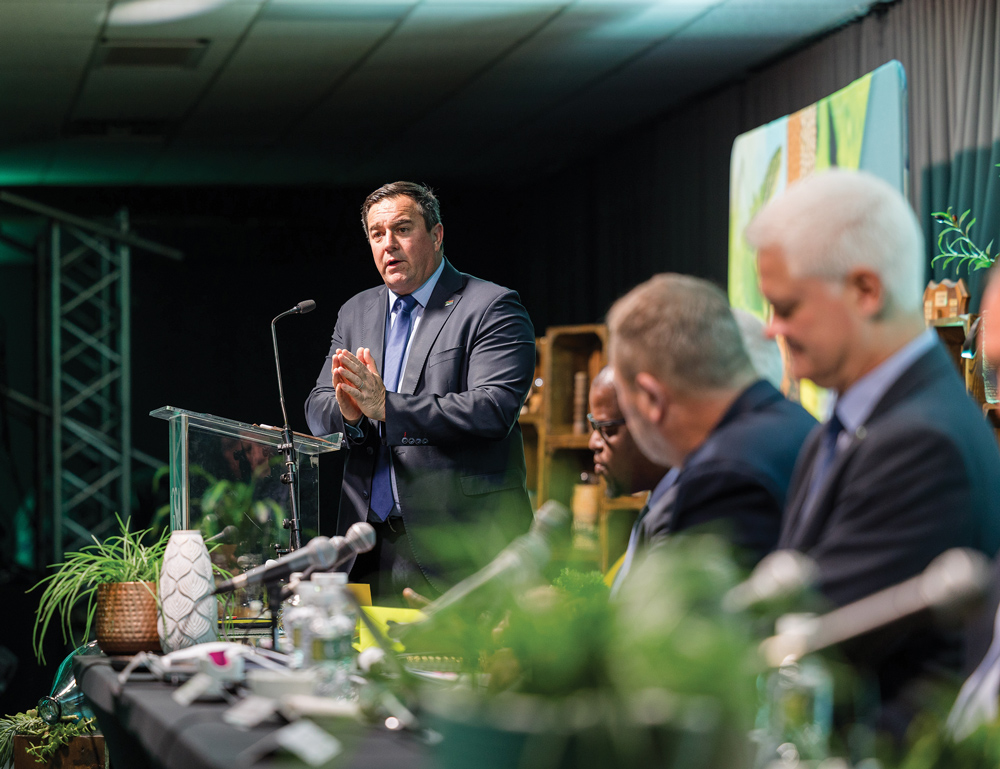
John Steenhuisen, Minister of Agriculture, delivered a wide-ranging address on the challenges facing the sector and the policy steps the government is taking to support agricultural growth.
Opening his address, Steenhuisen acknowledged the central role grain producers play in South Africa’s food system and economy. Maize alone feeds millions of households, supports livestock industries, and underpins a range of agro-processing industries. Agriculture, he noted, employs close to 950 000 South Africans directly and contributes roughly six to seven percent of the country’s economy when the broader value chain is included. It also remains one of the few sectors generating consistent export earnings, with agricultural exports reaching more than $15 billion last year and delivering a trade surplus of over $7 billion.
Within this broader system, grain production remains strategically important. South Africa produces between 10 and 16 million tons of maize annually, depending on rainfall conditions, supplying both domestic and regional markets. However, the picture for wheat is very different. The country consumes more than 3,5 million tons of wheat annually, while domestic production typically reaches only around 2 million tons, leaving South Africa structurally dependent on imports for roughly 40 to 50% of its wheat needs.
Pressure on profitability
The Congress theme, ‘Opening the gap – sustainability key; profitability foremost’, resonated strongly with Steenhuisen’s address. He noted that producers are facing a convergence of pressures, including rising input costs, climate variability, infrastructure challenges, and volatile global markets.
South Africa imports more than 80% of its fertiliser requirements, making producers particularly vulnerable to exchange rate fluctuations and global supply disruptions. Fertiliser comprises around 35 to 50% of a producer’s production costs depending on the production region, with costs for maize ranging from about R3 300/ha for lower yield targets to nearly R6 900/ha in the North West, and up to R8 900/ha in the Eastern Free State. The current conflict in the Middle East is expected to further impact fertiliser prices, with insurance risk premiums for vessels using the Strait of Hormuz having surged from an average of 0,25 to 1% of total cargo value over the previous ten days (1 to 10 March), forcing exporters to either absorb the cost or reroute, both of which will ripple down the value chain to the producer.
At the time of Congress, diesel prices were expected to rise by approximately R4,40/litre from 1 April 2026, adding another layer of pressure to already tight margins. Fuel accounts for roughly 12 to 18% of a producer’s production costs, meaning increases of this magnitude will have a direct impact on both winter grain producers preparing to plant from May and summer grain producers entering the harvest period.
The minister also highlighted the challenge facing South African producers who planted crops when input costs were still very high but had to harvest into a cheaper market, as strong rainfall and good global harvests have pushed local grain prices down towards export parity levels.
Wheat producers in the Swartland, Overberg and Southern Cape regions, Steenhuisen noted, are clear that wheat farming under current market and policy conditions is no longer economically sustainable. Economists have repeatedly shown that wheat contributes a relatively small proportion to the final bread price, yet producers carry cost pressures that are not evenly spread throughout the value chain.
While farming has always involved risk, Steenhuisen said the challenge today is the growing unpredictability that makes long-term planning increasingly difficult. ‘Farmers do not need government to tell them how to farm,’ he said. ‘What they need is an environment in which they can apply their knowledge, their technology, and their capital with confidence.’
Infrastructure and logistics
The minister pointed to deteriorating rural infrastructure as a major cost multiplier for the sector. He highlighted a dramatic shift in grain logistics: in 2011, approximately 20% of South Africa’s grains and oilseeds were transported via freight rail, but by 2025 that figure had decreased to just 3%, with a corresponding increase in road transport. Poorly maintained rural roads, unreliable electricity supply, and failing local services all add to producers’ operating costs and reduce efficiency in the agricultural value chain.
To address this, he highlighted a recent memorandum of cooperation signed by the Minister of Public Works and Infrastructure, Dean Macpherson, with AgriSA, Agbiz, and Infrastructure South Africa to prioritise key agricultural road corridors. The initiative will begin with a pilot in the Free State, a province central to national grain production, to identify corridors where targeted investment can unlock measurable economic value and reduce transport costs for producers.
Wheat tariffs and market structure
Steenhuisen addressed delays in the implementation of variable wheat tariff adjustments in some detail. He said he had been engaging with the Minister of Trade, Industry and Competition, Parks Tau, since as far back as April 2025 regarding delays in the publication of revised wheat tariff adjustments after the reference price formula had triggered a recalculation.
Administrative delays of this nature can create unnecessary volatility within the value chain, with importers and millers facing unexpected cost exposures that can amount to millions of rands for a single shipment.
The minister said one of the improvements being discussed with industry is the possibility of moving towards a more automated tariff adjustment system, where tariff changes triggered by the reference price formula take effect automatically.
He also addressed the request by the Wheat Forum for the establishment of a Section 7 Committee under the Marketing of Agricultural Products Act to examine market structure within the wheat value chain. Steenhuisen said the process of appointing the new National Agricultural Marketing Council is currently underway, and once council appointments are finalised, the establishment of the Section 7 Committee can proceed.
Embracing innovation
Innovation and technological advancement were highlighted as key to improving long-term sustainability. Steenhuisen emphasised the importance of ensuring that South Africa’s regulatory frameworks keep pace with global developments in agricultural technology.
The Executive Council established under the GMO Act has already begun updating the risk-assessment framework by introducing a tiered system that aligns regulatory requirements with the level of risk involved. Discussions last year also explored ways to simplify the process for certain low-risk applications without compromising safeguards, with the outcomes to be considered by the Executive Council this month.
Steenhuisen highlighted research being conducted by institutions such as Stellenbosch University on new breeding techniques (NBTs), including CRISPR gene-editing technologies, which have shown significant improvements in yield stability under climate stress, with some genome-edited lines demonstrating stronger performance during drought and variable rainfall conditions.
Biofuels and domestic demand
A further area addressed was the potential for expanding domestic demand for grain through biofuels. Steenhuisen noted that South Africa has significant maize production capacity in favourable seasons, and the question increasingly being debated is whether the country is doing enough to unlock additional domestic demand streams that could provide greater price stability and reduce reliance on volatile export markets.
He referenced a 2022 WWF report indicating that South Africa has the immediate technical potential to produce 3,2 billion litres of sustainable aviation fuel annually. However, he cautioned that any biofuels framework must be economically viable and must not create unintended distortions elsewhere in the food system.
Export opportunities
Steenhuisen highlighted the growing interest from Japan in importing South African yellow maize because of its consistently high quality. Delegations visited South Africa last year to see production systems first-hand, and another visit is planned for April. He noted that access to a market as demanding as Japan confirms that South African maize meets some of the strictest food safety and phytosanitary standards globally and demonstrates that local producers can compete successfully with major exporters such as the United States, Brazil, and Argentina.
Questions from producers
During the question-and-answer session, producers raised several concerns relating to the practical challenges facing the agricultural sector. One of the key issues discussed was the management of livestock diseases, particularly outbreaks of foot-and-mouth disease, and the strain this has placed on veterinary services. Producers expressed frustration about the lack of coordination and support from government structures, noting that veterinary services are often under-resourced at provincial level and that producers frequently feel left to manage outbreaks on their own. In response, the minister acknowledged the problem and explained that veterinary services fall under provincial government authority, which has led to gaps in capacity in some regions. He said the national department has had to step in in certain cases and that new systems are being introduced to improve oversight and ensure that provincial funding is spent more effectively.
Questions were also raised about the allocation and accountability of agricultural support funding, with producers calling for greater transparency and suggesting that more support could be channelled through agricultural organisations that work closely with producers. Steenhuisen agreed that accountability is critical and said mechanisms are being strengthened to ensure funds are monitored more closely. The discussion also touched on opportunities for expanding agricultural exports and improving trade within Africa, as well as the potential development of a local biofuels industry to create new markets for crops such as sorghum, canola, and sugar. The minister said the government is exploring policy options that could unlock these opportunities and help position South Africa, and the continent more broadly, as a major supplier of food and agricultural products to global markets.
A sector central to the economy
Closing his address, the minister emphasised that food security ultimately rests on farm profitability.
‘If farmers cannot operate viable businesses, the entire food system becomes fragile,’ he said.
The government’s role, he concluded, must be to create certainty, remove barriers, and allow producers to get on with the job by adapting, innovating, and continuing to feed the nation.