

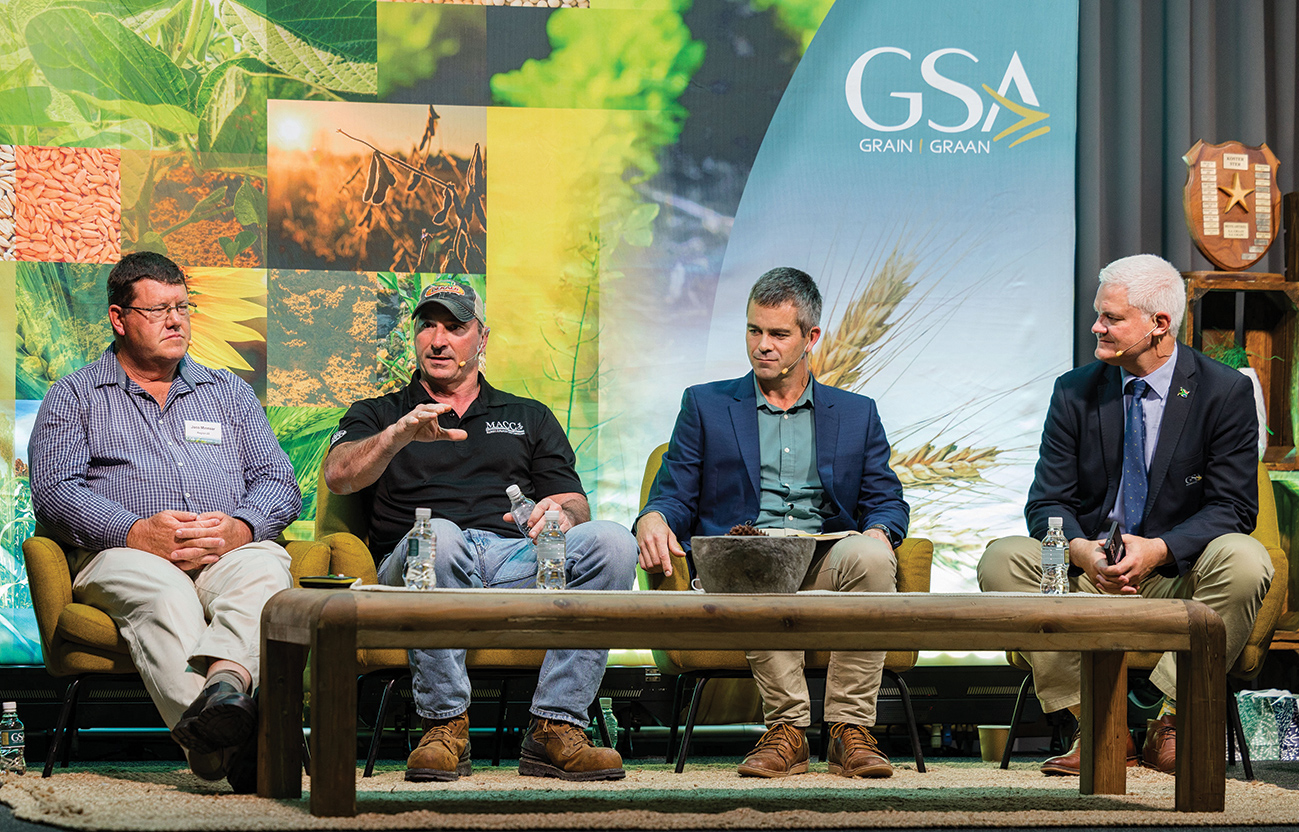
The current situation experienced by South African producers – including high international grain stocks, the prevailing foot-and-mouth disease and the pressing economic cycle – led to a lively panel discussion on the theme ‘Opening the gap – sustainability key; profitability foremost’ on the first day of Grain SA’s recent annual Congress.
Heavyweights from the agricultural sector took part in the discussion: Jaco Minnaar (producer and former AgriSA president), Kevin Kalb (keynote speaker and producer from the USA), Prof Pieter Swanepoel (Department of Agronomy, Stellenbosch University) and Dr Tobias Doyer (CEO of Grain SA).
The discussion was facilitated by Dr Dirk Strydom, managing director of Nampo (Pty) Ltd, and introduced by Corné Louw, head of Applied Economics and Member Services at Grain SA. Insights that emerged from the discussion included knowing your farming area, making a mental shift, learning from the past, and making small adaptations.
Technology
Minnaar explained that producers cannot continue doing the same as in previous years and expect higher yields and income. He makes use of scientific and technical data obtained from various trials on his farms to his advantage.
According to him, one has to determine the optimal point of profit to be successful. In practice, this means the lower the grain price, the fewer seeds should be planted in order to remain profitable.
Solvable problems
On the question of where to start to increase yields and lower costs, Kalb advised producers to begin with the problems that they can solve.
‘Start with easy trials, which do not have to cost much,’ he said. ‘Look at your pH levels. If levels are below 6, it makes more sense to spend money on lime rather than on fertilisers,’ he said, warning against over-fertilisation.
Kalb added that producers should also learn to understand the different hybrids. ‘Seed is expensive, so it needs to work for the producer.’
Agronomy
Dr Strydom mentioned the changes in agronomy and soil science and requested Prof Swanepoel to elaborate.
According to Prof Swanepoel, it is vital to rethink how the entire agronomic system functions if one wants to open the gap between inputs and outputs. ‘We have to work from the soil upwards and start to think differently about conservation agriculture.
‘It is essential to apply all three principles of conservation agriculture to benefit from the system: no-till, diversification, and soil cover. If only one of these principles is applied, producers may actually be worse off compared with traditional methods.’
It should also be understood that the benefits of conservation agriculture differ from region to region. It is not a ‘silver bullet’ that will fix all problems.
Regulatory environment
Part of getting through the current cycle is to survive in the regulatory environment. South Africa, for instance, does not have subsidies, which prolongs the effects of the low-price cycle, according to Dr Strydom.
Dr Doyer noted that Grain SA assists producers in dealing with regulatory requirements, such as the diesel rebate and maize grading regulations, both of which have a significant impact on the bottom line of producers.
‘Regulation is a continuous battle, although we need it to govern the way certain things are done. We must ensure that the right rules are in place so that certain technologies can enter the country as soon as possible and be available to producers.’
He added that discussions with banks regarding regulations the Reserve Bank has imposed on them are currently underway. ‘Banking regulations should not endanger our producers even more.’
Re-elected Grain SA chairperson, Richard Krige, summed up the discussion by highlighting the key takeaways:
- Work on pH levels
- Know your farm
- Start slowly and see how changes fit within your management systems
- Make small adaptations rather than big leaps
- Implement conservation agriculture gradually
- Work on soil health
- Apply strategic tillage
- Focus on principles rather than actions
- Change your mind-set
- Realise that the current price climate is a good time to start doing trials
- Reduce inputs
- Learn from the past – this is neither the first nor the last low economic cycle
- Stick to the fundamentals