

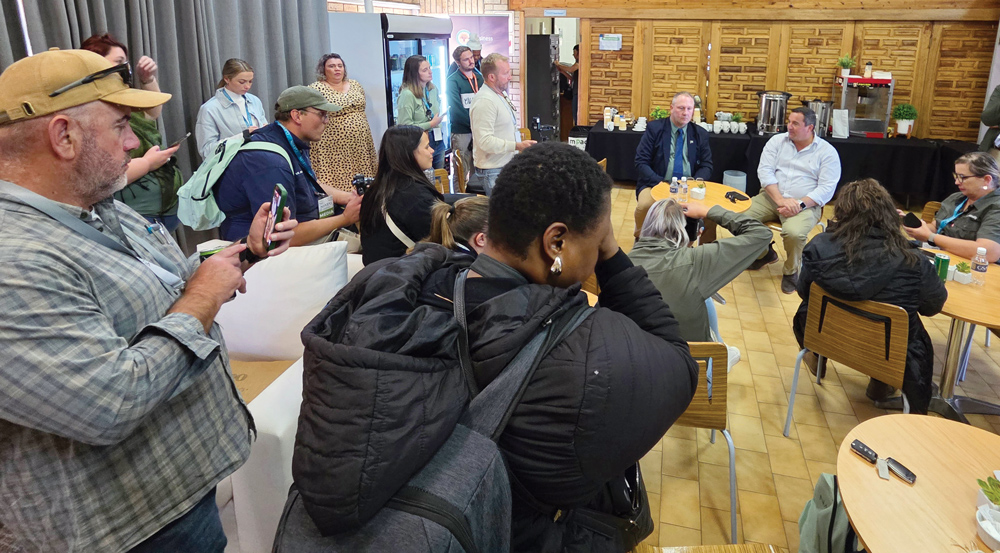
The Minister of Agriculture, John Steenhuisen, met with journalists at the Grain SA/
Agricultural Writers SA Media Centre on Tuesday 12 May to thank them for the role they play in growing the sector. During his visit, he gave an update on South Africa’s response to foot-and-mouth disease (FMD). He also spoke about the wider pressures facing agriculture locally.
While the seriousness of the outbreak was clear at the showgrounds with no cloven-hoofed animals allowed for the first time in NAMPO’s history, Steenhuisen was cautiously positive about the national vaccination campaign. Early supply problems, he said, have now been solved.
‘We are busy winning the race to meet our targets,’ he said. ‘We want to vaccinate 80% of the national herd by December this year.’ Scientific advice suggests that the campaign will start to have a real impact before that point is reached. ‘I met with my counterparts from Mozambique and Eswatini in Mpumalanga this week. They saw a positive change once they vaccinated 60% of their herds, and we are well on our way to that mark.’
The early delays, he explained, were caused mainly by limited vaccine supply. This pushed the government to look for more suppliers.
Securing international supply
New partnerships have since been put in place. These include an agreement with Biogénesis Bagó in Argentina, and the import of Dollvet vaccines from Türkiye. The minister said that the larger supply marks an important change:
- Two million Dollvet doses arrived in South Africa on the opening day of NAMPO.
- Another 3,5 million doses from Biogénesis Bagó were expected by the end of NAMPO.
- By the end of May, South Africa will have imported 15 million doses in total.
‘That is enough to vaccinate every single animal in the national herd of around
14 million at least once. Then we will begin with the booster shots,’ said Steenhuisen.
From shortage to surplus
He warned that the country will need to keep receiving vaccines, because FMD continues to spread around the world.
‘There are current SAT-1 outbreaks in China, Greece, Türkiye, and the Middle East, and we want to secure supply to South Africa.’
He noted that South Africa has signed an agreement with Biogénesis Bagó to supply up to 5 million doses per month. Dollvet can produce 2 million doses per week, and the Department are applying for permits to import 10 million doses.
Public-private partnerships unlocked
To speed up vaccinations on the ground, the government adjusted regulations to involve the private sector. The Routine Vaccination Scheme for FMD was published in early May under Section 10 of the Animal Diseases Act, following talks with industry bodies. The new voluntary framework allows livestock owners to vaccinate their own animals, without waiting for the state-run rollout to reach their area.
By mid-May, around 3 million animals had been vaccinated. The minister expects vaccinations to speed up under the new framework. ‘I believe it will go much faster now because of the regulatory changes.’
The minister said the goal consists of two parts: to make this South Africa’s last major FMD outbreak, and to end the country’s dependence on any single supplier. ‘We are producing our own vaccines locally and forging strong partnerships, particularly in Argentina, to secure future supply,’ he said.
A broader sector under pressure
While FMD remains the main concern, Steenhuisen said it is only one of several challenges facing agriculture. He mentioned changing weather patterns, global conflict, rising input costs, and biological risks affecting farming systems.
‘We’ve seen drought in parts of the Southern Cape, heavy rains in other parts of the country, and now I’m told there are locusts in Colesberg. All of these things put huge pressure on the sector,’ he said, calling for closer cooperation across the value chain. ‘There’s no single solution that’s going to lighten the load. It’s a multifaceted approach and one where we all have to work together.’
Supplying vaccines in record time
SA Graan/Grain spoke to Daniel Helou, regional director of Biogénesis Bagó, at the Argentinian Pavilion during NAMPO. He discussed the Argentine company’s agreement with the South African government to supply FMD vaccines.
According to Helou, Biogénesis Bagó has moved quickly to meet South Africa’s vaccine needs since the supply agreement was signed. He described the deliveries as arriving in record time for the company.
‘We delivered around 2,5 million doses in less than 30 days, which was a record time for us,’ he said. ‘On Sunday, we hope to deliver another 3,5 million doses. We are planning to produce 21 million doses from now until the end of the year. That gives the country the opportunity to vaccinate the national herd more than once.’Helou said the partnership is strengthened because Argentina and South Africa share similar profiles. Both are Southern Hemisphere agricultural economies with similar export interests.
‘We are very happy to be here at NAMPO, but especially in South Africa, supporting you through this critical situation with FMD,’ he said. ‘Argentina and South Africa have a lot in common. We are both agricultural countries and meat exporters, so we share a great deal of experience. We were in this same situation 20 years ago, so we know how to deal with it.’
He said that production scale is a key factor at a time when FMD outbreaks are being reported in many parts of the world.
‘South Africa is fortunate to have access to the world’s leading FMD vaccine producer,’ he said. ‘We have the scale to provide the quantities needed, on time.’