


executive officer, Right
to Repair Movement South Africa
Three years ago, we asked whether agriculture would become the next frontier in South Africa’s Right to Repair movement. That question has become increasingly important as producers rely on ever more sophisticated equipment while facing growing economic and environmental pressures.
Modern tractors, harvesters, and self-propelled implements are no longer purely mechanical machines. They are complex systems incorporating software, electronics, and advanced diagnostics. When those machines break down, the consequences are immediate: planting is delayed, harvesting windows are missed, and costs escalate.
Climate change has made these challenges even more acute. Unpredictable rainfall, extreme temperatures, and shorter planting or harvesting windows leave producers with less margin for error than ever before. When the weather provides only a brief opportunity to plant or harvest, waiting days or even weeks for an authorised workshop can have devastating consequences. Every unnecessary delay increases the risk of lost yields and financial harm.
For this reason, Right to Repair South Africa believes that producers should be able to choose qualified independent repairers and should not face unnecessary restrictions that reduce competition or limit consumer choice.
Global conversation
Internationally, disputes involving John Deere in the United States have focused attention on the ability of producers to access diagnostics, software, and repair information. The debate has highlighted a simple principle: ownership should include the practical ability to maintain and repair equipment.
South Africa already has a framework
Many producers are unaware that South Africa’s Competition Commission Guidelines for the Automotive Aftermarket are not confined to passenger cars. The guidelines apply broadly to vehicles and equipment capable of being driven on a road. As a result, many categories of agricultural machinery that travel on roads between fields or farms may already fall within their scope.
The significance of this is considerable. Where the guidelines apply, they promote consumer choice and competition by discouraging practices that unfairly tie owners to a single repair network or imply that using a qualified independent repairer automatically voids a warranty. Their objective is to ensure that competition takes place on merit while preserving safety and quality.
Right to Repair South Africa has observed increasing awareness and implementation of these principles in the motor vehicle sector. However, we do not yet have sufficient visibility into the practices of agricultural OEMs to draw conclusions about compliance in that market. Greater engagement from producers and independent repair businesses will help establish a clearer picture.
 Time matters in farming
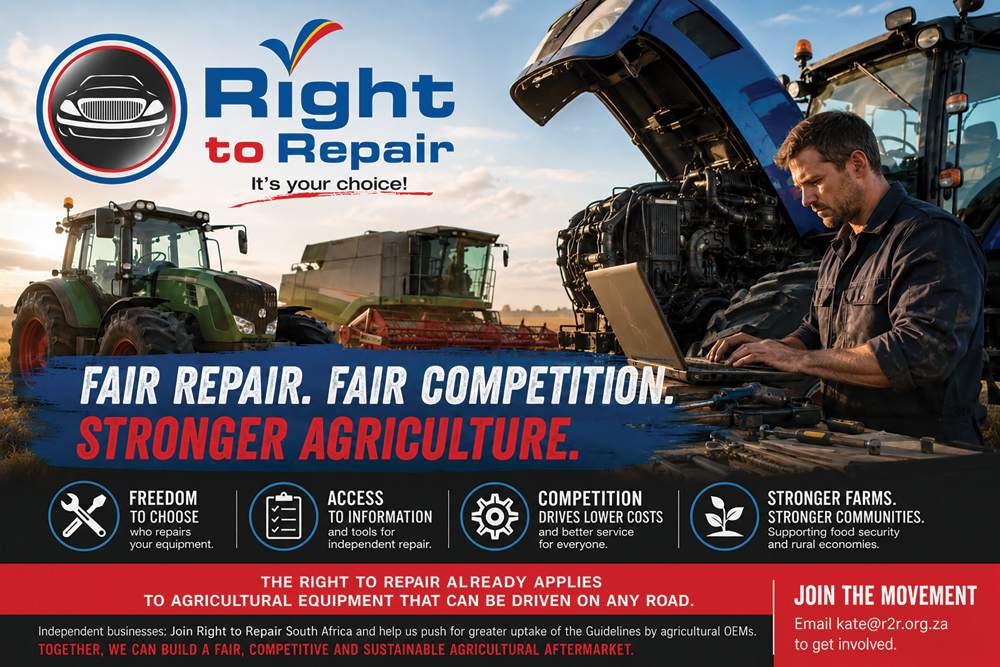
Agriculture is unlike many other industries because opportunities cannot simply be postponed. A delayed harvest can coincide with rainfall that damages crops. A missed planting window can reduce yields for an entire season. In this environment, being forced to wait for a distant authorised workshop when capable local expertise exists imposes unnecessary risk on producers already coping with volatile weather, rising input costs, and market uncertainty.
What producers can do
If you are told that using an independent repairer will automatically invalidate your warranty, or if you experience conduct that appears inconsistent with the Competition Commission’s guidelines, document the circumstances and consider lodging a complaint with the commission. Practical examples from the agricultural sector are essential to understanding whether the existing framework is working as intended.
A call to the independent aftermarket
Independent workshops, rebuilders, parts suppliers, diagnostic specialists, and service providers play a vital role in keeping South African agriculture running. Right to Repair South Africa encourages businesses in the agricultural equipment aftermarket to join the movement, share their experiences, and advocate for greater awareness and uptake of the guidelines. A vibrant independent sector increases resilience, supports rural economies, and provides producers with meaningful choice.
Looking ahead
The right to repair is not about undermining manufacturers. It is about ensuring that producers can keep working when every day counts. As climate pressures intensify and technology becomes more sophisticated, access to competitive repair options will become even more important. By working together, producers, independent businesses, and policymakers can help build an agricultural sector that is resilient, innovative, and better equipped to feed South Africa.
For any queries or questions please contact Kate Elliott, CEO of Right to Repair South Africa, at kate@r2r.org.za. We will be happy to walk you through the complaints process, answer any questions surrounding the guidelines, or onboard you as a member.