


Part 3
Since 1993 employers have been required to assess all hazards which are in their workplace. In 2019, the Department of Employment and Labour promulgated the Ergonomics Regulations to provide employers and employees with more information on what to address if ergonomics-related risks are present in the workplace. The regulations require a programme approach, which entails collecting information on requirements from all sources, assessing the risk associated with the hazard, identifying control measures to reduce the risk, and maintaining those control measures.
On 6 December 2019, the Ergonomics Regulations were published in the Government Gazette No. 42894, Government Notice R. 1589, and they are applicable to all workplaces as per the definition in the Occupational Health and Safety Act, Act No. 85 of 1993, as amended.1,2 The intention of the regulations is an ergonomics programme approach which should be integrated into existing occupational health and safety programmes. Ergonomics is not a stand-alone hazard, but rather part of the broader approach to ensuring a workplace that is safe and without risk to the health of employees as well as productivity at work.2 It is therefore important to note that an ergonomics programme is a systematic process for anticipating, identifying, analysing, and controlling ergonomic risks, and should include at least an ergonomics hazards identification and risk assessment, risk controls (through the implementation of the hierarchy of controls), information and training, monitoring and evaluation, and medical surveillance.
Discussion
The aim of the Ergonomics Regulations is to balance worker well-being and productivity through interactions of the human and the work system, thus focusing on a human-centred approach. The practical benefits of ergonomics include:
-
- for the employee: improved health, well-being and safety at the workplace;
- for the employer: improved productivity, efficiency and prevention of occupational incidents and adverse health effects; and
- for government: a workplace that is safe and without risk to the health of employees.2
The regulations also incorporate the three factors of ergonomics, previously known as domains, which are physical, cognitive, and organisational, as these are interrelated.4 The interaction between the three factors is illustrated in Figure 1.
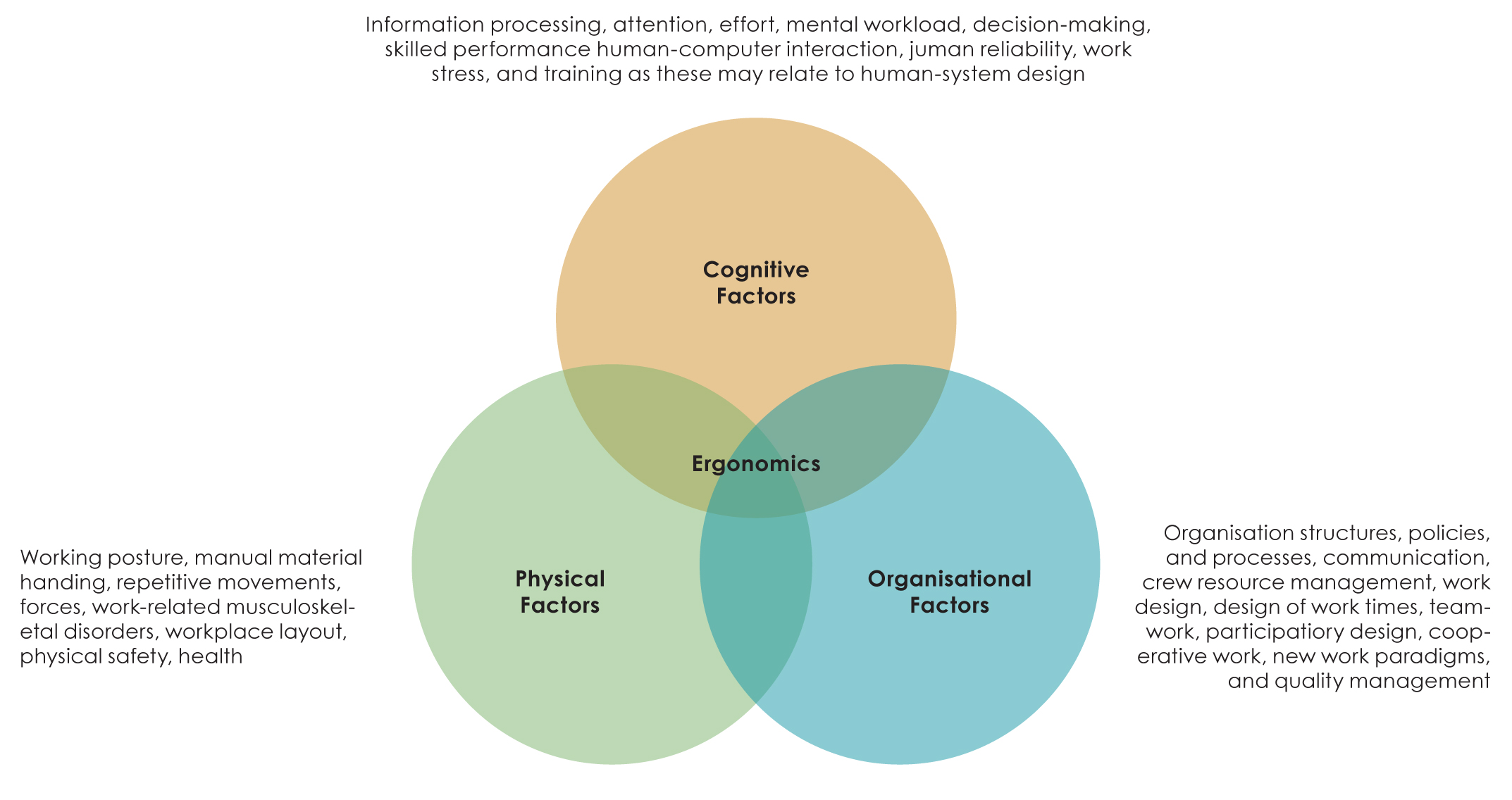
(Source: International Ergonomics Society https://iea.cc/about/what-is-ergonomics/)
With respect to these factors, physical ergonomics focuses on human anatomical, anthropometric, physiological, and biomechanical factors, while cognitive ergonomics is concerned with mental processes such as perception, memory, reasoning, and motor response, as they affect interactions among humans and other elements of a system. Organisational ergonomics focuses on optimisation of sociotechnical systems, including their organisational structures, policies, and processes.
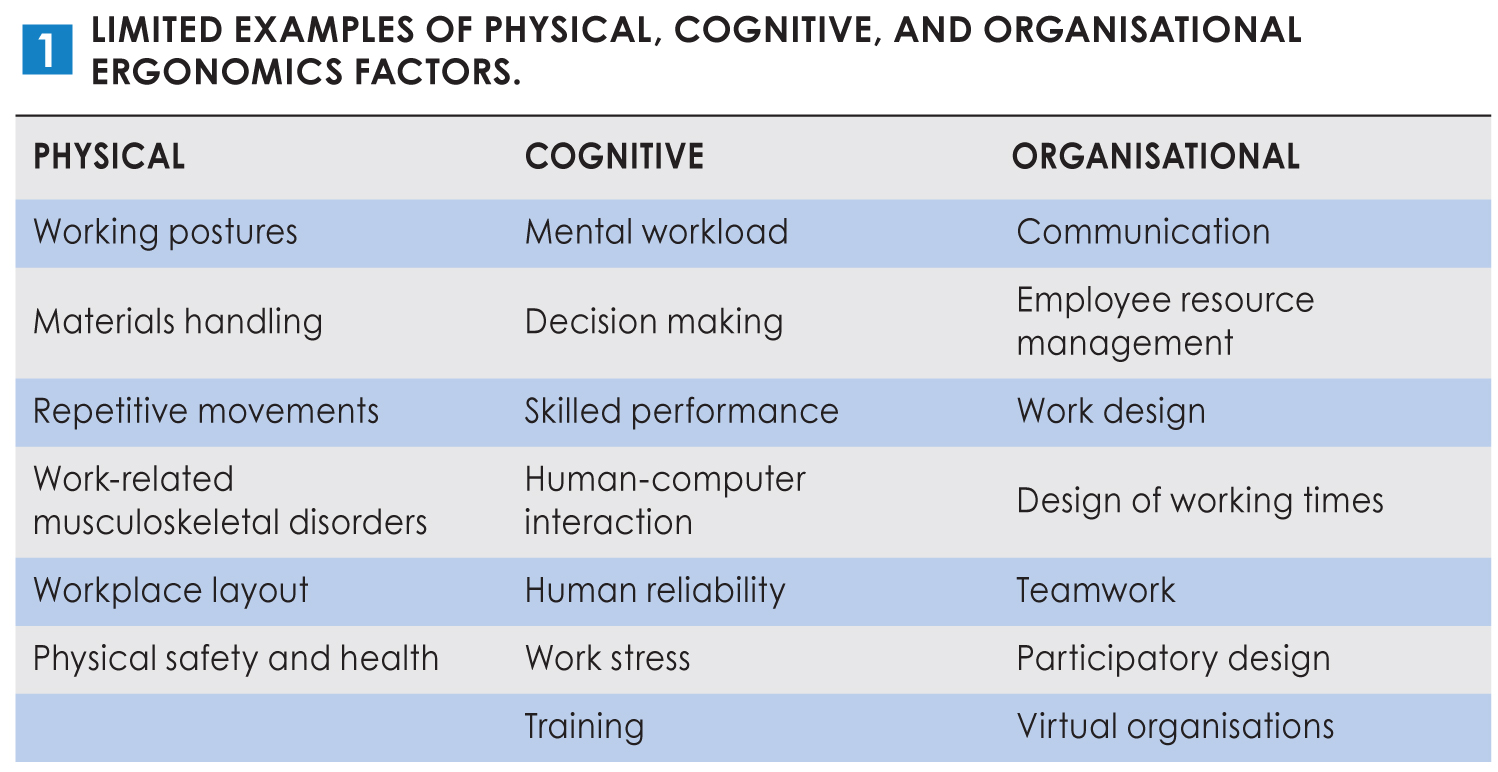
Table 1 provides a few examples of each factor. It is important to keep in mind that employers and competent persons must take all three factors into account when conducting an ergonomics risk assessment, and also work with other disciplines when addressing these matters.3
 Ergonomics legislation
It is important that the Ergonomics Regulations are not read in isolation. As indicated by some of the examples of cognitive and organisational ergonomics, some are governed in other laws administered by the department. Therefore, when designing, implementing, and maintaining the ergonomics programme, consideration must be taken of the following:
- Occupational Health and Safety Act, Act No. 85 of 1993 as amended and relevant regulations promulgated under Section 43;
- Basic Conditions of Employment Act, Act No. 75 of 1997 as amended and Codes of Practice;
- Compensation for Occupational Injuries and Diseases Act, Act No. 130 of 1993 as amended and Instruction 180;
- Labour Relations Act, Act No. 66 of 1995, as amended;
- Employment Equity Act, Act No. 55 of 1998 as amended and Code of Practice on the Prevention and Elimination of Harassment in the Workplace; and
- other legislation applicable to work systems.
Capacity building and enforcement
Labour inspectors and cognate disciplines within occupational health and safety (OHS) frameworks must be trained to recognise and quantify emerging hazards associated with ergonomics. The Department of Employment and Labour’s approach in controlling all hazards in the workplace provides for using a combination of control measures, while following a hierarchy of controls: elimination, substitution, engineering, administrative, and PPE.
The department also drafted and published additional documents to support the Ergonomics Regulations. The Competent Person Guideline was developed to be read in conjunction with the definition of a competent person defined in the regulations.4 This guideline provides more details to the employer on how to select a competent person. However, while the regulation requires the appointment of a competent person to perform the risk assessment, the department has always promoted the team approach when conducting risk assessments, as it is beneficial to draw on knowledge and skills of others in the workplace.
A second document produced by the department is the Ergonomics Programme Approach document. This document outlines the requirements of a programme, specific to ergonomics, but should be incorporated into existing occupational health and safety programmes.5
International organisations, such as the International Labour Organization (ILO), have also produced documents to support the agricultural sector. The ILO, collaborating with the International Ergonomics Association (IEA), produced a checklist which may be used as a guidance tool when assessing ergonomics within the agricultural sector. Scan the QR code to download the checklist.
Conclusion
The agriculture sector is one of the most hazardous sectors. Increased attention should be given to applying practical solutions to reduce work-related incidents and occupational diseases, improve living conditions, and increase productivity.6 These feed into the definition of ergonomics, which addresses the interactions between the employee and elements of the work system to optimise human well-being and overall system performance.2
References
1. South Africa. Occupational Health and Safety Act No. 85 of 1993.
2. South Africa. 2022. Occupational Health and Safety Act No. 85 of 1993. Ergonomics Regulations, 2019. Government Gazette No. 42894, 6 December (published under Government Notice R1589).
3. International Ergonomics Association. What is ergonomics (HFE)?
4. South Africa. Competent Person Guideline.
5. South Africa. Ergonomics Programme Approach.
6. International Labour Organization. Ergonomics Checklist in Agriculture.