


Groundnuts may occupy a relatively small footprint in South Africa’s summer crop landscape, but their importance extends far beyond hectares planted. As a crop positioned at the intersection of nutritional security, value-added processing, and crop diversification, groundnuts continue to play a strategic role in the broader grains and oilseeds economy.
A stable crop and solid demand but a tight balance
‘The opportunity for the groundnut sector is no longer just about hectares – it is about quality, consistency and value per ton.’
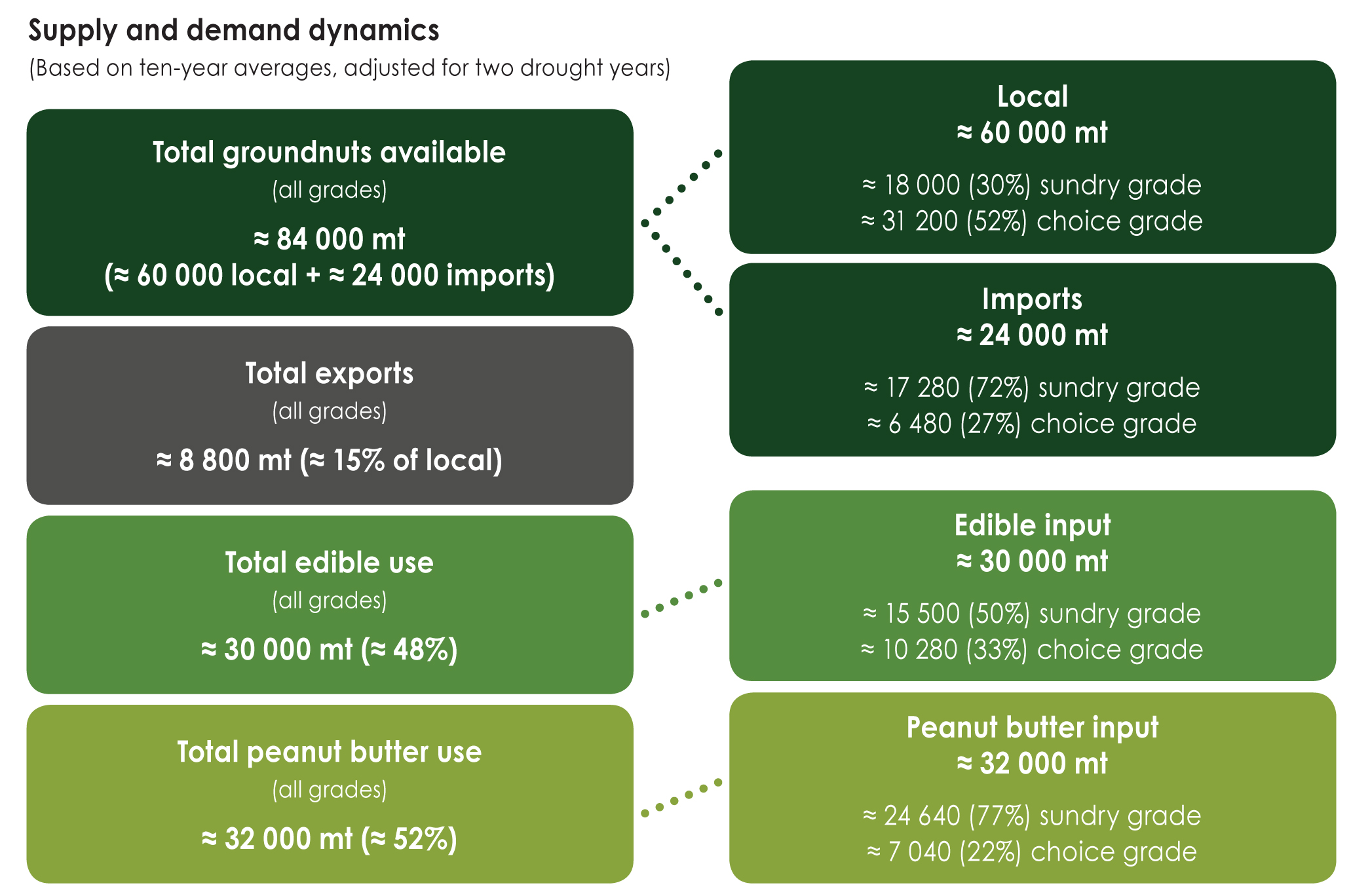
National data point to average South African groundnut crops of around 50 000 to 55 000 tons (including drought years) from a ten-year average of around 40 000 ha. At an average yield of around 1,3 t/ha, the published intentions to plant of 42 240 ha suggest a reasonably stable production outlook for the current season, although it remains insufficient to meet total commercial demand.
As a result, South Africa continues to rely on imports to supply the edible nut and peanut butter markets, even in seasons with fair local production. This ongoing gap between supply and demand continues to offer opportunity, with the focus not only on hectares, but also toward yield reliability, quality consistency, and value per ton.
While we export around 15% of the local crop (all grades), the domestic demand for groundnuts remains steady at around 84 000 t/year (all grades), driven primarily by the direct edible market (≈48%) and peanut butter manufacturing (≈52%).
For producers aiming to stabilise hectares and reduce production risk, the ongoing industry-funded and industry-managed cultivar evaluation programmes, also including individual entity programmes, have become increasingly important. These trials, some in collaboration with the Agricultural Research Council (ARC) and international partners, generate region-specific data on yield potential, disease tolerance, and kernel quality, with the view of increasing cultivar choices which will enable producers to select cultivars that balance productivity with market requirements. For processors and manufacturers, improved cultivar performance translates into more predictable quality and reduced variability as a key factor in maintaining efficient processing operations.
Market insight – what consumers are telling us
‘Consumers know peanuts are nutritious and filling – the challenge is keeping them affordable and visible as a staple choice.’
Recent research conducted by the University of Pretoria and funded through the Oil and Protein Seeds Development Trust (OPDT) and the Oil Seeds Advisory Committee (OAC) framework provides valuable insight into South African consumer behaviour, particularly in mid- and lower-income groups. The findings confirm that peanuts and peanut butter are widely recognised as nutritious, filling, and versatile foods, even though many consumers do not consciously associate them with cultural eating patterns.
The research shows that peanut products were almost always present in households growing up – used as spreads, snacks, or cooking ingredients. These findings present an opportunity to remind consumers that peanuts are not a new product, but a trusted everyday staple already embedded in family diets over generations, with the potential to fit into any traditional or modern menu.
Affordability remains central to purchasing decisions. In an environment of sustained food inflation, peanuts and peanut butter are evaluated alongside other staple protein sources. When prices rise sharply, consumers readily substitute or reduce consumption, reinforcing the importance of stable pricing, appropriate pack sizes, and efficient value chains.
At the same time, research highlights strong growth potential across both formal and informal markets. Informal traders, particularly street vendors and spaza shops, play a critical role in supplying affordable roasted peanuts to commuters and urban consumers. In formal retail, demand is expanding for flavoured peanuts, functional snacks, and healthier peanut butter variants, especially among younger consumers. Millennials and Gen Z are consuming peanut butter more frequently – a positive long-term signal for the industry.
Trade policy and the peanut butter tariff debate
‘A sustainable groundnut sector depends on fair trade rules that recognise the value of local processing.’
Trade dynamics remain one of the most pressing challenges facing the groundnut value chain. Industry has consistently raised concern that imported peanut butter competes directly with locally manufactured products, often at prices below local production costs.
Strong industry support continues for the long-running tariff application on peanut butter. Engagement with the International Trade Administration Commission (ITAC) has been ongoing since the first applications were submitted pre-Covid, and recent discussions confirmed that ITAC would present updated findings and recommendations to the Minister of Trade and Industry early in January. While outcomes remain long awaited and uncertain, the process reflects a coordinated effort to ensure fair trade conditions that support local value-adding without compromising consumer access and demand.
Information gained from these research projects will be put to use in upcoming generic marketing projects planned for 2026.
Quality and food safety
Food safety, particularly aflatoxin control, remains central to market confidence. Effective management spans the entire value chain, from cultivar choice and agronomy to harvest timing, drying, storage, and transport. The industry’s response to recent aflatoxin concerns demonstrated the strength of South Africa’s regulatory and monitoring systems, helping to maintain consumer trust. Efforts will be increased during 2026 to promote facilities that complies with local and international standards, thus supporting buyers in choosing suppliers that continuously invest in certification and food safety requirements.
Rising production pressure
Producers are operating under increasing pressure from the restriction and withdrawal of certain chemical crop protection products. These constraints have made pest and disease management more complex, especially in relation to nematodes, which continue to pose a serious threat to yield and quality.
Encouragingly, work is underway through the ARC, in collaboration with chemical companies, to expand the registration of available products – more specifically alternatives suitable for nematode control. While timelines remain uncertain, this research is hoped to increase practical, compliant options available to producers under this tightening regulatory environment.
The road ahead
‘Quality, collaboration, and consistency remain the most powerful levers for the future of South Africa’s groundnut sector.’
Looking ahead, the resilience of the groundnut industry will depend on continued improvements in yield and quality through sound agronomy and expanded cultivar options. Equally important will be continued and stronger coordination across the value chain – from producers and selection plants to processors and manufacturers to improve consistency and market alignment. Fair and balanced trade, supported by focused regulatory engagement, remains critical to sustaining local value-adding. At the same time, consumer-focused marketing and education, grounded in local research and informed by international innovation, will play a growing role in maintaining demand.
The South African groundnut industry may be modest in scale, but its importance is undisputed. With steady demand, research opportunities, and active industry and regulatory engagement, the foundations for growth for both large- and small-scale producers are in place. The challenge and opportunity lie in aligning production, processing, policy, and consumer insight to unlock sustainable value across the entire value chain.
This article is based on current industry data, research, and stakeholder engagement. Contact the author at groundnutforum@opot.co.za.