


Gert Conradie, Depart-ment of Agronomy, Stellenbosch University and Western Cape Department of Agriculture, Elsenburg

Prof Johan Labuschagne, Department of Agronomy, Stellenbosch University

Prof Johan Strauss,
Department of Agronomy, Stellenbosch University and Western Cape Department of Agriculture, Elsenburg

Prof Pieter Swanepoel, Department of Agronomy, Stellenbosch University

Dr Chloe MacLaren, Department of Agronomy, Stellenbosch University and Department of Crop Production Ecology, Swedish University of
Agricultural Sciences
Farming practices in the Western Cape’s grain-producing areas have undergone significant changes, largely due to the adoption of conservation agriculture (CA) and, to a lesser extent, regenerative agriculture (RA). While CA offers numerous benefits, it has led to a greater reliance on chemical weed control. This, in turn, has unfortunately resulted in increased herbicide resistance among problematic weeds, forcing producers to seek alternative, sustainable weed management strategies. This is where cover crops come into the picture.
Cover crops are receiving increased attention in the Western Cape, not just to improve soil health in general, but also as a potential powerful tool to suppress weeds. With several weed species, especially ryegrass (Lolium spp.), developing resistance to herbicides in crops such as wheat, exploring these alternative strategies is more important than ever.
Cover crops can combat weeds in two ways.
- Directly: When actively growing, they compete with weeds for vital resources like sunlight, water, and nutrients.
- Indirectly: When or after they are terminated (e.g., grazed, cut and removed as hay, or rolled), the remaining mulch or residue acts as a physical barrier, blocking weed germination and establishment.
Cover crops in the Swartland
The harsh summer conditions in the Swartland sub-region of the Western Cape mean that cover cropping is limited to the cooler, wetter months. This often means producers must sacrifice potential income from a cash crop. This highlights the importance of finding ways to generate income from cover crops while still benefiting from their weed-suppressing abilities.
International research suggests that the type of cover crop and how it is terminated are crucial factors influencing weed suppression. These specific factors, however, hadn’t been thoroughly studied in the Swartland until now. While studies often show cereal-based cover crops suppress weeds better than legume-based crops, the ability of legumes to fix nitrogen in the soil, reducing the need for expensive nitrogen fertilisers in subsequent crops, should be considered.
The research project
To address the knowledge gaps listed above, a research project was launched with the goal to investigate how cover crop composition (different crops in the mixture) and termination method (how the cover crops were managed during termination) affect weed suppression.
This important study was led by PhD candidate Gert Conradie of the Western Cape Department of Agriculture, under the supervision of Professors Johan Labuschagne, Johann Strauss, and Pieter Swanepoel, and Dr Chloe MacLaren. The research was conducted as part of a long-term trial under dryland conditions at the Langgewens research farm (located at -33.276822; 18.703171). The study was done during the 2017/2018, 2018/2019, and 2019/2020 growing seasons.
The area has a Mediterranean climate with an average annual rainfall of 389 mm, with about 80% of that rain falling between April and September. The soil at the site is a grey, shallow, loam shale-derived soil generally referred to as a Glenrosa-soil form.
Study focus
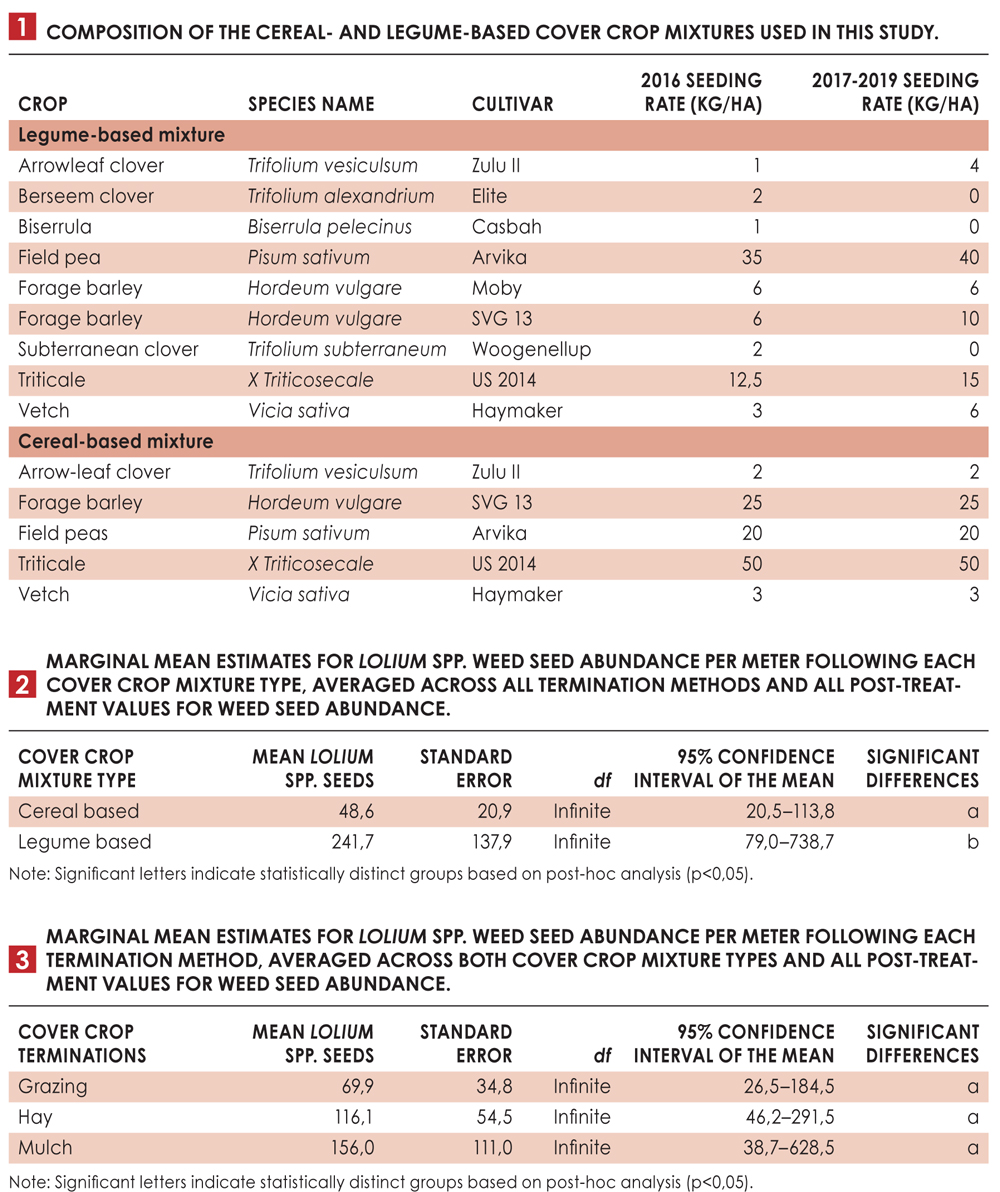
Two main types of cover crop mixtures were included in the study. Firstly, a cereal-based mixture consisting of 70% cereals and 30% legumes, based on seed number, and secondly, a legume-based mixture made up of 70% legumes and 30% cereals (Table 1).
Three different ways to terminate cover crops were included in the study (Figure 1):
- Grazing: Sheep were used to graze the plots when at least 85% of the cereals in the mixture reached the flag-leaf growth stage. Two SA mutton merino ewes, averaging 75 kg each, were allocated to each 150 m² grazing subplot for ten days, representing a stocking rate of 133 ewes/ha.
- Cutting for hay: The crops were cut and removed as hay when 85% of the cereals reached the soft dough stage.
- Rolling: A crimping roller was used when cereals reached the soft dough growth stage and the crop residues were left on the plots.
After these methods were applied, all subplots were also treated with a non-selective herbicide to ensure no viable crop or weed seeds were produced. This step was crucial to control variables and focus on the impact of the cover crops and termination methods themselves.

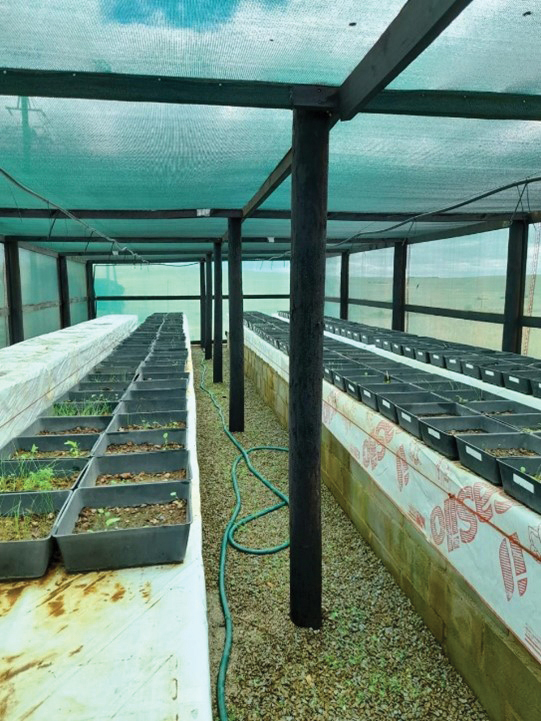
To monitor weed populations, soil samples were collected annually in February. Each combined sample consisted of twelve subsamples taken to a depth of 5 cm. These samples were air-dried and then placed in trays with a layer of vermiculite, irrigated, and placed under shade netting to encourage seed germination (Photo 1). Seedlings were allowed to develop until they could be identified by genus or species, at which point they were noted and removed. This process was repeated monthly for six months.
Key findings
Interestingly, the study found that neither the type of cover crop (cereal- or legume-based) nor the termination method (rolling, baling, or grazing) had a significant influence on the total number (abundance) of weed seeds in the seedbank. As expected, a higher number of viable total weed or ryegrass (Lolium) seeds before the cover crop was planted resulted in a higher number of viable Lolium seed after the cover crop. This shows the importance of existing weed pressure.
In contrast to total number of weed seeds, the total number (abundance) of Lolium seed in the seedbank was significantly reduced by the cereal-based cover crop treatments (Table 2).
This is likely because cereal-based cover crops generally produce more aboveground biomass (Smit et al., 2021). More biomass means better competition with weeds for resources, leading to improved weed suppression (MacLaren, Swanepoel et al., 2019). Therefore, incorporating a cereal-based cover crop can be a powerful strategy for lowering ryegrass seed abundance in the soil seedbank.
While some studies suggest termination method doesn’t affect total weed biomass, this research revealed that grazing tended (p>0,05) to result in relatively lower numbers of Lolium seeds than rolling, with cutting for hay falling in between. This is great news for producers! Grazing and cutting can be a win-win situation, improving fodder availability for livestock and potentially generating cash income, all while effectively suppressing Lolium.
Take-home message
The impact of this research on sustainable farming in the Western Cape includes the following:
- Cereal-based cover crops are allies against Lolium. They are particularly effective when ryegrass populations are high.
- Consider grazing as a termination method. It can further help reduce Lolium seed numbers in the soil.
- Cover crops aren’t just for soil health. Using cover crops for hay or grazing, producers can improve fodder flow and generate extra income without the risk of increasing problematic Lolium weeds.
For more information, you are welcome to contact Gert Conradie at Gert.Conradie@westerncape.gov.za.
Full article available online: Conradie, GWDR, Labuschagne, J, Strauss, JA, Swanepoel, PA & MacLaren, C. 2025. Cover crops improve weed management in South Africa’s Mediterranean climate region. Agron. J. 117(3): e70091.
https://doi.org/10.1002/agj2.70091
Correspondence
PA Swanepoel, Department of Agronomy, Stellenbosch University, Stellenbosch, South Africa, 7602. Email: pieterswanepoel@sun.ac.za, assigned to associate editor, Leonard Kibet.
Funding information
Western Cape Department of Agriculture; South African Winter Cereal Industry Trust
Reference
- MacLaren, C, Swanepoel, P, Bennett, J, Wright, J & Dehnen-Schmutz, K. 2019. Cover Crop Biomass Production Is More Important than Diversity for Weed Suppression. Crop Sci. 59(2): 733-748. doi: 10.2135/cropsci2018.05.0329.
- Smit, EH, Strauss, JA & Swanepoel, PA. 2021. Utilisation of cover crops: Implications for conservation agriculture systems in a Mediterranean climate region of South Africa. Plant and Soil, 462(1-2), 207-218. https://doi.org/10.1007/s11104-021-04864-6