


 When it comes to centre pivot irrigation, few things are as important as choosing the correct sprinkler package. While a trustworthy machine structure forms the backbone of the system, it’s the sprinklers that directly impact crop performance.
Why is the choice of sprinklers important?
Sprinkler type and spacing largely determine irrigation uniformity and efficiency, both of which impact yield. Uniformity refers to delivering the same amount of water to every part of the field. This means each sprinkler should distribute water evenly within its wetted area and sprinklers’ wetted areas should overlap by at least 150%.
Efficiency is the percentage of water that actually enters the soil and benefits the crop, compared to the total amount discharged by the sprinkler. Factors like wind drift losses and evaporation losses significantly reduce efficiency. For centre pivots, we aim for an efficiency of above 80%.
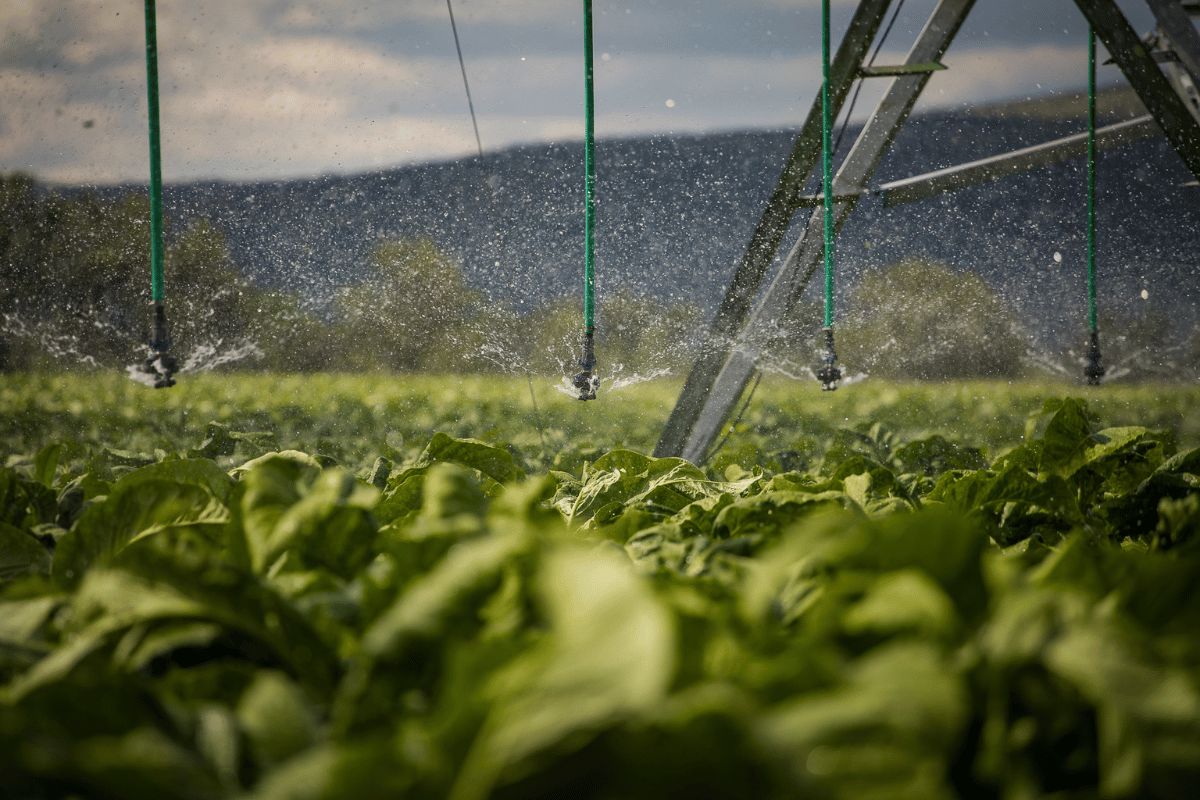
Why should I upgrade my sprinkler package?
The cost of a spray package is minimal when compared to the significant benefits of using a high-quality option. A new Agrico sprinkler package can be installed on any brand of pivot, and can be incredibly advantageous:
- Modern systems maintain uniformity at lower pressures, reducing energy use.
- Better uniformity improves yields – every 1% drop can reduce yield by 2% (Reinders, 1998).
- Modern sprinklers reduce evaporation and wind drift.
- Higher efficiency means less irrigation is needed to get the right amount of water to the crops.
- Sprinklers typically last 10 000 to 15 000 hours before performance drops.
Sprinkler criteria: what makes one sprinkler better than the other?
When comparing sprinklers, several key factors determine which performs better in the field.
A sprinkler that passes the test of time
Sprinklers have many parts that can wear over time, especially when the water contains particles of sand or silt. This causes wear on the flow paths of the components, compromising delivery and flow. In a good sprinkler, all components are of high-quality material and accurate design, giving them a long lifespan while staying effective. Regulators also have a limited lifespan and become less accurate over time: consider replacing your regulators after operating 10 000 hours.
High efficiency: getting water to the soil with minimal losses
The efficiency of a pivot sprinkler is the percentage of water delivered to the sprinkler that actually enters the soil and becomes available to crops. Typical centre pivot irrigation systems achieve efficiencies of 80 to 90%. Here, sprinkler features matter: larger droplets resist drift and evaporate less, while high trajectories and wide patterns can increase losses.
A good sprinkler has a low energy requirement (but not too low)
With centre pivots, the biggest energy cost doesn’t come from moving the pivot itself, but from pumping water at a specific flow rate and pressure. So, why not always just work at the minimum pressure that a sprinkler is rated for? There’s a catch. Lower pressure means less water coming out of each nozzle, unless you make the nozzle bigger. However, pivot sprinkler nozzles have a limit as to the maximum nozzle size that still works effectively.
Application uniformity: getting the right amount of water to your crop, everywhere
To achieve optimal crop yields, it’s essential to apply the right amount of water evenly across the entire field. This is known as application uniformity. Good application uniformity depends on two key factors. Firstly, each sprinkler should have an even distribution of water over its wetter area. Secondly, the wetted areas of neighbouring sprinklers should overlap to prevent dry or overly wet spots.
Obtaining the least amount of soil compaction
When a water droplet hits the ground, it applies a force to the soil, which can lead to compaction. Two main factors influence compaction: (1) soil type, i.e., soils with higher clay content are more prone to compaction than sandy soils; and (2) droplet kinetic energy, i.e., higher energy droplets exert more force on the soil, increasing the risk of compaction.
Practically, we aim for a smaller droplet, being thrown as far as possible, with the best possible uniformity. To help you achieve this, working with a skilled irrigation designer is essential.